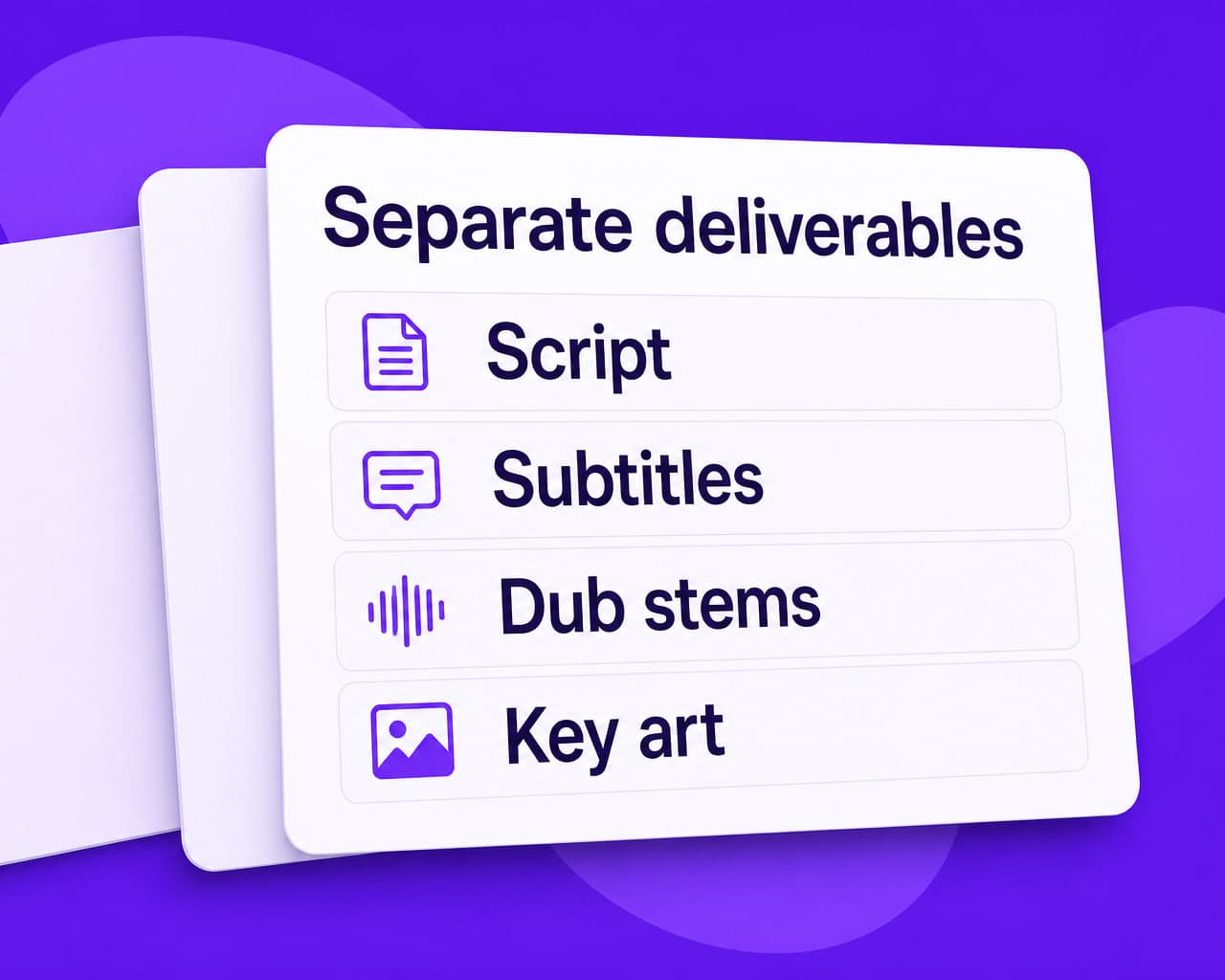
Quick answer — Localizing a title is not one job. Script, subtitle files, dub stems, on-screen text, metadata, key art and platform packaging are separate deliverables with separate specifications, and the non-video ones are where it goes wrong.
The deliverable list
| Deliverable | Format | What breaks |
|---|---|---|
| Script | Continuity or as-broadcast | Timecode alignment |
| Subtitles | SRT, TTML, IMSC | Reading speed, line length, frame rate |
| Dub audio | Stems delivered separately from M&E | Sync, and level matching to the mix |
| On-screen text | Burned into the picture | Requires a new render, not a translation |
| Metadata | Synopsis, cast, genre, keywords | Character limits per platform |
| Key art | Layered design files | Title treatment, and legibility at thumbnail size |
| Platform package | Each service has its own spec | Rejection on delivery, not on quality |
Subtitles have engineering rules, not stylistic ones
Reading speed in characters per second, maximum line length, minimum duration, frame-rate conversion. A subtitle that is a perfect translation and sits on screen for eleven frames has failed. Those rules differ by platform and by language, because a language that expands thirty percent against English needs either faster reading or shorter sentences. That trade-off is an editorial decision somebody has to make once and apply consistently, and quality control is what enforces it across a slate.
Metadata is undervalued and cheap
Synopses and keywords are what makes a title findable in a territory. They are a few hundred words, they are almost never localized well, and they decide whether anyone reaches the thing you spent months dubbing.
Key art has to work at thumbnail size
A title treatment that reads at poster scale disappears in a grid. Localized key art needs the same legibility test as the original, and image translation handles the text layer without a full rebuild.
The deliverables, one by one
Each item on an order behaves differently, and most of the trouble is in the handover rather than the language.
Text first: the dialogue list is the source everything else is built from, the dub script is adapted to fit mouths rather than translated, and subtitle file formats decide what survives a conversion.
Audio next. Dubbing is impossible without a clean M&E track, and the accessibility pair — captions against subtitles and audio description — is where compliance actually bites.
Then the visible layer: key art, the trailer, EPG metadata, and end credits and on-screen text.
Where to start
Subtitles and metadata, in that order, before any dubbing spend.
Post-production workflow covers the pipeline; the capability view is AI for production media.
FAQ
What are the actual deliverables in a localized title? Script, subtitle files, dub stems, on-screen text renders, metadata, key art and a platform-specific package. Only two of them are the video, and the rest is where localization usually fails.
Why do subtitles have engineering rules? Because reading speed, line length, minimum duration and frame rate all constrain them. A perfect translation that sits on screen for eleven frames has failed regardless of how it reads.
Why is metadata worth localizing first? Because synopses and keywords decide whether a title is findable in a territory. They run to a few hundred words and determine whether anyone reaches the content you spent months dubbing.
What does localized key art need that the original does not? The same legibility test at thumbnail size. A title treatment that works at poster scale can disappear in a grid, and an expanded translated title makes that worse.