Context about anything
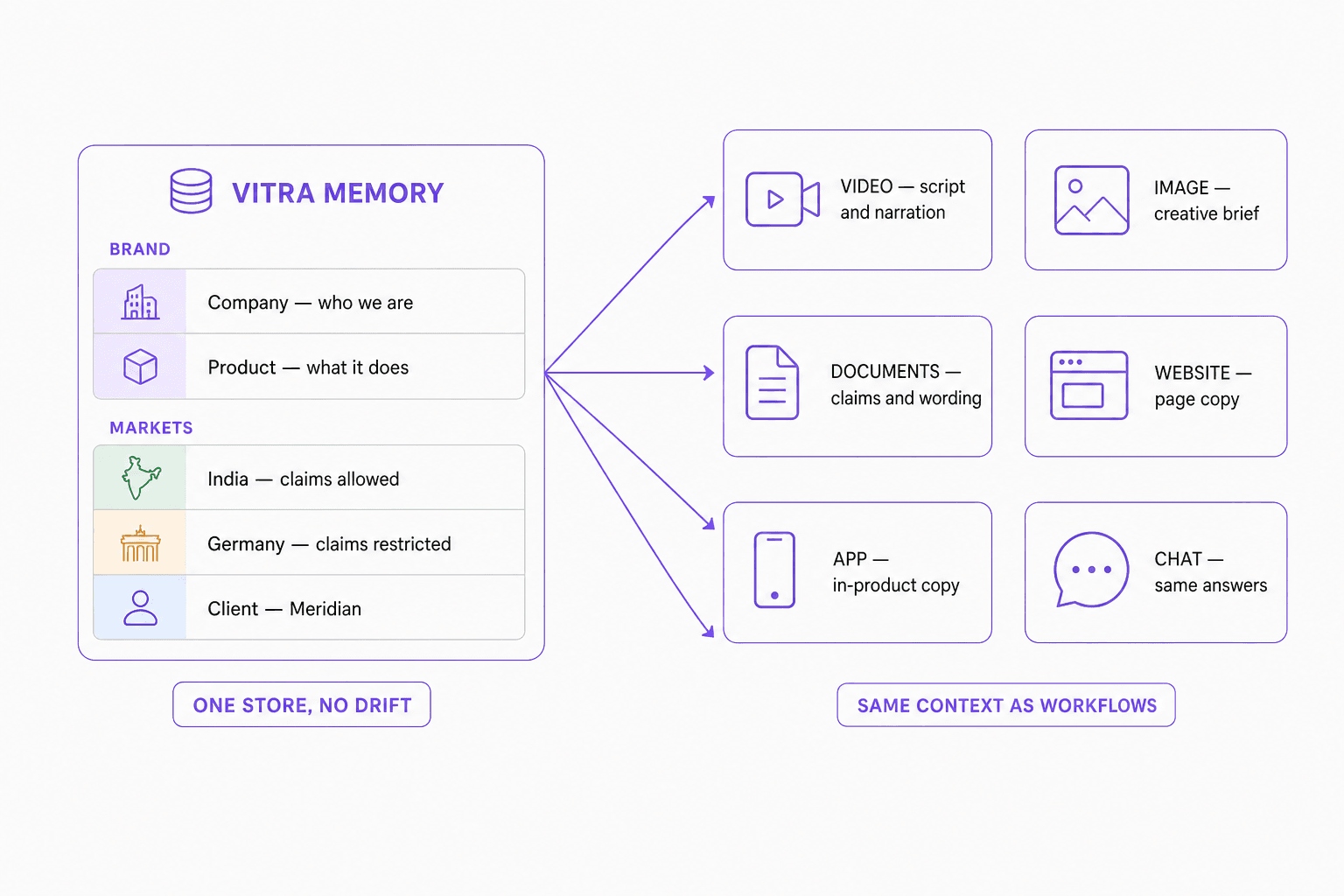
A memory can hold what your company is, what a product does, what is true about a market, or the contents of a document. It is not a fixed schema you have to fit your business into.
Give your content workflows the facts behind the brief: your company, products, audience, markets, and source material. Vitra Memory keeps that knowledge available for creation, translation, personalization, and chat. Vitra TM, inside Vitra TMS, keeps the reviewed language. Together they help your team stop rebuilding the context for every asset.
Free to start · 120 languages · No credit card required
1 store
for chat and every workflow
No limit
on memories, organized by category
Per-org
isolation, down to the client
VitraTM remembers your wording. Vitra Memory remembers your facts — and chat, workflows and every format resolve against the same store.
Step 1 of 5
One per product, per brand, per market, per client. Created by name, with no limit — because a single blended store is slightly wrong for every use.
No limit
memories, created by name
Capabilities
A memory can hold what your company is, what a product does, what is true about a market, or the contents of a document. It is not a fixed schema you have to fit your business into.
The same memory informs video, images, audio, text, documents, websites and apps. A positioning decision made once does not have to be re-explained to the tool that happens to be producing the next asset.
Use selected company and product knowledge in chat and content workflows. Keep the source material current and review important claims in the output; shared context is guidance, not a guarantee of accuracy.
Create memories by name, without a limit. A memory per product, per brand, per market, per client — whatever matches how the business is actually organized.
Cluster memories under categories so a large estate stays organized rather than becoming a flat list nobody can find anything in. Organization is the difference between a knowledge base and a folder.
Generation draws on material you curated rather than on whatever the model inferred, which is what makes an output traceable to something a person wrote and someone else checked.
A market memory carries what differs locally — claims you can make, terms you cannot use, the competitor set — so localized content is adapted rather than merely translated.
Memories are scoped per organization with role- and entitlement-based control, so an agency keeps a separate context store per client and nothing leaks between them.
What comes out
Why it matters
A model that does not know what is true about your company will confidently produce something that is not.
Re-explaining context is the hidden cost of AI
Every tool, every prompt, every new team member starts by restating who you are and what the product does. That work is repeated forever unless it is stored somewhere.
What is true differs by market
Claims you can make, terms you cannot use and the competitor set all change across borders. That is context, not translation, and generation needs to read it.
Ungrounded output has to be fully checked
If nothing constrains the model, every sentence is a claim to verify. Grounding narrows review to the things that genuinely need judgement.
Answers and assets must agree
When the chat assistant and the overnight batch draw on different context, a customer eventually receives two different versions of the truth.
Consistency you can automate. Correctness has to come from somewhere, and it has to be somewhere the generation step can read.
VitraTM remembers your wording. Vitra Memory remembers your facts — and every workflow reads it.
One store, every modality
The same memory informs video, images, audio, text, documents, websites and apps. A positioning decision made once does not have to be re-explained to whichever tool produces the next asset.
Chat and workflows share it
What a person is told in chat and what a scheduled batch generates at three in the morning resolve against the same context, so they cannot drift apart.
As many memories as the business has shapes
One per product, brand, market or client, with no limit — organized under categories so an estate of three hundred stays navigable instead of becoming a flat list.
Curated, not scraped
What goes in is what you decided should be relied on, which is what makes an output traceable to something a person wrote and someone else checked.
Scoped per organization
An agency holds a separate context store per client with no leakage between them, under role- and entitlement-based access.
1 store
for chat and every workflow
No limit
on memories, organized by category
Per-org
isolation, down to the client
How it works
Keep the brief, language resources, and review decisions connected. Use the finished result in Universe or export it for the next step.
Start one per product, brand, market or client. The name is how workflows and chat will refer to it later, so it is worth choosing deliberately.
Company and product context, market facts, positioning, constraints, and the source documents themselves. This is curation rather than upload — what goes in is what gets relied on.
Cluster related memories so the estate stays navigable as it grows from three memories to three hundred.
Creation, translation and personalization workflows, and chat, all resolve against the memory you select — across every format they produce.
Who it is for
The positioning holds whether the next asset is a dubbed video, a translated banner or an app screen, because all three read the same context.
Forty products with genuinely different claims and constraints stay separate, instead of one blended context that is slightly wrong for all of them.
What can be claimed in one market and not another is context, not translation — and it belongs somewhere the generation step can actually read.
A separate, access-controlled memory per client, so the work done for one never informs the output produced for another.
FAQ
Vitra Memory holds company, product, audience, and source knowledge for content work. Vitra TM keeps reviewed translations and their context. Vitra TMS connects that adaptive translation memory to terminology, style guides, glossary, context, and review. A content workflow can use knowledge and language resources together.
Company context, product detail, market information, positioning and constraints, and source documents themselves. It is deliberately not a fixed schema, because the context that matters differs between a bank and a travel brand.
There is no limit. Memories are created by name, so teams typically run one per product, per brand, per market or per client rather than trying to fit everything into a single store that would be slightly wrong for every use.
Because an estate of three memories needs no organization and an estate of three hundred is unusable without it. Categories cluster related memories so the right context is findable, which is what keeps people using it rather than working around it.
Chat and content workflows can use the selected memory resources. Keep those resources current and check the output, especially where it makes a product, financial, legal, or other sensitive claim.
It narrows the problem by grounding generation in material you curated rather than in whatever the model inferred. It does not remove the obligation to review claims — anything stating a price, an entitlement or a regulated fact should still pass quality control and a named reviewer.
Access is scoped per organization with role- and entitlement-based control. An agency can hold a separate memory per client with no leakage between them, and a reviewer sees only what their role permits.
Everything in Vitra Universe shares one translation memory, one brand kit, and one quality bar — so the work you do here makes everything you do next faster.