One snippet, no backend changes
Paste a lightweight tag into your head and the site is multilingual. No re-platforming, no duplicate codebase, no per-language build.
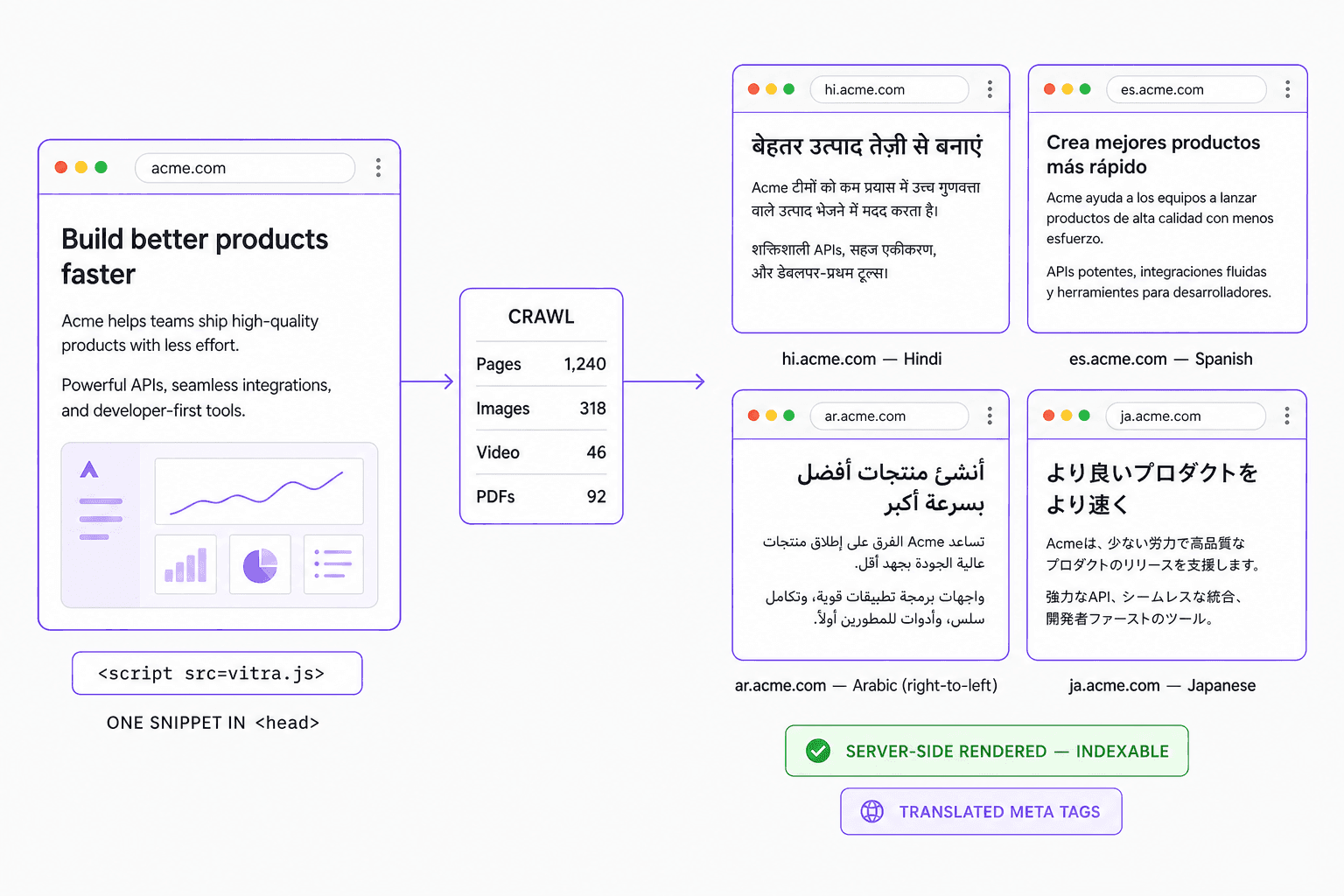
Add one snippet and serve your site in 120 languages — text, images, video, and documents included. Server-side rendering keeps it indexable, and new content is picked up and translated without anyone filing a ticket.
Free to start · 120 languages · No credit card required
10 min
to integrate, with no backend change
SSR
so translated pages are indexable
24×7
monitoring for new content
Server-side rendering keeps it indexable, and new content is picked up and translated without anyone filing a ticket.
Your website
One snippet in <head>. No re-platform.
Step 1 of 5
Create the project, choose your languages and glossary, and paste one snippet into the head. That is the integration.
~10 min
to first translated page
Page and asset counts are illustrative. Discovery volume and translation time depend on your site, its structure and your review rules.
Capabilities
Paste a lightweight tag into your head and the site is multilingual. No re-platforming, no duplicate codebase, no per-language build.
Server-side rendered translations with language-specific URLs and meta tags, so translated pages are crawlable and rankable rather than client-side only.
Text is the easy part. Images, embedded video, and linked documents are detected and localized through the same pipeline.
New and edited content is detected, translated, validated, and synced back automatically. Publishing in English stays a one-step process.
Edit any translation, set tone and glossary rules, keep a shared translation memory, and put a human in the loop wherever it matters.
Visitors land in their own language based on browser settings and region, with a language selector you can style to match your site.
What comes out
Why it matters
The site is where buying happens. In any market where it only speaks English, the funnel leaks at the top.
People buy in the language they think in
Most consumers will not complete a purchase when the information is not in their own language. Every untranslated market is demand that arrives, looks around and leaves.
Search happens in the local language too
If the page is not in the language of the query, it does not compete for it. Localized pages open a search channel that a client-side widget cannot.
Maintaining parallel sites is the expensive option
Separate builds per language drift within a quarter, and every content update becomes a coordination problem across teams that do not share a calendar.
Inconsistency reads as untrustworthy
A product named three different ways across three pages undermines the credibility of the page a customer happens to land on.
You are already paying to bring these visitors to the page. The language is the last thing standing between them and the checkout.
One snippet, but with server-side rendering, human review and rich media — the three things free translators cannot give you.
Indexable, not just readable
Server-side rendering with language-specific URLs, subdomains and meta tags means the translated page can actually rank — rather than being a client-side overlay a crawler never sees.
The media translates too
Videos, images and documents on the page are localized alongside the copy, and swap as the visitor changes language. Text-only translation stops at the first banner.
You keep control of the wording
Edit any translation, set tone and glossary rules, and move each string through unverified, verified and approved. A machine translator gives you no say at all.
New content is picked up on its own
The site is monitored continuously; new and changed content is translated, validated and synced back without anyone filing a request.
One memory with everything else you publish
The site resolves wording from the same VitraTM as your app, your documents and your dubbed video — so all four say the same thing.
10 min
to integrate, with no backend change
SSR
so translated pages are indexable
24×7
monitoring for new content
How it works
Keep the brief, language resources, and review decisions connected. Use the finished result in Universe or export it for the next step.
Add your domain, pick source and target languages, and choose the glossary the site should follow.
One tag in the head. Setup typically takes about ten minutes and needs no engineering sprint.
Universe reads the site, reuses translation memory, and fills the gaps — including media and documents.
Refine strings, approve, and go live. New content is picked up continuously from then on.
Who it is for
Open a new market in days rather than in a quarter-long localization project.
Serve every language your customers actually speak, not just the official one.
Localize thousands of product pages, including imagery and spec documents.
Meet language-access obligations with reviewable, auditable translations.
FAQ
Yes. Translations can be served server-side with language-specific URLs and meta tags, so search engines crawl real localized HTML rather than a client-side overlay. That is the difference between adding languages and actually ranking in them.
Roughly ten minutes for a standard site: create the project, choose languages, and paste one snippet into the head. There are no backend changes and no separate build per language.
It is detected automatically, translated, validated, and synced back. Your publishing workflow does not change and nobody has to remember to request a translation.
Universe gives you control: edit any translation, enforce glossary and tone, share one translation memory across your whole content estate, localize video, images, and documents as well as text, and route anything sensitive through human review.
Everything in Vitra Universe shares one translation memory, one brand kit, and one quality bar — so the work you do here makes everything you do next faster.