SDK, not a re-write
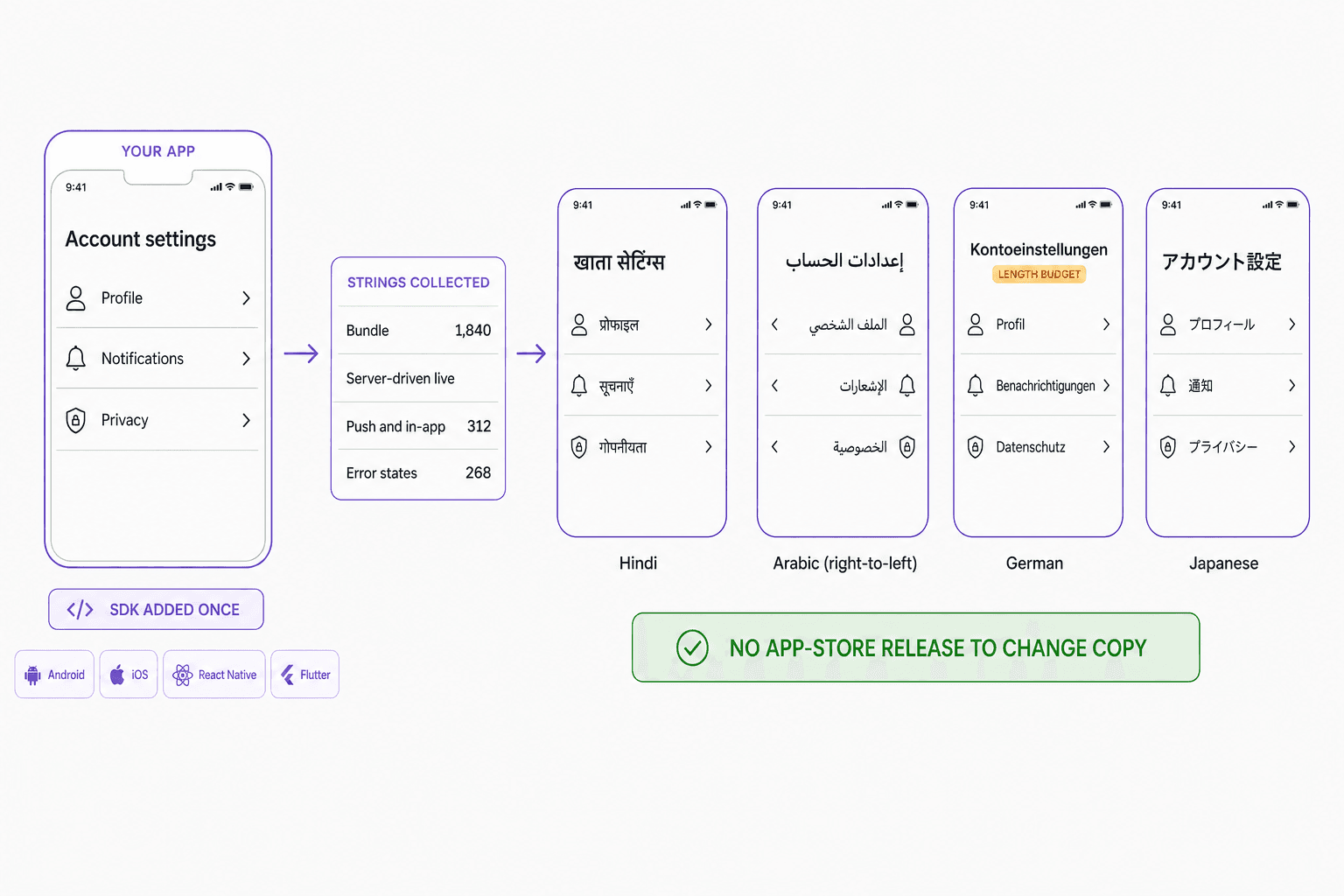
Integrate once and screens are translated dynamically. You do not restructure the app or maintain a parallel string set per language.
Drop in the SDK and translate app screens on the fly in 120 languages — no re-release for every string change, no resource-file merge conflicts, and the same translation memory your web and video content already uses.
Free to start · 120 languages · No credit card required
4
platforms from one SDK
0
app-store releases to change copy
1
shared memory with web and video
The SDK resolves strings at runtime, so copy is a content decision again rather than a build, a review and a store submission.
Your app
Android, iOS, React Native, Flutter.
Step 1 of 5
Android, iOS, React Native and Flutter are supported by the same SDK, and your existing resource files stay where they are.
4
platforms, one SDK
String counts are illustrative. Coverage depends on how your app sources its copy and which surfaces you connect.
Capabilities
Integrate once and screens are translated dynamically. You do not restructure the app or maintain a parallel string set per language.
Native Android (Java and Kotlin) and React Native for both platforms, with the same behaviour and the same console across them.
Fix a mistranslation or add a language without shipping a new binary and waiting on review.
The app and the website draw on one translation memory and one glossary, so the product speaks consistently across surfaces.
Server-driven strings, images, and in-app video are covered by the same pipeline as static UI text.
Every string is visible in the console, editable, and routable to a reviewer, with changes propagating to live sessions.
What comes out
Why it matters
For most consumer businesses the app is the product. Language is the difference between installed and used.
Installs are not the metric — retention is
An app in the wrong language gets downloaded and abandoned. Localized copy affects onboarding completion, activation and long-run retention far more than store creative does.
Regional growth is where the users are
The next hundred million users in most markets are not English-first. Reaching them is a localization decision before it is a marketing spend.
Regulated flows must be understood
In banking, insurance and health, a consent screen or a fee disclosure a user cannot read is a compliance exposure, not just poor UX.
Resource files are an engineering tax
Hand-managed string files mean merge conflicts, missing keys and a copy fix that waits for the next release train.
Installs are cheap to buy and easy to lose. Language decides which of the two you end up with.
An SDK that translates screens on the fly, so copy changes ship on your schedule and not the app store's.
No release cycle for copy
Change a translation and it reaches users immediately. Nobody waits days for review to fix a mistranslated button.
Android, iOS, React Native and Flutter
One integration model across the platforms your app actually runs on, rather than a separate localization approach per codebase.
Server-driven content included
Dynamic screens, remote configuration and user-generated content are translated on the fly, not just the strings compiled into the build.
The same words as your website
App and web resolve from one VitraTM, so a plan name, a fee or a legal phrase is identical in both — which is the thing users notice when it is not.
Editable and reviewable output
Every string can be corrected by a linguist and approved, and the correction becomes the reused translation everywhere else.
4
platforms from one SDK
0
app-store releases to change copy
1
shared memory with web and video
How it works
Keep the brief, language resources, and review decisions connected. Use the finished result in Universe or export it for the next step.
Register the app, pick source and target languages, and select the glossary.
Integrate the SDK and initialise it with your project key. No architectural changes required.
Screens and strings are discovered as they render, matched against translation memory, and translated.
Approve translations in the console and push them to users without an app-store release.
Who it is for
Reach users in their own language across a multilingual market without forking the app.
Serve regulated copy in every required language with an auditable review trail.
Localize dynamic, server-driven content that never lived in a resource file.
Give frontline teams tooling in the language they actually work in.
FAQ
Native Android and React Native for both Android and iOS. Web applications built on modern frameworks are covered by the same platform through website translation.
No. Translations are delivered over the air, so copy fixes and new languages reach users without a new binary or a review queue.
Yes. Dynamic strings, images, and in-app media are handled by the same pipeline as static UI text, which is where most localization tools stop.
Both draw on the same translation memory and glossary. A term approved for the website is reused verbatim in the app rather than being retranslated independently.
Everything in Vitra Universe shares one translation memory, one brand kit, and one quality bar — so the work you do here makes everything you do next faster.