Structure-aware parsing
Markup, tags, placeholders, and inline formatting are protected. Only translatable text is sent for translation, and it returns to exactly the right node.
Translate Word, PowerPoint, PDF, XLIFF, XML, JSON, HTML, DITA, and more into 120 languages — structure, tags, and layout intact, glossary applied, and every string written back into translation memory.
Free to start · 120 languages · No credit card required
25+
document formats, structure intact
DITA
maps translated in parallel
3 agents
checking every output
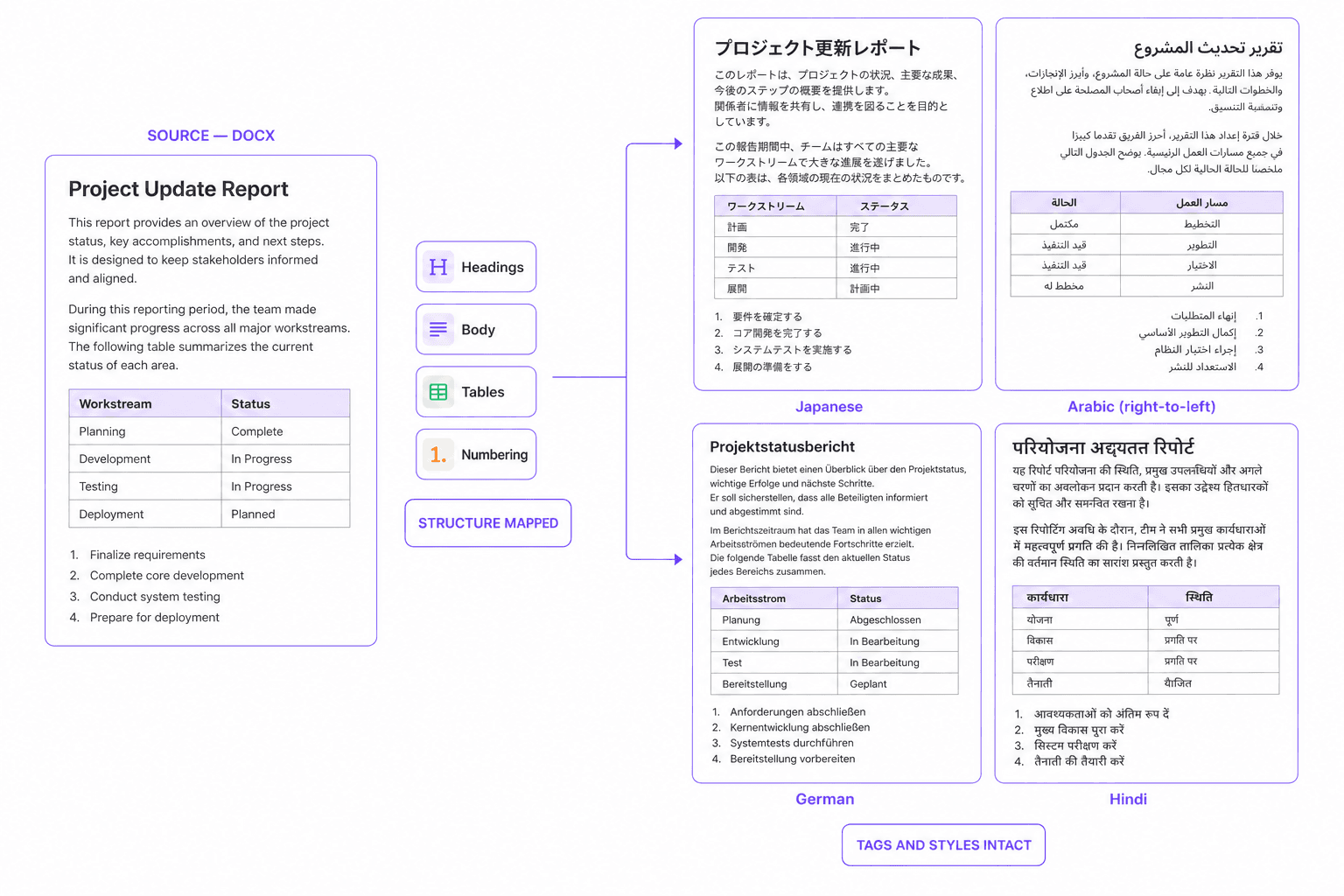
Structure-aware parsing means tags, styles, tables and layout survive — and every string is checked against your terminology before a model sees it.
Source document
DOCX, PPTX, PDF, XLIFF, DITA and more.
Step 1 of 5
Word, PowerPoint, Excel, PDF, XLIFF, XML, JSON, HTML or a full DITA map. Use the Office plugin and never leave the file.
25+
document formats
Capabilities
Markup, tags, placeholders, and inline formatting are protected. Only translatable text is sent for translation, and it returns to exactly the right node.
DOCX, PPTX, PDF, XLIFF, XML, JSON, HTML, Markdown, YAML, PO, RESX, properties, DITA and DITAMAP, ADOC, MIF, TTX, and more.
Translate inside Microsoft Word and PowerPoint directly, without exporting and re-importing.
Terminology, tone, and forbidden phrasing are applied automatically rather than corrected in review.
Full DITA map handling for technical documentation sets, so topic reuse survives localization.
A proofreading agent reviews as a subject-matter expert, and back-translation verifies that meaning survived the round trip.
What comes out
Why it matters
Manuals, contracts, decks and policies carry the obligations. Getting them wrong is not a content problem, it is a liability.
Regulated markets require the local language
Policy wordings, disclosures, labels and safety documentation frequently have to exist in the market's language as a condition of operating there at all.
Rebuilding layout is where the budget goes
Most of the cost of a translated manual is not translation. It is a person putting the tables, numbering and page flow back together afterwards, per language.
Terminology drift becomes a legal risk
When the same defined term is translated three ways across three documents, the discrepancy is discovered by an auditor, a regulator or a customer — never by you.
Documentation blocks the shipment
Hardware, pharma and industrial products cannot enter a market until the documentation does. Localization is on the critical path, not beside it.
A translated document that has to be re-laid-out by hand was not really translated. It was just started.
Structure is parsed and protected before a single word is sent, so what comes back is the same document in another language.
Structure-aware, not text-dumping
Headings, tables, numbering, styles, tags and placeholders are separated from translatable text first — so a shaded header row stays shaded and an Arabic table mirrors instead of overflowing.
The formats real teams actually hold
Word, PowerPoint, Excel, PDF, XLIFF, XML, JSON, HTML, Markdown and more — including flat, scanned PDFs that other tools can only hand back as images.
DITA maps, in parallel
Upload a full DITA package of hundreds of XML and SVG files, translate into any number of languages at once, then preview and edit the translated maps and graphics.
Approved terminology is enforced, not hoped for
Glossaries and style guides apply during translation, and every string is written back to VitraTM — so the next document starts from wording that already passed review.
Proofread, back-translated and QC'd
Three agents check the output and produce a quality report, with a human reviewer wherever the content warrants one.
25+
document formats, structure intact
DITA
maps translated in parallel
3 agents
checking every output
How it works
Keep the brief, language resources, and review decisions connected. Use the finished result in Universe or export it for the next step.
Drop files into Universe, or translate in place from Word and PowerPoint.
Choose targets and the glossary or style guide the run should follow.
Exact matches are reused for free, fuzzy and semantic matches are proposed, and models are only called for genuine gaps.
Route to a proofreader if needed, then export per-language files in the original format.
Who it is for
Localize manuals and help centres without breaking topic reuse or conditional text.
Pharma, finance, and legal documents where terminology must match an approved list exactly.
Translate PowerPoint without the layout falling apart on longer languages.
Ship XLIFF, JSON, and RESX resource files straight from the repo into localization and back.
FAQ
Yes. Files are parsed structurally: tags, placeholders, styles, and layout containers are preserved, and only translatable text is replaced. Documents come back in their original format, not as a flattened export.
Yes. Glossaries and style guides are applied during translation, and translation memory reuses previously approved wording before any model is consulted.
Yes, including DITA maps, so topic-based documentation sets localize as a set rather than as loose files.
Yes. AI proofreading and back-translation run automatically, and you can route any run to your own linguists or to Vitra's proofreading network before delivery.
Everything in Vitra Universe shares one translation memory, one brand kit, and one quality bar — so the work you do here makes everything you do next faster.