
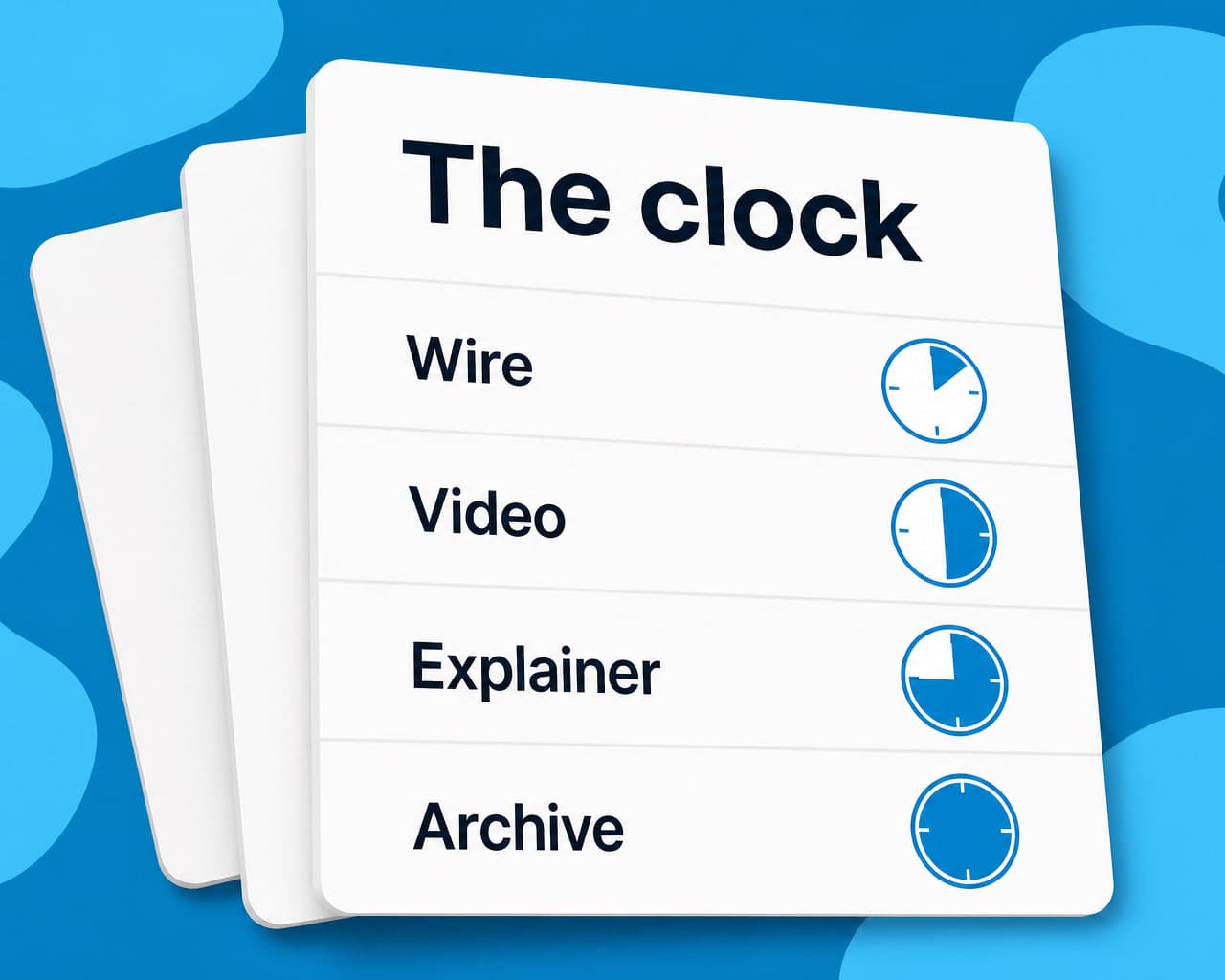
Quick answer — News media translation is governed by the clock attached to each format. Wire copy expires in hours, video in days, explainers in weeks and the archive never — and treating them the same wastes money on one end and credibility on the other.
The clock is the organising principle
| Format | Shelf life | What that means |
|---|---|---|
| Wire copy | Hours | Automatic tier or do not bother |
| Live blogs | Minutes | Streaming translation or nothing |
| Video packages | Days | Subtitles first, dubbing only if it will be reused |
| Explainers | Weeks | Worth full review; they get syndicated |
| Newsletters | One send | Templated, so memory covers most of it |
| Archive | Indefinite | Translate once, benefit forever |
Subtitles beat dubbing for news
News video is watched muted on a feed more often than not, and a dubbed anchor reads as inauthentic in a way a dubbed drama does not. Subtitles are faster, cheaper and better suited. Dubbing earns its place only where a package will be reused — documentary strands, explainers, anything with a shelf life measured in months. video dubbing is worth it there and wasteful on a day story.
Names, places and titles are the risk
The failure mode in news translation is not fluency. It is a transliterated name that does not match how the local press writes it, or an official title rendered with the wrong rank.
That is a glossary problem, and the glossary has to be shared across text and video or the same person acquires two names in one publication.
The archive is a different project
Bulk, no deadline, enormous long-tail search value. Run it through document translation as a batch and it costs a fraction of doing the same words under daily pressure.
Where to start
Wire copy on an automatic tier, and a shared name glossary before anything else.
Multilingual publishing platforms covers selection; AI for news media covers the capability map.
FAQ
Should news video be dubbed or subtitled? Subtitled, in most cases. News video is often watched muted, and a dubbed anchor reads as inauthentic in a way a dubbed drama does not. Dubbing earns its place only on material that will be reused.
What is the main risk in translated news copy? Names and titles, not fluency. A transliterated name that does not match local press convention, or an official title rendered at the wrong rank, is the error that damages credibility.
Why must the glossary be shared across formats? Because otherwise the same person acquires two names in one publication — one in the text desk's output and another in the video subtitles — and no single reviewer sees both.
How should a publisher approach its archive? As a batch project with no deadline. Bulk translation of an archive costs a fraction of doing the same words under daily pressure, and the long-tail search value compounds indefinitely.