One template, thousands of renders
Define the variable layers once — text, voice, footage, overlays — then render a unique cut for every row in your dataset.
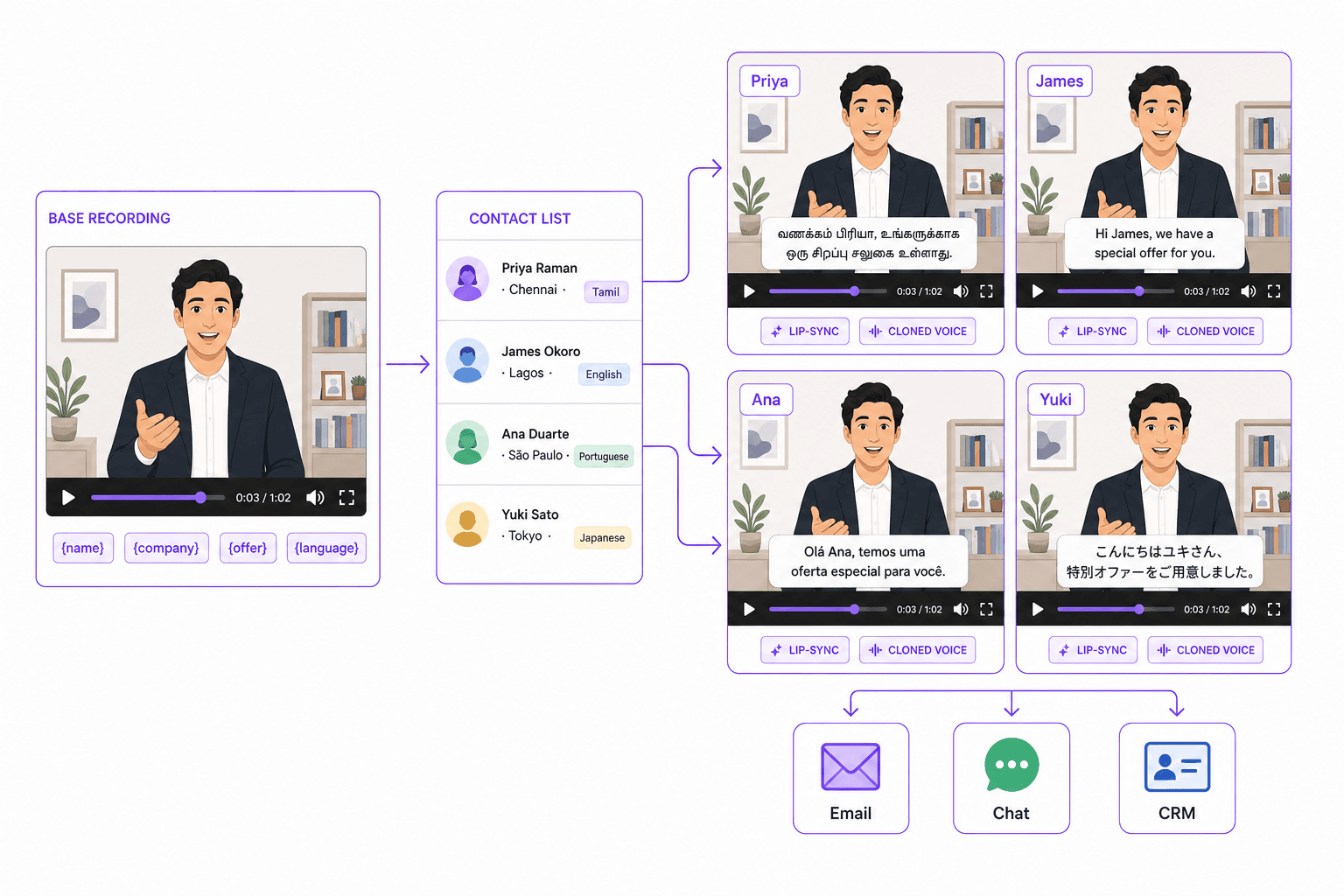
Render one video per person, product, or region — name, language, offer, and footage swapped per row — and deliver it from the CRM, ESP, or workflow you already run.
Free to start · 120 languages · No credit card required
400K+
face-swapped videos in a single campaign
1 row
in, one finished render out
120
languages, personalized in each
Not a name card bolted on the end — the speaker says their details on camera, in their language, and it ships from the system you already run.
Base video
Yours, or generated here.
Step 1 of 5
Shoot or generate the base video, then mark the spoken lines, on-screen text and footage that should change per recipient.
1
base recording
Illustrative run. The 300,000 figure is a real engagement total; per-campaign volume depends on your list, configuration and delivery limits.
Capabilities
Define the variable layers once — text, voice, footage, overlays — then render a unique cut for every row in your dataset.
Names, offers, and locations are spoken, not just captioned, with correct pronunciation handled by pronunciation rules and per-language dictionaries.
Each recipient gets their own language as well as their own details, dubbed through the same pipeline as the rest of your library.
Swap in region-specific talent, locations, and cultural cues so a campaign feels made for the market rather than translated into it.
Push finished videos into HubSpot, Klaviyo, Mailchimp, WhatsApp Business, or any endpoint you can reach from n8n, Make, or Zapier.
Every step is a callable skill over API, MCP, or SDK — trigger a render from a form submission, a CRM stage change, or a nightly batch.
What comes out
Why it matters
Personalization is the highest-response format in the channels you already own — and the one almost nobody can produce at volume.
It gets opened, watched and answered
A message addressed to one person behaves differently from a broadcast. In lifecycle email, outbound and renewals, a personal video is the asset that breaks through a channel everyone else is also using.
Onboarding that feels like a welcome
The first week decides retention. A video that greets the customer by name, in their language, with their plan on screen, does work that a templated email cannot.
Moments deserve more than a mail merge
Invitations, greetings, milestones and win-backs are the moments customers actually remember. They are also exactly where a generic asset reads as indifference.
The economics only work if it is automatic
Recording one video per recipient is impossible past about ten. Rendering one per row is the only version of this idea that survives contact with a real list.
Personalization is not a feature you add to a video. It is the reason the video gets watched at all.
Most tools overlay a name card. Universe changes what the speaker says, how they say it and how their mouth moves.
The speaker says it out loud
Names, companies and offers are spoken in the voiceover, not printed in a corner. Pronunciation is controllable, so an unusual name is said correctly on every render.
Lip-sync per render
Mouth movement is re-timed to the new line, so a personalized video reads as filmed rather than as a template with a swapped audio track.
Face augmentation at campaign scale
A single photo places each person into the film itself. This is the mechanism behind campaigns measured in hundreds of thousands of renders, not hundreds.
Personalization and language compose
The same run can personalize and localize together, so a recipient gets their name, their offer and their language in one asset instead of three compromises.
Triggered by the system that owns the data
Your CRM, ESP, HR system or workflow starts the render and receives the finished file back. Nobody exports a CSV, and nobody uploads anything.
400K+
face-swapped videos in a single campaign
1 row
in, one finished render out
120
languages, personalized in each
How it works
Keep the brief, language resources, and review decisions connected. Use the finished result in Universe or export it for the next step.
Start from a finished video and mark which layers vary: text, voice lines, footage, overlays, and language.
Upload a sheet or connect a CRM, ESP, or product catalogue. Each row becomes one render.
Universe fans the batch out across its worker fleet, so thousands of variants finish in parallel rather than in sequence.
Each render gets its own share page or file, pushed into the channel that sends it.
Who it is for
Welcome every new customer by name, in their language, with the plan they actually bought.
Send prospect-specific video that references their company and use case, generated from the CRM record.
Weddings, events, festivals, and employee milestones — personal at a volume no editor could hand-cut.
Trigger a tailored video at the churn signal instead of another templated email.
FAQ
There is no practical per-batch ceiling. Renders fan out across Universe's worker fleet, so batch size affects throughput rather than feasibility — catalogues and contact lists in the tens of thousands are routine.
Yes. Names, companies, offers, and locations are spoken in the generated voiceover. Pronunciation rules and per-provider dictionaries keep unusual names correct across languages.
Any system that can call an API or webhook. There are direct paths for HubSpot, Klaviyo, Mailchimp, MailerLite, ConvertKit, WhatsApp Business, and Salesforce, plus n8n, Make, Zapier, and MCP for everything else.
Yes. Language is just another personalization variable — the same batch can render English for one segment and Hindi, Arabic, or Spanish for another.
Everything in Vitra Universe shares one translation memory, one brand kit, and one quality bar — so the work you do here makes everything you do next faster.