Your brand, your domain
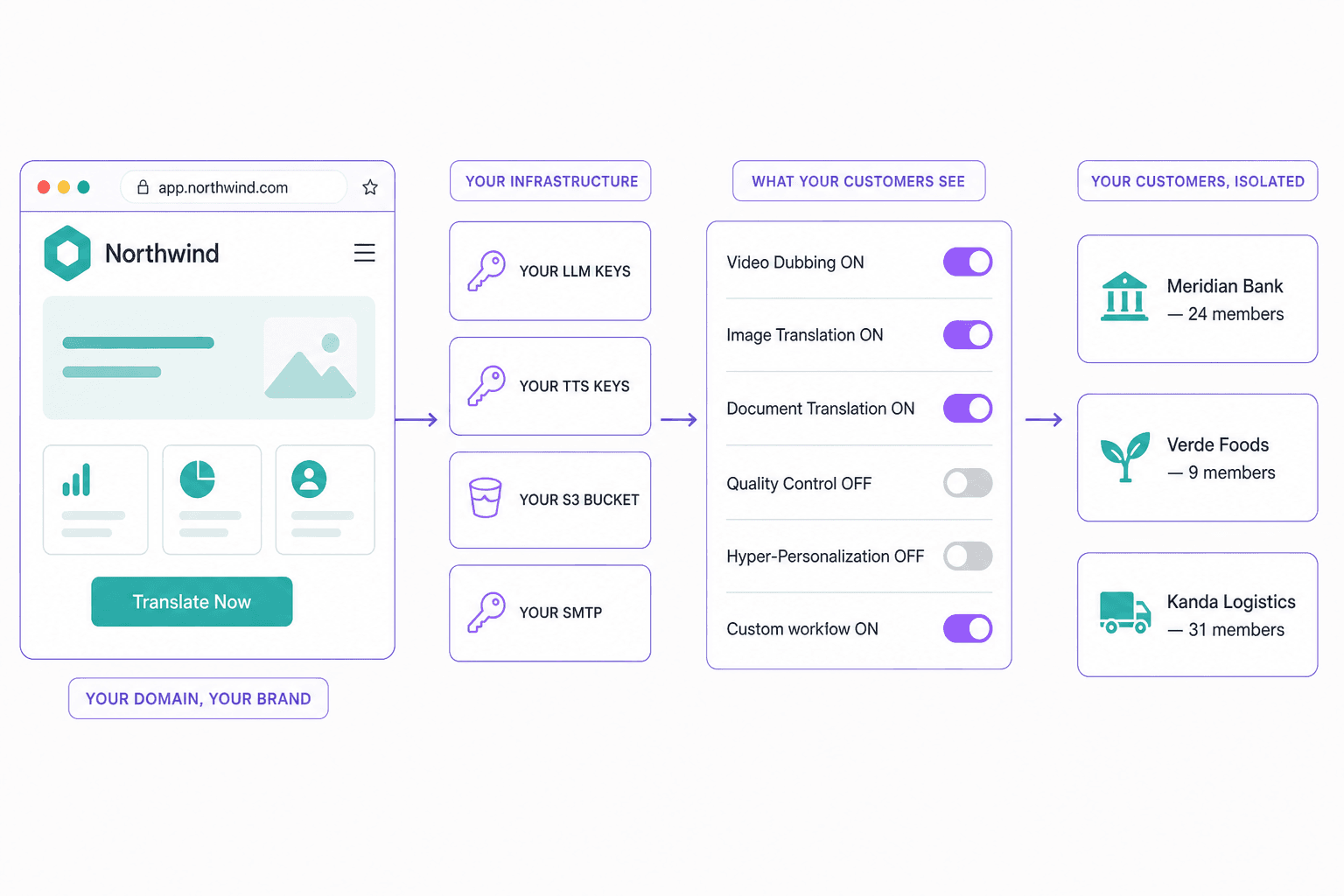
The platform runs on your own custom domain with your logo, your palette and your primary brand colour. Your customers sign in to your product, not to a reskinned one.
Reselling someone else's platform usually means reselling their brand, their storage, their model vendors and their invoice. White Label inverts that: your domain, your branding, your provider keys, your S3 bucket and your translation memory, with you deciding which capabilities your customers ever see.
Free to start · 120 languages · No credit card required
Your domain
branding, SMTP and palette
Your keys
for every model provider
Your bucket
holding every artifact
Your domain, your branding, your provider keys, your bucket and your memory — with you deciding which capabilities your customers ever see.
Step 1 of 5
Point your domain at the platform and apply your logo, palette and primary colour. Notifications go out through your own SMTP, from your own address.
Yours
end to end, not a reskin
Capabilities
The platform runs on your own custom domain with your logo, your palette and your primary brand colour. Your customers sign in to your product, not to a reskinned one.
Branded email templates sent through your own SMTP credentials, so notifications, invitations and reports arrive from your domain rather than from a vendor your customer has never heard of.
Bring your own API keys for LLMs, image generation, video generation and TTS. Inference runs on your accounts, under your commercial terms, against vendors you have already assessed.
Choose which provider serves which workflow rather than accepting one default everywhere — the model that wins on dubbing is rarely the one that wins on document translation.
Supply your S3 access key, secret and bucket configuration, and every artifact is stored in your account. The Intelligent Asset Manager runs directly on your bucket, so the repository your customers use is infrastructure you own.
A translation memory scoped to your organization, built from your customers' work — with Phrase and XTM selectable where an external TM should stay the system of record.
Members, roles, permissions, teams, team members and credits are all yours to define, alongside your company details, so the tenancy behaves like a product you built.
Pick which features and products each customer can see, and compose custom workflows on top. Your catalogue does not have to be our catalogue.
What comes out
Why it matters
Agencies, LSPs and integrators are judged on the capability they deliver — and undermined by the vendor logo on it.
The client relationship should stay yours
The moment a customer can look up the tool, they can also look up its price. Reselling a visible platform prices your service for you.
AI throughput without losing your identity
Language service providers need the speed, but their business is the linguists, the memory and the trust. Those should not move to a vendor.
Enterprise clients ask where the data is
Procurement wants to know whose keys, whose storage and whose region. If every answer is a third party's, the deal slows or dies.
Margin lives in what you control
Owning the tenancy, the entitlements and the pricing is the difference between reselling seats and running a product.
Your clients are buying a capability. Whether they are also buying a vendor relationship is entirely your decision.
Your domain, your branding, your provider keys, your bucket, your memory — and you decide what your customers can even see.
Your brand, end to end
Custom domain, logo, palette and primary colour, plus branded email sent through your own SMTP — so notifications arrive from you, not from a vendor your client has never heard of.
Your model accounts, your terms
Bring your own keys for LLMs, image, video and TTS. Inference runs on your accounts, under commercial terms you negotiated, against vendors you already assessed.
Your storage, your memory
Artifacts land in your S3 bucket and the asset manager runs directly on it, while a translation memory scoped to you accumulates from your customers' work.
Sell a catalogue, not the catalogue
Choose which capabilities each customer sees and compose custom workflows on top, so you can package a focused service and price it however your business requires.
Their customers are tenancies, not seats
Each of your clients is a sub-organization with its own members, roles, entitlements, credits and assets — isolated from the others, under your brand.
Your domain
branding, SMTP and palette
Your keys
for every model provider
Your bucket
holding every artifact
How it works
Keep the brief, language resources, and review decisions connected. Use the finished result in Universe or export it for the next step.
Your organization is created with your company details, custom domain and brand kit — colours, logo and primary brand colour applied across the product.
Add your provider API keys, your S3 credentials, your SMTP settings and your translation memory. From here, data and inference sit on accounts you control.
Decide which capabilities are exposed, define roles, teams, permissions and credit allocations, and build any custom workflows your service depends on.
Onboard your own customers as sub-organizations, each with their own members, entitlements and assets, under your brand end to end.
Who it is for
Offer localization and content production as your own capability rather than reselling a logo your client can look up.
Add AI throughput under your existing brand and keep the linguist review, the memory and the client relationship where they already are.
Deliver a content capability inside a larger engagement, on infrastructure that satisfies the client's own vendor and residency requirements.
Run separate tenancies per brand or per region, each with its own storage, memory, entitlements and credit budget.
FAQ
The custom domain, the logo, the colour palette including your primary brand colour, and the email templates — sent through your own SMTP credentials so mail comes from your domain. Company details are yours throughout, so the tenancy reads as your product rather than a themed version of someone else's.
Yes. Bring your own API keys for LLMs, image generation, video generation and TTS, and inference runs on your accounts under your commercial terms. Provider preferences then let you choose which provider serves which workflow instead of applying one default across all of them.
In your own S3 bucket, if you want them there. Supply the access key, secret and bucket configuration and every artifact is written to your account, in your region, under your lifecycle rules. The Intelligent Asset Manager operates directly on that bucket.
Yes. Memory is scoped to your organization and accumulates from your customers' work, so the reuse benefit belongs to you. Phrase and XTM are selectable per organization where an external TM should remain the system of record.
Yes, per customer. Choose which capabilities and products are exposed and compose custom workflows on top, so you can sell a focused service rather than the full catalogue, and price it however your business requires.
Members, roles, permissions, teams and team members are defined by you, with credits allocated across them. Each of your customers can be a sub-organization with its own members and entitlements, isolated from the others.
White Label is about commercial identity — running the platform as your own product for your own customers. The enterprise page covers the security and deployment posture underneath it: tenant isolation, residency, the audit ledger and fully air-gapped installs. Most partners need both, and they compose.
Everything in Vitra Universe shares one translation memory, one brand kit, and one quality bar — so the work you do here makes everything you do next faster.