Multimodal checks
Image QC for brand and quality, text QC for accuracy and tone, audio QC for voice and dubbing, and video QC for translation inside the finished cut.
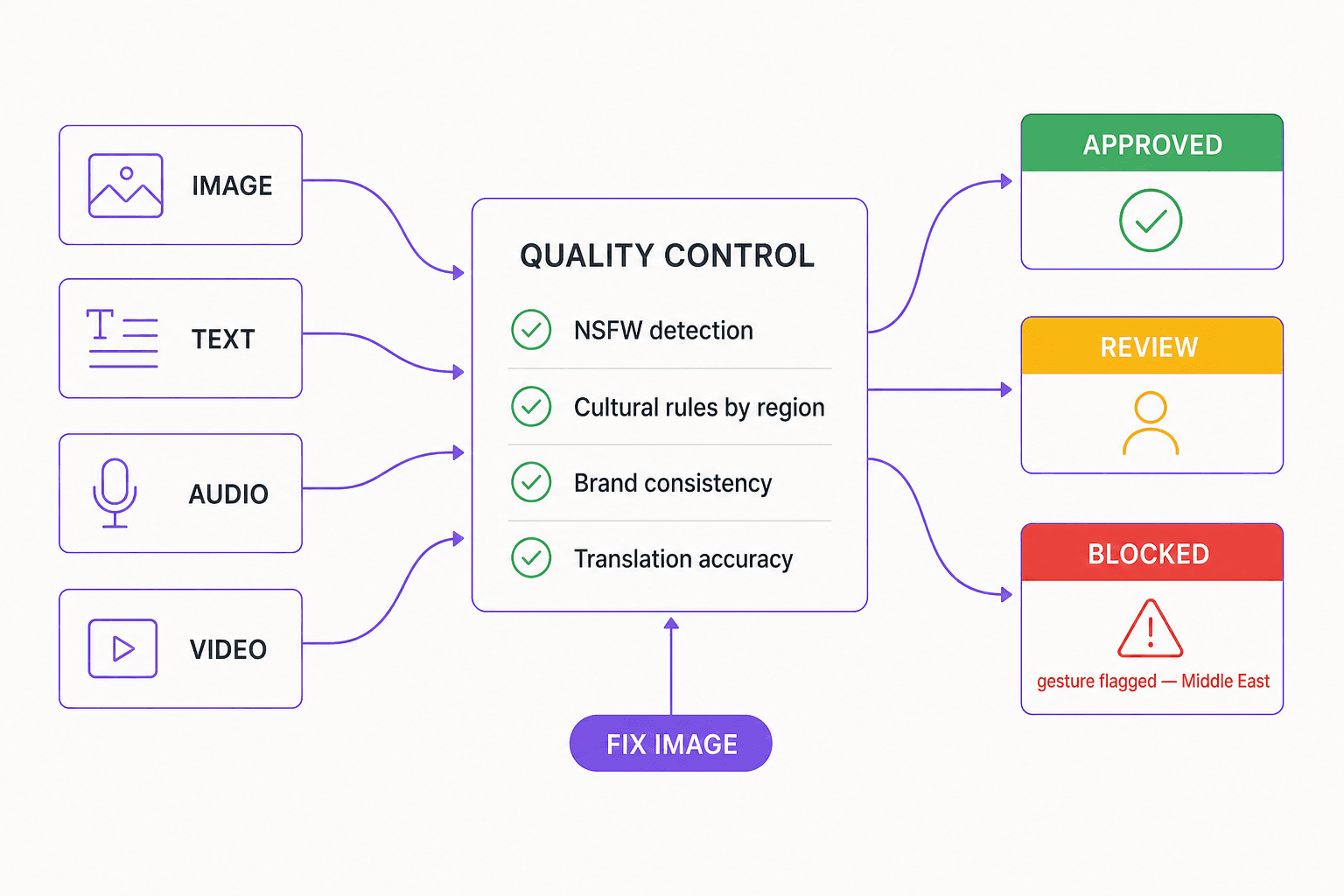
Multimodal QC agents check image, text, audio, and video before anything reaches an audience — brand consistency, translation accuracy, cultural fit, and compliance — and return a verdict you can act on rather than a score you have to interpret.
Free to start · 120 languages · No credit card required
16 regions
and 124 cultural rules, seeded
4
modalities on the same quality bar
3
verdicts a workflow can branch on
Multimodal agents check image, text, audio and video against your markets' rules and return a verdict with the evidence — so a person only looks at what actually needs a person.
Asset under review
Image, text, audio or video — same pipeline.
Step 1 of 5
Submit directly, or let it trigger automatically as the last node of a workflow so nothing ships unchecked.
4
modalities checked
Capabilities
Image QC for brand and quality, text QC for accuracy and tone, audio QC for voice and dubbing, and video QC for translation inside the finished cut.
Translated output is translated back and compared, so meaning drift is caught mechanically rather than spotted by luck.
A proofreading agent reviews as both a language expert and a subject-matter expert, flagging what a generic grammar check would miss.
A cultural-rule engine with severity weighting scores content per region and returns approved, review, or blocked with reasons.
An in-process safety model screens generated and uploaded media before it enters the workflow.
Flagged images can be regenerated into a compliant version for that region straight from the decision, instead of going back into a design queue.
What comes out
Why it matters
The moment you can produce a hundred thousand assets, human review stops being possible and starts being theatre.
One bad asset is the one that travels
A culturally offensive creative, a mistranslated claim or an unsafe image does not stay in the market it shipped to. The cost is reputational and it arrives fast.
Nobody has reviewers for every market
No team holds fluent, culturally-native reviewers for forty markets and four modalities. What actually happens is that most assets ship unchecked.
Regulated claims need a paper trail
In finance, pharma and health, being able to show what was checked, by what rule and by whom is part of the obligation — not a nice-to-have.
Translation drifts quietly
Meaning shifts are the defects nobody catches by reading the target language, because the target language reads perfectly well. They only surface against the source.
Producing at scale without checking at scale is not efficiency. It is exposure with a shorter feedback loop.
A verdict with evidence, across every modality, on a rule pack specific enough to quote.
Image, text, audio and video on one bar
Video is scored on frames and transcript together, so a violation in either the visuals or the audio counts. Most tools check one modality and call it moderation.
A real cultural rule pack, out of the box
Sixteen regions and 124 rules are seeded for every organization — specific, citable rules, not a generic safety filter. Your own rules sit alongside them.
Back-translation makes drift visible
The translation is turned back into the source language and compared, so a meaning shift shows up as a concrete difference rather than a reviewer's hunch.
Approved, Review or Blocked — with reasons
The output is a verdict you can route on, with the evidence behind it, not a score somebody has to interpret. A workflow can branch on it automatically.
Fix it from the finding
A flagged image can be repaired in place with the smallest localized edit — face, pose, background and lighting explicitly preserved — instead of going back for a reshoot.
16 regions
and 124 cultural rules, seeded
4
modalities on the same quality bar
3
verdicts a workflow can branch on
How it works
Keep the brief, language resources, and review decisions connected. Use the finished result in Universe or export it for the next step.
QC runs automatically inside creation and translation workflows, or on demand for assets produced elsewhere.
Each asset is checked across the relevant modalities against your brand rules, glossary, and region rule sets.
You get approved, review, or blocked with per-region cultural scores and the specific findings behind the call.
Route to a human reviewer, or trigger a compliant regeneration directly from the decision.
Who it is for
Check thousands of generated assets without a proportional review team.
Enforce claim rules and required disclosures before anything is published.
Catch the imagery or phrasing that works in one market and fails in another.
Attach an evidence-backed quality report to every batch you hand to a client.
FAQ
Brand and visual quality on images, accuracy and tone on text, voice and dubbing quality on audio, and translation correctness inside finished video. Each check produces findings, not just a pass or fail.
Translated output is translated back into the source language and compared against the original. Meaning that shifted in translation shows up as a concrete difference rather than being caught by chance in review.
Yes. Verdicts are approved, review, or blocked, with severity-weighted cultural scoring per region. You decide which verdicts stop a workflow and which route to a human.
Frontier models are used as graders, but under Vitra's own rubric, thresholds, and rule engine. The scoring logic and region rules are Vitra's, so results stay consistent even as underlying models change.
Everything in Vitra Universe shares one translation memory, one brand kit, and one quality bar — so the work you do here makes everything you do next faster.