Quick answer — SRT is the plain-text baseline and carries no styling. WebVTT adds positioning and basic formatting for the web. TTML and its IMSC profile carry full styling and are what broadcast and most streaming platforms require.
Vitra.ai Universe handles the dub, the captions and the artwork around them.
The four you will actually be asked for
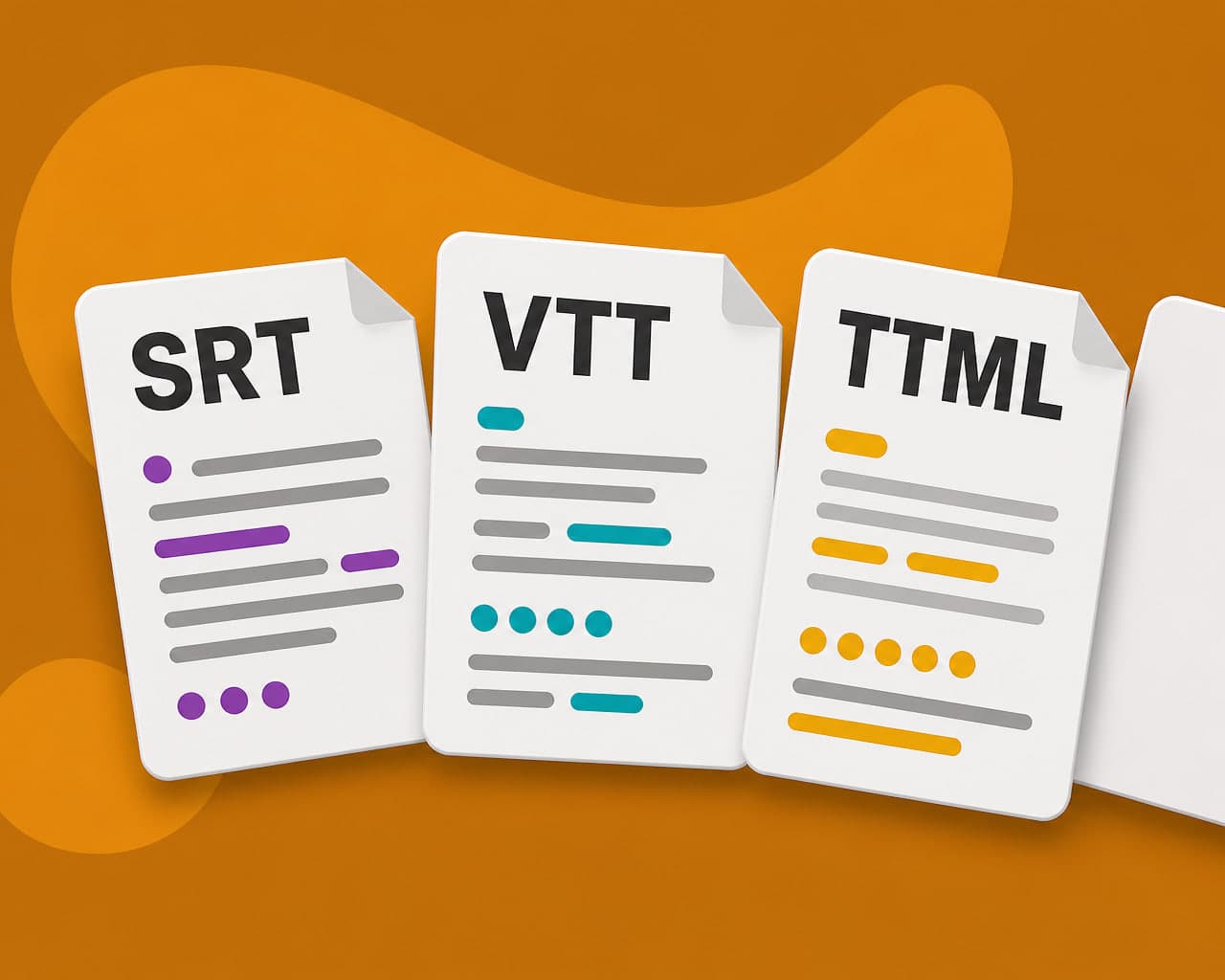
| Format | Carries | Typically wanted by |
|---|---|---|
| SRT | Text and timings only | Social, rough cuts, anything simple |
| WebVTT | Positioning, basic styling, metadata | Web players, HTML5 video |
| TTML | Full styling, regions, timing model | Broadcast, enterprise delivery |
| IMSC | A constrained TTML profile | Most streaming platforms |
IMSC is the one worth knowing. It is TTML with the ambiguity removed, which is precisely why platforms specify it — two players given the same IMSC file should render it the same way, and that is not true of TTML in general.
Converting down loses things quietly
Going from IMSC to SRT is not a format change. It is a deletion. Positioning goes, so a caption that was placed to avoid burned-in text now covers it. Styling goes, so the italics that marked a foreign-language line or a voiceover become indistinguishable from ordinary dialogue. Ruby text for Japanese goes entirely.
None of this errors. The file converts cleanly and looks fine until someone watches the scene where it matters.
So keep the richest version as the master and generate the simpler ones from it, rather than the other way round.
Frame rate is where the real bugs live
Timings in SRT and VTT are wall-clock. Timings in broadcast workflows are frequently frames, and 29.97 is not 30. A file authored at one rate and played at another drifts progressively — imperceptible in the first minute, a second out by the end of an episode. It is the most common subtitle bug in existence and it is invisible in a spot check of the opening scene.
Check the last caption in the file, not the first.
Practical defaults
Author in the richest format the workflow supports, store that as the master, and derive the rest. Keep line length and reading speed within the target platform's guidance rather than the source language's habits, because a translated line that runs 30% longer is a caption nobody finishes reading.
Video dubbing produces the caption track alongside the audio from one script, and running a check over the output catches the reading-speed and overlap failures that a human spot check will not.
Where the same series ships in many languages, hold the terminology steady with a translation memory so a character name does not change spelling between episodes.
For what actually belongs in a caption as opposed to a subtitle, see captions against subtitles.
FAQ
What is the difference between SRT and WebVTT? SRT carries text and timings only. WebVTT adds caption positioning, basic styling and metadata, which is why web players prefer it. Neither approaches the styling control of TTML.
What is IMSC and why do platforms ask for it? IMSC is a constrained profile of TTML with the ambiguity removed, so two different players render the same file identically. Platforms specify it precisely because plain TTML does not guarantee that.
What is lost when converting subtitles to SRT? Positioning, styling and ruby text. Captions placed to avoid burned-in text may now cover it, and italics marking a voiceover or foreign dialogue become ordinary text. The conversion does not error.
Why do subtitles drift out of sync near the end of a file? Almost always a frame rate mismatch, commonly 29.97 against 30. The offset accumulates, so the opening scene looks correct and the final scene is a second out. Check the last caption, not the first.