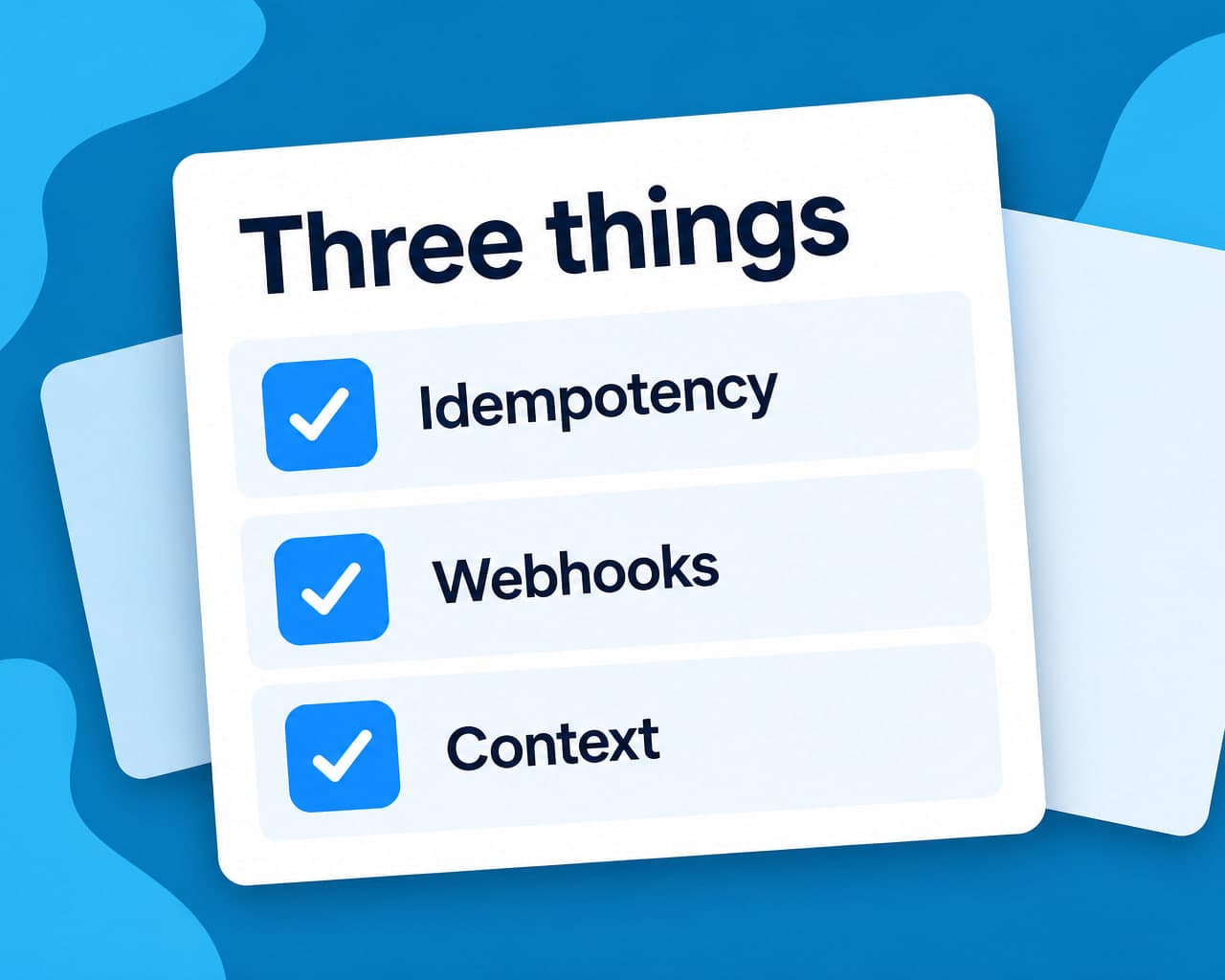
Quick answer — A localization API should accept content, return translations with status, and call back when work completes. Idempotency, webhooks and per-request context are what separate a usable API from one that needs babysitting.
Vitra.ai Universe creates, translates, adapts and publishes from one place.
Localization as a build step
The point of an API is that translation stops being something a person remembers to request. A string lands in the repository, CI calls the API, translations come back, and the build has them. Nobody filed a ticket, and nothing waits for a Monday. That only works if the API is designed for automation rather than for a person watching it.
What it has to expose
| Capability | Why it matters |
|---|---|
| Submit with context | A string without context is a question |
| Status per item | Partial completion is normal |
| Webhooks | Polling at scale is waste |
| Idempotency keys | Retries must not duplicate work |
| Glossary and memory access | Terminology consistent with everything else |
| Quality result | The verdict, not just the text |
Context is the one most often missing and most damaging. A string sent as "Open" with no screenshot, no character limit and no note about whether it is a verb or an adjective will be translated wrongly in roughly half of languages, and no model fixes that.
Send the key, the surrounding context, the constraint and the screenshot where you have one.
Three details that decide reliability
Idempotency. Networks fail and CI retries. Without an idempotency key, a retry either duplicates a job or double-charges, and both surface as confusing noise months later.
Partial results. A batch of a thousand strings will not complete at once, and an API that only reports done or not done forces you to wait for the slowest item.
Webhooks over polling. At any real volume, polling for completion is the thing that makes an integration feel slow when the service is not.
What it should return besides text
The quality verdict and its findings, so your pipeline can gate on them rather than treating every translation as equally trustworthy.
And whether the segment came from memory or was generated, which tells you what to review and what is already approved.
If you are building the integration rather than evaluating it, the mechanics are in building a custom translation integration.
What sits either side of the API
Before wiring anything, internationalization versus localization settles what has to be true of the codebase, and headless CMS patterns covers how locales should be modelled when content lives in a CMS. For mobile, app localization compared covers the jobs beyond strings.
The file formats behind the API
What you send depends on the stack. Mobile uses iOS .strings and Android strings.xml; .NET uses RESX and Java uses .properties.
Gettext projects send PO and POT files. Docs pipelines send Markdown, YAML, AsciiDoc, DocBook, DITA maps or TTX.
FAQ
What should a localization API expose? Submission with context, per-item status, webhooks, idempotency keys, access to glossary and memory, and the quality verdict alongside the translated text.
Why does context matter so much in API requests? Because a bare string is ambiguous. A word like Open with no screenshot, character limit or note about part of speech is translated wrongly in many languages, and no model resolves that.
What makes a localization API reliable in CI? Idempotency keys so retries do not duplicate work, partial result reporting so a batch is not blocked by its slowest item, and webhooks so completion is pushed rather than polled.
What should an API return besides the translation? The quality verdict with findings so a pipeline can gate on it, and whether the segment came from memory or was generated, which tells you what still needs review.