Quick answer — A multimodal translation memory helps teams reuse reviewed language across videos, images, documents, websites, and apps. The value is a connected language decision, not an assumption that one sentence should be copied unchanged onto every surface.
Vitra TM is the adaptive memory inside Vitra TMS.
Start with one product claim
Imagine a reviewed website says a product has “No setup fee.” The same claim appears in a launch video, an image ad, a help article, and an app onboarding screen.
If each project starts without the approved language, the team may end up reviewing the same claim repeatedly. Worse, one version may imply there are no fees at all, which is not what the source says.
A shared memory lets the team bring its reviewed wording to the next job. Context explains what the fee refers to and where the wording is appropriate. The reviewer checks that the new asset has not changed the promise.
Language resources and media assets do different jobs
Translation memory keeps useful language. An asset manager keeps the files that people create, edit, review, and deliver.
A finished video also needs its source footage, script, audio, and relevant output settings. A translated design needs the editable source, fonts, and layout. A memory is not a substitute for those assets.
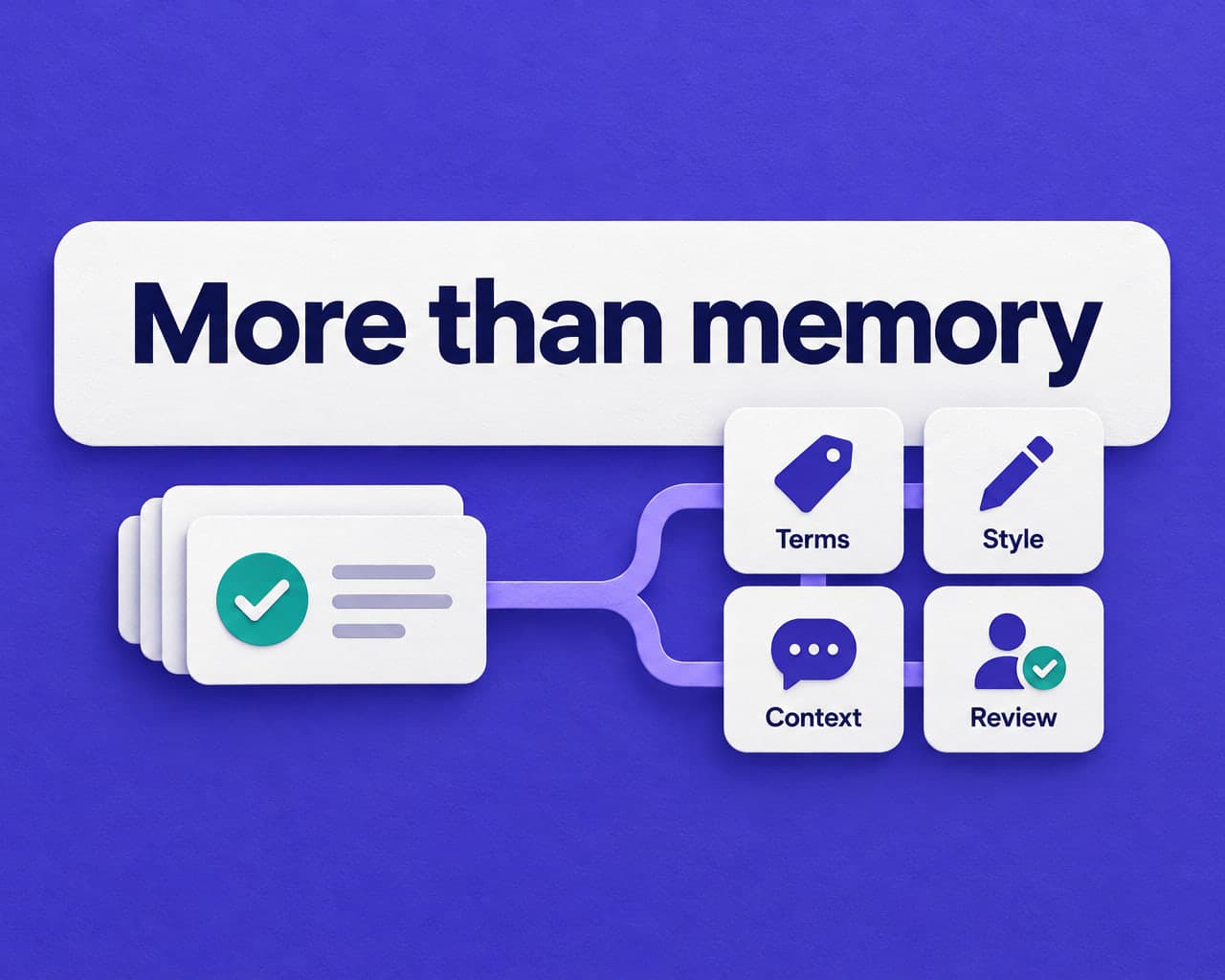
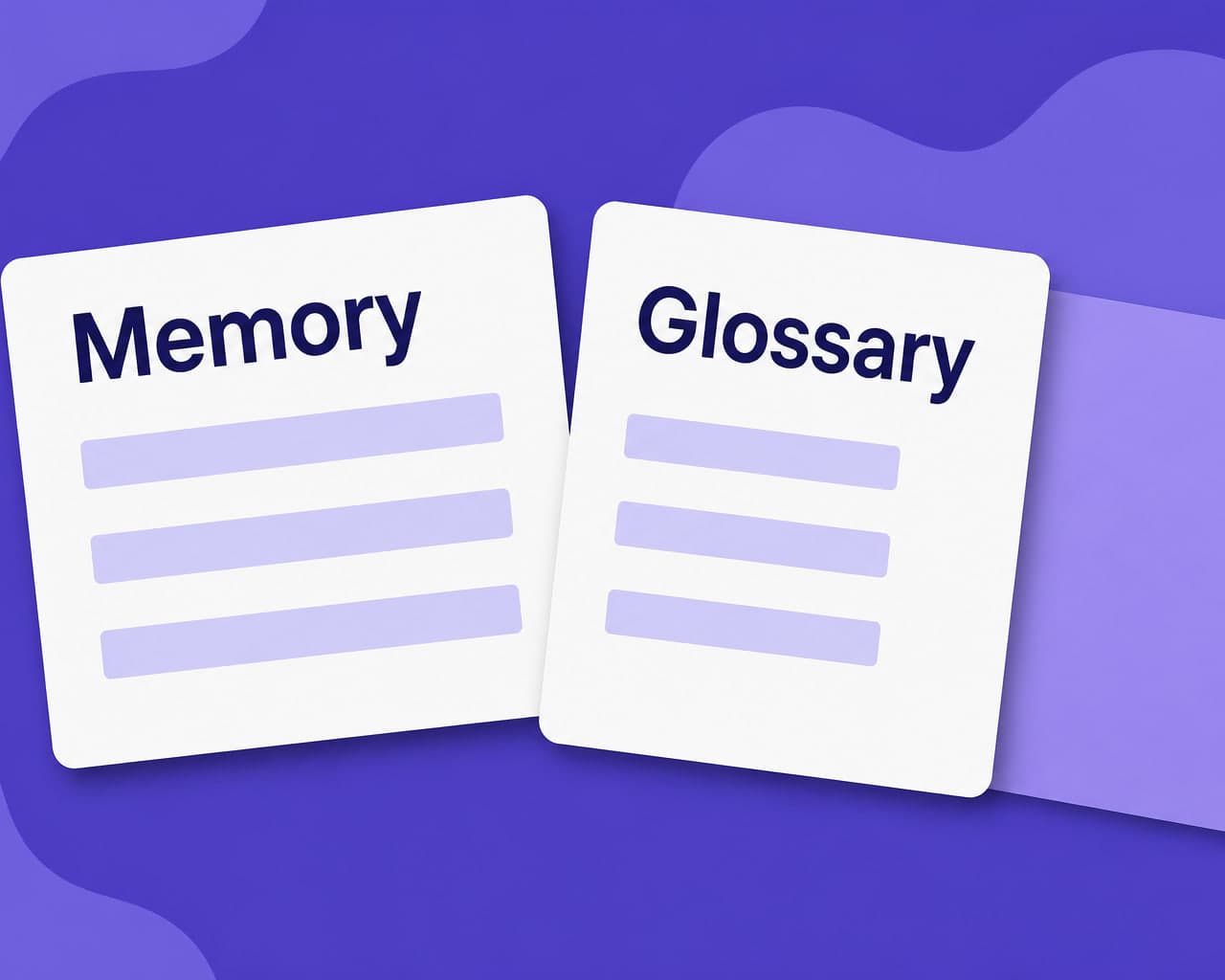
That is why the surrounding workflow matters. In Vitra TMS, memory sits alongside terminology, glossary, style guides, and context. Universe connects that language work to creation, translation, and review of the actual content.
Test the same decision on different surfaces
| Surface | What language should carry forward | What needs another check |
|---|---|---|
| Website | Product meaning and approved terminology | Page context and local navigation |
| App | Feature names and reviewed interface wording | Available space and the user's action |
| Document | Approved statements and technical vocabulary | Surrounding explanation and specialist claims |
| Image or design | Campaign meaning and product names | Text fit, line breaks, and fonts |
| Video or subtitles | Script meaning and terminology | Timing, pronunciation, and natural delivery |
The table describes practical review questions. It does not claim that every format stores identical fields or has identical output controls.
An image headline may use fewer words than the document. A spoken explanation may need a different rhythm from the interface label. Give the team a way to keep those choices intentional.
Context makes reuse useful
“Charge” is a useful example. An approved translation for a payment statement is not automatically suitable for a battery instruction. A match without the product and intended use can be misleading.
Describe the audience, subject, product meaning, and surface. Select the relevant resources for the client or project rather than mixing unrelated language decisions.
The contextual translation guide shows how to write that brief in practical terms. It explains the information a reviewer needs, without asking the reader to understand a translation engine.
Keep approval distinct from generation
An AI output is a draft until the relevant review has happened. Do not let a successful export or an attractive preview imply that the language is approved.
Keep unverified, verified, and approved work distinct where the workflow provides those states. Decide which corrections should be retained for future use. When a claim changes, review its affected variants instead of assuming earlier approval still applies.
The return is straightforward: the team spends less effort re-establishing settled language and can focus review on what is genuinely new. The size of that benefit depends on the content, repetition, formats, and review requirements.
Evaluate the whole job
Bring one real campaign or training module. Include the source context, approved terminology, target languages, and the person who checks the result.
Try a document, a design, and a short video together. Can the team find the approved wording? Does it carry the right meaning? Where is a shorter variant needed? Can the reviewer distinguish a draft from a signed-off result?
Those questions tell you more than a claim that a platform is “multimodal.” For the wider system, see translation memory vs. TMS.
FAQ
What makes a translation memory multimodal?
It supports reuse of reviewed language across content formats such as video scripts, subtitles, image text, documents, websites, and apps. The useful question is whether an approved decision can reach the next format with enough context to be applied correctly.
Does memory store a finished image or video?
Translation memory is a language resource, not a replacement for an asset manager. The finished media asset and its editable source need their own storage and workflow. Test how language decisions connect to those assets in the platform you use.
Should the exact same wording appear in every format?
Not always. Keep the meaning and approved terminology consistent, but review the wording for space, reading time, spoken delivery, and local conventions. A subtitle or app button may need a deliberate shorter variant.
Does a multimodal memory remove the need for review?
No. Reviewed language provides a useful starting point. People still need to check changed claims, specialist terminology, new markets, and whether the wording fits the finished surface.