Quick answer — An agentic translation memory makes reviewed wording and context useful inside an AI-assisted content workflow. It helps the next project start with existing language decisions, while people check whether those decisions still apply.
The useful part is the decision you keep
A translator has already worked out how your product name, instruction, or claim should read in another language. A reviewer has checked it. The next team shouldn't have to discover that decision in an old email.
Translation memory keeps the language work available. In an agentic workflow, the value is that this resource can inform repeatable content production rather than sit in an archive outside it. The team still needs to know why the wording was approved and where it belongs. A sentence approved for a payment screen isn't automatically the right sentence for a marketing headline.
Context makes reuse easier to judge
Suppose a source article says, “No setup fee.” The Spanish wording is approved for a particular product's pricing page. A later campaign uses the same source sentence.
Before reusing the translation, check whether the statement is still true, whether the audience is the same, and whether the new offer has the same conditions. Memory gives the team useful starting language. Product context gives the team a reason to trust—or revisit—it.
| What to keep with the wording | Why a reviewer needs it |
|---|---|
| Product and subject | Similar words can describe different things |
| Audience and intended use | A label, instruction, and campaign headline have different jobs |
| Review status | Draft language is not the same as approved wording |
| Relevant terminology | Product concepts need a consistent treatment |
| Current guidance | Voice and regional conventions can change |
The goal is not to reuse everything. It's to reuse the right things.
Human review is part of the memory story
A new draft can be fluent and still change a claim. An old translation can be approved and still be outdated. Both need a clear status.
Keep unverified, verified, and approved work distinguishable. When the product changes, review the affected language instead of assuming earlier approval carries forward. When a reviewer makes a useful correction, keep that reviewed wording available to the next job. It reduces repeated decision-making without pretending the team will never have to check the sentence again.
Quality control helps identify issues. A qualified reviewer remains responsible for approving sensitive claims and specialist language.
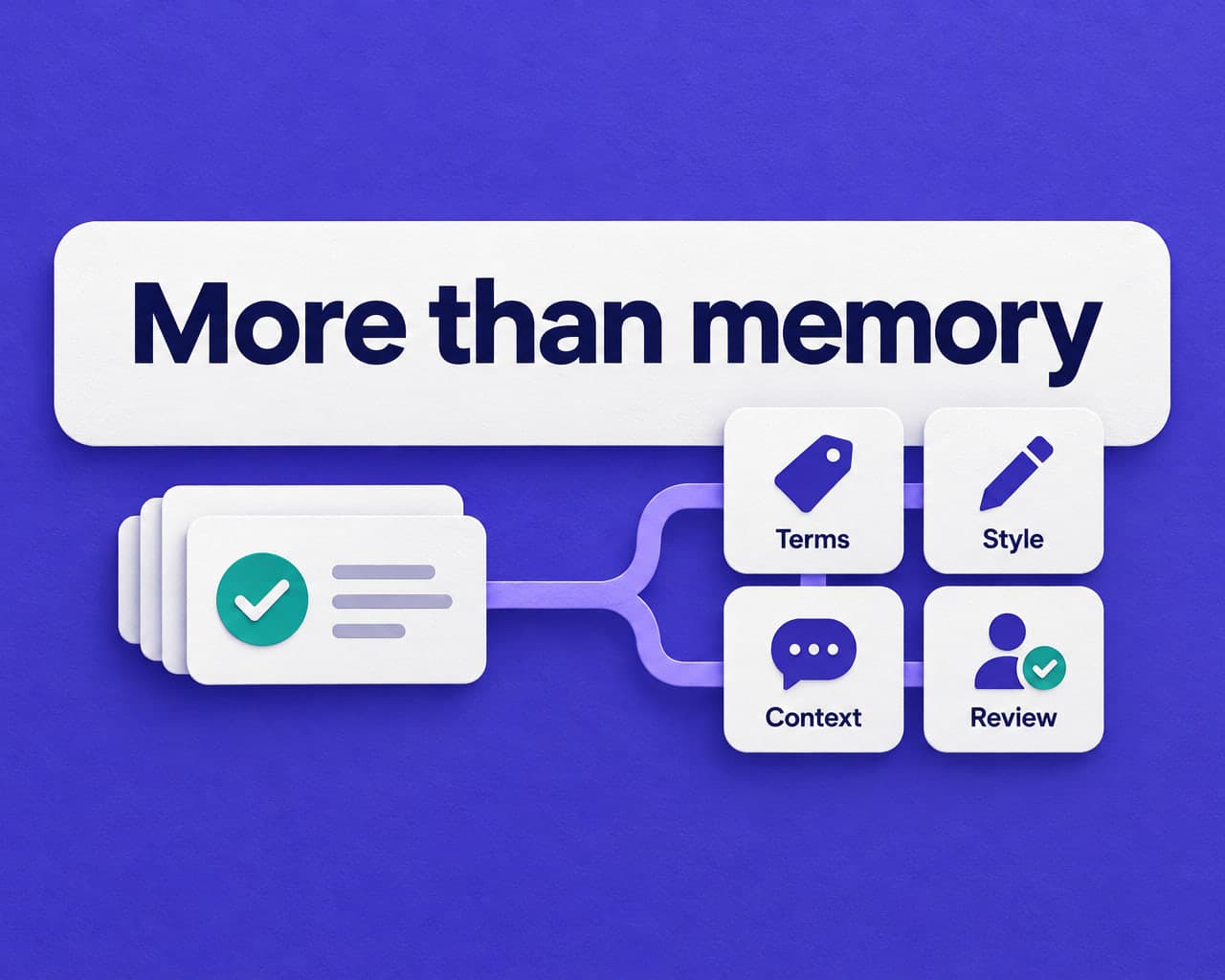
Memory is one part of a TMS
Translation memory stores reusable translations. A term base explains concepts and preferred terms. A glossary sets direct wording and protected-name rules. A style guide explains how the language should sound and read.
Vitra TMS brings those resources together with context and review inside Universe. Vitra TM remains the memory component. This is a product hierarchy, not a reason to rename every language resource “memory.”
See translation memory vs. TMS for a practical guide to the distinction.
Check reuse in the finished format
The customer doesn't see a memory entry. They see a website, a video, an image, a document, or an app.
Check the actual output. Does the term fit the interface? Does the subtitle remain readable? Is the product name pronounced correctly? Did a longer translation change the design? A text approval can be useful without being sufficient for every delivery format.
Vitra Flow connects repeatable content steps and human approval. The memory helps carry decisions forward; the workflow gives people a place to check the finished result.
FAQ
What makes a translation memory useful in an agentic workflow? It makes reviewed translations and their context available to the content workflow. Agents can handle repeatable production work while people check whether the previous wording still fits the new job.
Does a previous approval make a translation correct forever? No. A product, claim, audience, or intended use can change. Review the context before reusing old wording, especially when the meaning or risk has changed.
How does Vitra TM fit inside Vitra TMS? Vitra TM is the adaptive memory layer. Vitra TMS connects it with terminology, glossaries, style guides, context, and human review across content formats inside Universe.
Does translation memory remove the need for reviewers? No. Memory preserves useful decisions; reviewers decide whether those decisions apply to the current content and approve the finished language.