Quick answer — Translation memory keeps reusable translations. A translation management system, or TMS, coordinates the resources, tasks, people, and review around translation. If your problem is repeated wording, memory helps. If your problem is disconnected language work, evaluate the system around it.
Vitra TMS connects adaptive memory, terminology, style guides, glossaries, and context to content workflows in Universe.
A memory answers a different question from a TMS
“Have we translated this before?” is a memory question. “Who needs to review it, which terms apply, and how does the approved version reach the customer?” is a management question.
Consider a product launch. The landing page calls a feature “Team workspace.” A help article explains it. A short video shows it. An email promotes it. Your Spanish reviewer has already agreed on the feature name, but that decision lives in the website project. The video producer doesn't see it and uses a different term. Both versions may sound natural, yet the customer now has to decide whether they describe the same feature.
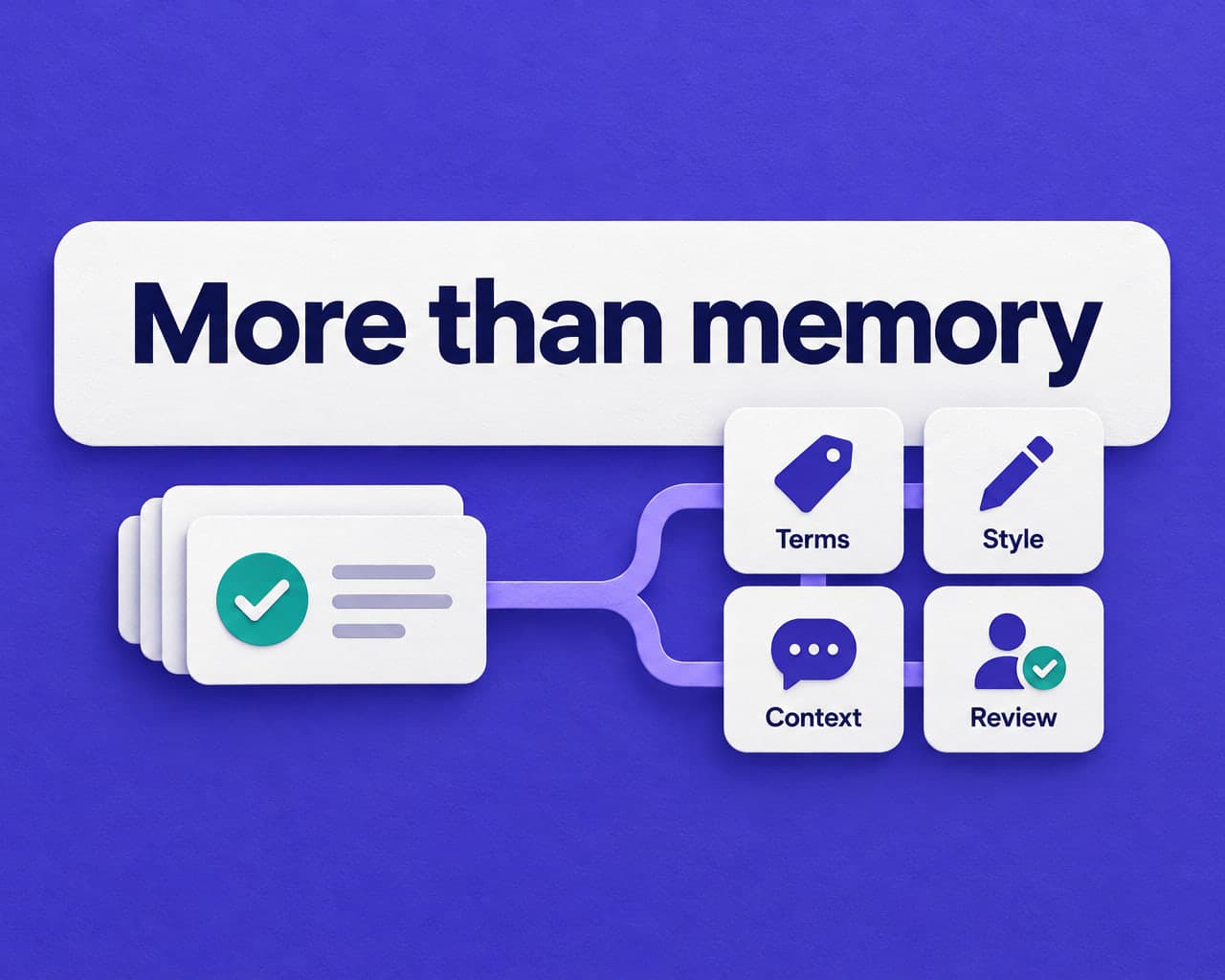
More stored sentences won't fix that handoff on their own. The language resource needs to be available in the right workflow, with the right context and a clear review step. That's the reason to look beyond memory.
What each language resource does
The names are useful when they stop overlapping. They become confusing when every resource is called a “memory.”
| Resource | The question it answers | A practical example |
|---|---|---|
| Translation memory | What reviewed translation can we reuse? | A previously approved onboarding sentence |
| Term base | What does this concept mean, and what should we call it? | A feature definition with preferred terms and synonyms by language |
| Glossary | What wording should we use for this source phrase? | A fixed target label or a do-not-translate product name |
| Style guide | How should the language sound and read? | Formality, punctuation, date format, and examples |
| Context | Who is this for, and where will it appear? | A short button label for new users, not a paragraph in a manual |
| TMS | How do these resources connect to the work and review? | A translation job with the right resources and an assigned reviewer |
A term base is particularly useful when a concept has more than one acceptable form or needs an explanation. A glossary is a simpler wording rule. Neither replaces a style guide, and a style guide doesn't tell you whether the product claim is true.
Keep those responsibilities distinct.
When translation memory is enough
Memory can be the right first investment when the process around translation already works. Your contributors know who owns the job, the output format is predictable, and review decisions reach the people who need them. The remaining issue is that the team repeatedly translates the same instructions, descriptions, or product copy.
In that situation, improve the resource before replacing the entire system. Check whether its language pairs, review statuses, and product context are usable. Remove obsolete wording deliberately, not just because it is old. A short, current memory can be more useful than a large archive with no indication of which entries are trustworthy.
The strongest test is the next real update. Can the reviewer find the approved wording and tell whether it still applies? If yes, you've solved a concrete problem without a large migration.
When the management layer matters more
A TMS becomes worth evaluating when coordination is consuming the team's time. Different formats use different terminology. Review happens in email. A source update doesn't reach every language. Nobody can tell whether a file is a draft or an approved deliverable.
Those are workflow problems. Ask how the system handles them before comparing the number of AI models or languages in a sales presentation. A platform may have excellent translation output and still leave the team moving files, explaining context, and reconstructing approval history. Conversely, an established TMS may already manage your release pipeline well; replacing it without understanding those dependencies creates a different problem.
The useful question is not “Which platform has the most features?” It's “Which steps will our team still have to coordinate outside it?”
Why multimodal content changes the evaluation
A sentence in a spreadsheet isn't the whole deliverable when the customer sees a video, design, or product screen. The translated wording needs to work in that format.
For a video, reviewers may need to hear pronunciation and pacing, read the subtitles, and check the speaker's delivery. In a design, longer text may need a layout decision. In software, a placeholder or short label has constraints that a paragraph doesn't. A correct written translation can still produce an unsuitable finished asset.
Vitra TMS is positioned around that wider job. Its language resources sit inside Vitra Universe, where teams can connect creation, translation, video dubbing, design adaptation, personalization, and review through Vitra Flow. That doesn't mean every established TMS lacks context or multimedia features. It means the evaluation should follow your actual content through its entire lifecycle.
Where Vitra TM sits inside Vitra TMS
Vitra TM remains the adaptive memory layer. It keeps translations, review status, and useful business context. Vitra TMS is the broader product: that memory alongside Vitra TB, glossaries, style guides, contextual translation, and human review.
The hierarchy is intentional. Saying “TMS” whenever the work is only about memory hides the resource's job. Saying “TM” when you're describing terminology, guidance, and approval understates the system. Use the narrower name when you mean reusable translations; use the broader one when you mean the connected translation operation.
Run a pilot before planning a migration
Use one product update with at least two content formats. Bring a real source asset, current terms, a small memory sample, and the person who approves the result. Don't give one system a rich brief and the other a single sentence, then call that a fair comparison.
Check the following before expanding:
- The meaning stays correct in the finished asset.
- Preferred terms and protected names are treated as expected.
- Draft, reviewed, and approved work remain distinguishable.
- Your actual import and export files preserve the information you need.
- Required connectors, permissions, deployment, and delivery steps are covered.
- The reviewer can do the job without reconstructing the brief elsewhere.
Measure the handoffs as well as the output. A good pilot may show that Universe should handle new content workflows alongside your current TMS. It may support a larger migration. Both are reasonable outcomes.
For product-specific evaluations, see the TMS and localization comparisons, including Phrase, memoQ, and Trados.
FAQ
What is the difference between translation memory and a TMS? Translation memory stores reusable translations. A translation management system coordinates language resources, translation tasks, contributors, and review. A TMS can include translation memory, but the two names describe different jobs.
Is Vitra TM being replaced by Vitra TMS? No. Vitra TM remains the adaptive translation memory. Vitra TMS is the broader system connecting that memory with Vitra TB, glossaries, style guides, context, and human review inside Universe.
How should we evaluate a new translation management system? Use a representative job with your own source assets, language resources, and reviewers. Check meaning, terminology, finished formats, review steps, imports, exports, and required integrations before planning a wider migration.