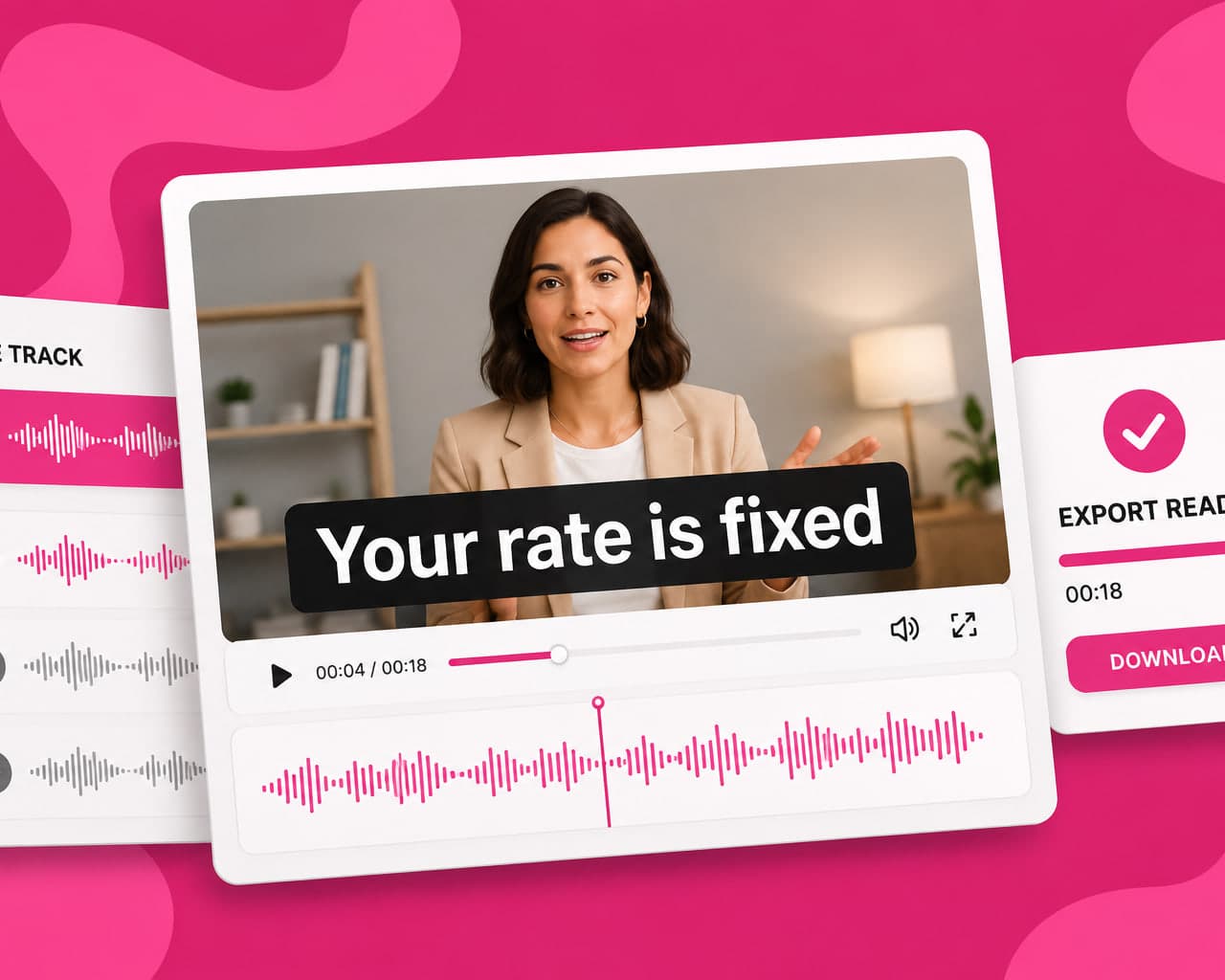
Quick answer — AI video dubbing runs as one orchestrated job: transcribe, diarize speakers, translate, clone or select a voice, re-align the mouth, synchronise to picture, and export subtitles. The failures are in synchronisation and speaker mapping, not in the translation.
Vitra.ai Universe dubs, clones the voice and re-aligns the mouth in one pass.
Seven stages, one pass
The old workflow was a chain of vendors — transcription house, translator, studio, mixer — with a handoff and a wait between each.
| Stage | What it does |
|---|---|
| Transcription | Speech to timed text |
| Speaker diarization | Splits who is talking, automatically |
| Translation | Against your glossary, not a generic model |
| Voice | 12,000+ voices across 178 language variants, or a clone |
| Emotion | Detected in the source, recreated in the target |
| Lip-sync | Mouth movement re-aligned to the new audio |
| Sync and subtitles | Audio to picture, plus SRT and VTT |
Running them as one job removes the handoffs, which is where most of the elapsed time used to sit.
Diarization is the stage nobody thinks about
Multi-speaker footage — a panel, an interview, a podcast — has to be split by speaker before any voice is assigned, or two people end up sharing one voice and the conversation becomes incomprehensible.
Automatic speaker detection maps each voice to its own target voice without manual tagging. Get it wrong and everything downstream is wrong in a way that is obvious to a viewer and invisible in a QC report that only checks the words.
Emotion, and why flat dubs feel wrong
A faithful translation read flatly is a worse dub than a loose translation read well.
Emotion is detected in the source performance and recreated in the target, with pace and pronunciation editable per segment. That is what stops a dubbed explainer sounding like a satnav, and it matters more for anything persuasive than the word choice does.
Where it still needs a person
Two places, and both are worth building in. Timing, because translated speech usually runs longer than the source — write to the timing rather than translating and then discovering the segment overruns. And claims, because a spoken claim is still a claim: review the script per market before rendering, not the finished files after. A workflow gate parks the run until a reviewer approves the transcript or the speaker mapping, while translation keeps processing in parallel — so the check costs a decision rather than the whole schedule.
Then quality control runs on the output, and corrections write back to translation memory so the terminology matches the subtitles and everything else that shares it.
The rest of the decisions
Dubbing one video is the easy case. A whole library needs the voice, terminology and review band settled first, and recorded webinars need editing before anyone translates them.
On output, there is a release checklist, the accessibility obligations that captions and audio description answer, and voiceover where no presenter appears on screen. Where the presenter is synthetic, see AI avatars; where every viewer gets their own cut, lip-sync personalization.
FAQ
What are the stages of AI video dubbing? Transcription, speaker diarization, translation against your glossary, voice selection or cloning, emotion recreation, lip-sync realignment, and synchronisation to picture with subtitle export — run as one job rather than sequential vendors.
What is speaker diarization and why does it matter? It splits multi-speaker footage so each voice is mapped to its own target voice automatically. Without it, two people share one voice and the conversation becomes incomprehensible to viewers.
Why do some dubbed videos sound flat? Because the performance was not carried across. Emotion detected in the source and recreated in the target, with pace editable per segment, is what separates a dub from a machine reading a script.
Where does a human still need to approve a dub? On timing and on claims. Translated speech usually runs longer than the source, and a spoken claim is regulated like a written one, so the script needs market review before rendering.