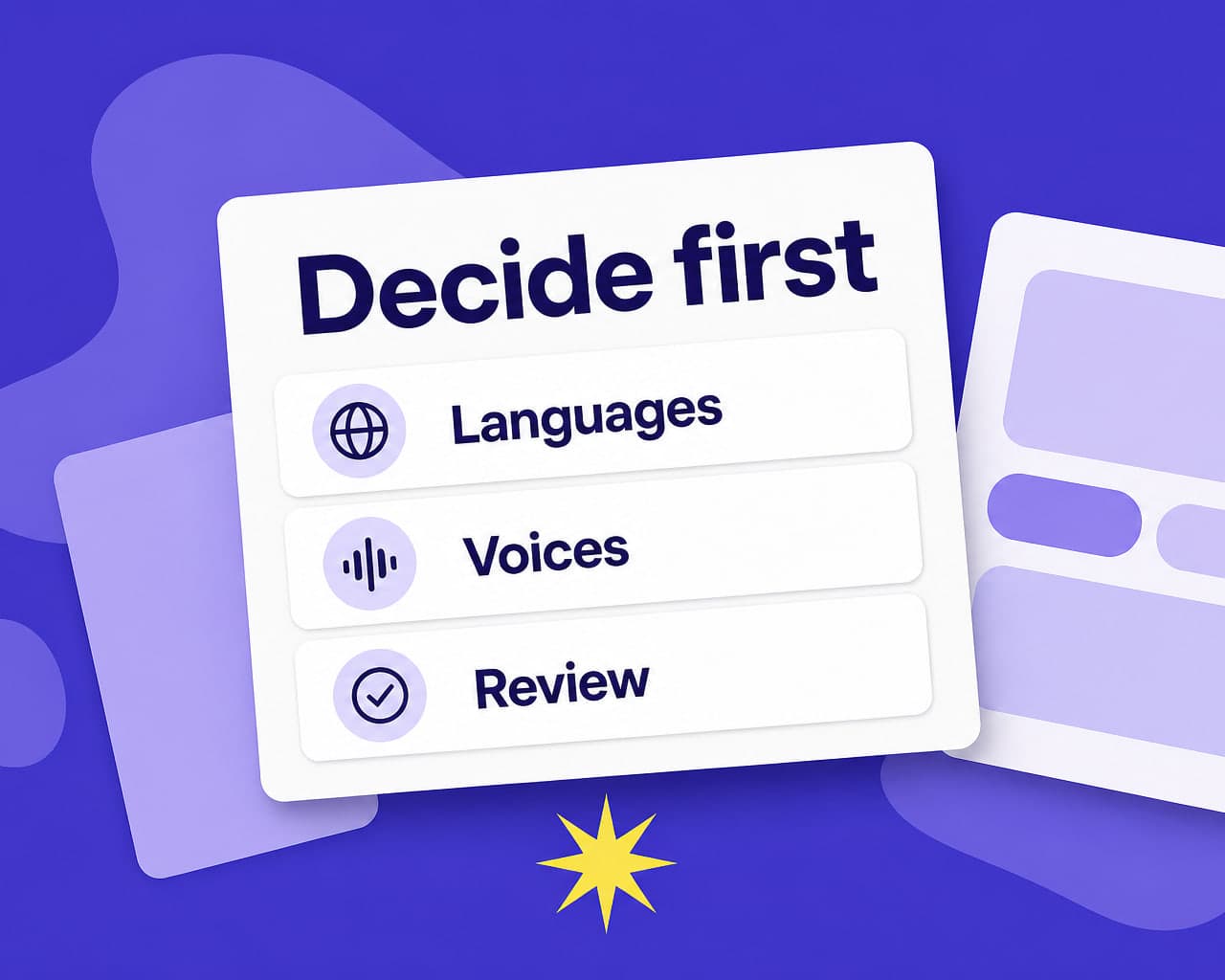
Quick answer — Bulk video localization is a sequencing problem, not a translation one. Decide the language list, the voice per language and the review band before the first job, because those choices become expensive to change once hundreds of files exist.
Vitra.ai Universe dubs, clones the voice and re-aligns the mouth in one pass.
The first video teaches you nothing
A pilot on one flagship video answers questions that do not scale. Everyone is paying attention, the terminology gets checked by hand, and the voice is chosen by a committee.
At four hundred videos none of that is available, and the decisions you deferred become the bottleneck.
Decide these before the first job
| Decision | Cost of changing later |
|---|---|
| Language list | Moderate — add markets, keep the rest |
| Voice per language | High — a re-voiced library sounds like a rebrand |
| Terminology | High — inconsistent across everything already rendered |
| Review band by risk | Moderate |
| Subtitle or dub per placement | Low, if the script is shared |
| Naming and storage | Painful, and always underestimated |
Voice is the one that hurts. Forty videos in, changing the German voice means re-rendering forty videos or living with a library that sounds like two companies.
Sequence by value, not by folder
The instinct is to start at the top of the file list. The useful order is by what gets watched. Pull the view counts first. In most libraries a small fraction of videos carries the majority of views, and localizing those first delivers most of the benefit while the pipeline is still being tuned.
Then the compliance-mandated content, which has a deadline rather than an audience. Then the long tail, which can run continuously in the background.
What makes the volume survivable
One shared translation memory across the library, so the fourth hundred videos cost less than the first — terminology is already settled and repeated segments are reused rather than retranslated.
Video dubbing running the stages as one job rather than as vendor handoffs, and quality control checking every file rather than a sample, because at this volume nobody watches them all.
Review only what is flagged or high-risk, on the same logic as routing review by risk.
Budget for the tail. The last fifty videos in a library are usually the oldest, the worst documented, and the ones whose source files nobody can find. Site training runs the opposite way, short clips reissued constantly — construction video training.
FAQ
What should be decided before bulk video localization starts? The language list, the voice for each language, the terminology, the review band by risk, and file naming. Voice is the most expensive to change later, since a re-voiced library sounds like a different brand.
In what order should a video library be localized? By views rather than by folder. A small fraction of most libraries carries the majority of watch time, so localizing those first delivers most of the value while the pipeline is still being tuned.
Why does localizing a large library get cheaper over time? Because a shared translation memory accumulates. Terminology settles, repeated segments are reused instead of retranslated, and reviewer corrections apply to everything rendered afterwards.
What is usually underestimated in a bulk video project? The tail. The last videos in a library tend to be the oldest, with missing source files and no documentation, and they take disproportionately long to finish.