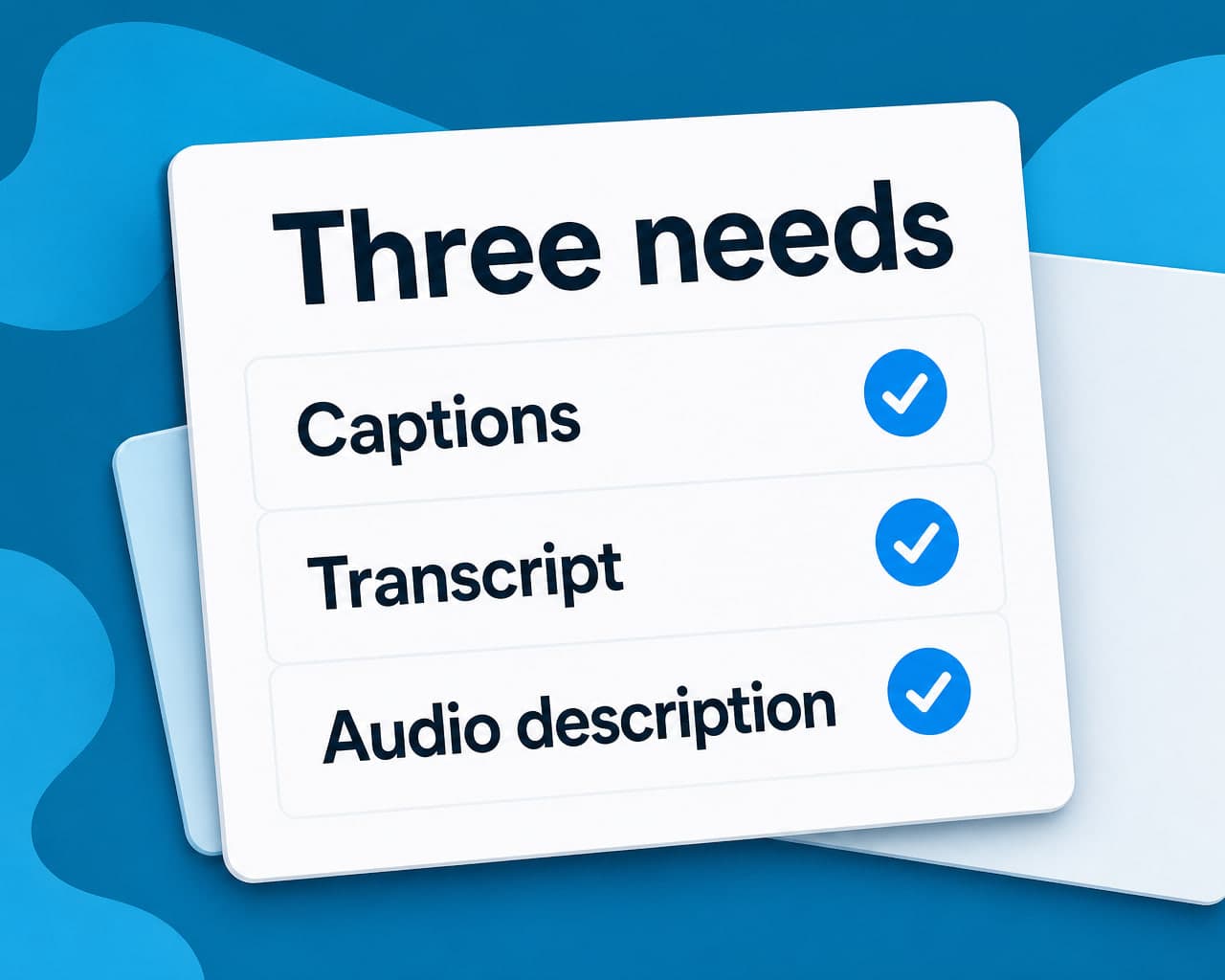
Quick answer — Video accessibility needs captions for deaf and hard-of-hearing viewers, transcripts for screen reader users, and audio description for blind viewers. Captions are the baseline; audio description is the one most organisations skip.
Vitra.ai Universe dubs, clones the voice and re-aligns the mouth in one pass.
Three different needs, three different outputs
They get conflated constantly, and each serves a different person.
| Output | For | What it carries |
|---|---|---|
| Captions | Deaf and hard of hearing | Speech plus meaningful sound |
| Subtitles | Viewers in another language | Speech only |
| Transcript | Screen reader users, and search | Full text, no timing |
| Audio description | Blind and low vision | What is shown but not said |
Captions and subtitles are not the same output. Captions include the door slamming and the music swelling because those carry meaning; subtitles do not, because a hearing viewer already got them.
Shipping subtitles and calling them captions is the most common way a video fails an accessibility review while appearing to pass.
Audio description is the gap
It is the track that narrates what a sighted viewer sees — a chart appearing, a demonstration on screen, text that is shown but never read aloud. Almost nobody produces it, and it is frequently the specific finding in an accessibility audit. The cheap mitigation is to write scripts that describe what they show. A presenter who says "as the figure on the left shows, renewals rose" has narrated their own slide, and the need for a separate description largely disappears.
Where the obligations bite
Public sector bodies in most jurisdictions have explicit requirements, and in the EU the accessibility rules reach consumer-facing digital services rather than only government.
The practical standard people are measured against is WCAG, where captions and audio description sit at different conformance levels — captions earlier, description later, which is why organisations tend to have one and not the other.
Employment and education contexts often carry their own separate duties.
Doing it as part of the pipeline
Captions come out of the same pass that produces subtitles — use a sidecar file rather than burning text in, so it can be corrected, translated and read by search.
Transcripts fall out of the same transcription step and cost almost nothing extra, while also making the video findable.
Audio description needs a decision and a script. Treat it as content rather than compliance and it tends to actually get made, which is more than can be said for treating it as a checkbox — and run the result through quality control like anything else you publish.
Where accessibility and language access are separate duties, both have to be checked — public sector accessibility.
FAQ
What is the difference between captions and subtitles? Captions serve deaf and hard-of-hearing viewers and include meaningful non-speech sound such as a door slamming. Subtitles serve viewers in another language and carry speech only.
What is audio description? A narration track describing what is shown but not spoken — a chart appearing, an on-screen demonstration, text never read aloud. It serves blind and low-vision viewers and is the most commonly missing output.
Do transcripts count as accessibility provision? They help screen reader users and search, but they do not replace captions for a viewer watching the video. A transcript is a supplement rather than a substitute for timed captions.
How can the need for separate audio description be reduced? By writing scripts that describe what they show. A presenter who says what the on-screen figure demonstrates has narrated their own visuals, which covers much of what a description track would add.