
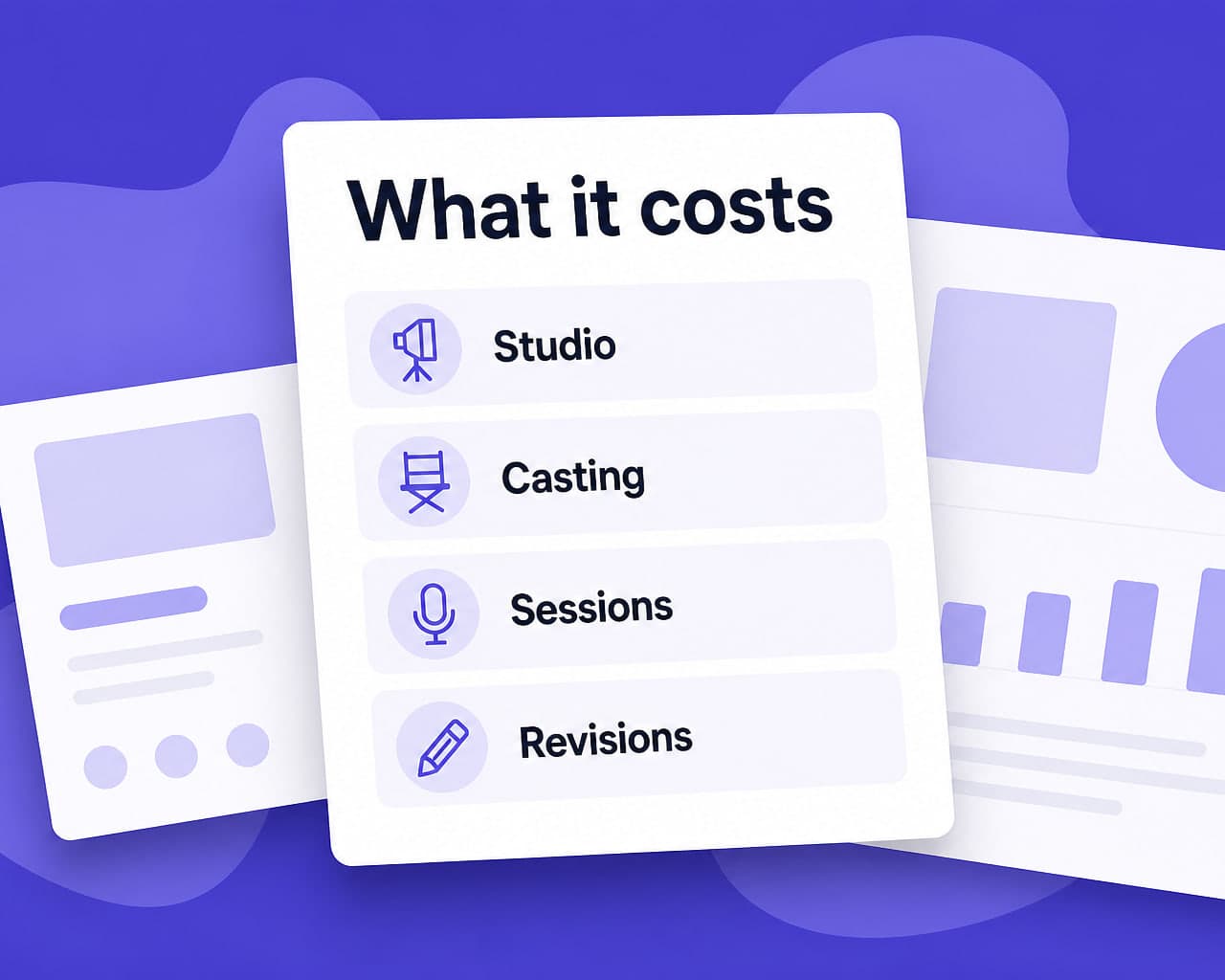
Quick answer — The cost of localizing video sits in studio booking, casting, session time and revision rounds rather than in the translation itself. AI removes the scheduling cost, which is the largest line, not the linguistic one.
The invoice is mostly logistics
Ask what a dubbed episode costs and the answer includes a studio day, a director, a casting process, an engineer and a mix. The translation is a small fraction of it. That is why per-word comparisons mislead. Two vendors can quote the same rate per word and differ by a factor of five on a finished episode, because one of them books a room and the other does not.
Where the money actually goes
Scheduling. A voice actor, a director and a room have to be free on the same day, in the right city. This is the single largest driver and it is invisible on a quote.
Revision rounds. A note on episode three means recalling the actor. Each recall is another booking.
Per-language multiplication. Everything above happens again for every language, which is why the tenth market costs roughly what the first did.
What AI changes and what it does not
It removes the room and the calendar.
A revision becomes a re-render rather than a recall, and the tenth language costs a fraction of the first because video dubbing and translation memory reuse everything already approved.
It does not remove the need for a good adaptation, a terminology decision or a final listen. Those still cost something and they should.
Where the savings are largest
Back catalogue, training, corporate and factual content — anything where a specific performance is not the product. Flagship drama and comedy are where the old economics still apply.
Where to start
Price one back-catalogue title both ways, end to end, including the revision rounds. The comparison only means something at finished-episode level.
AI for production media covers where it fits.
FAQ
What is the biggest cost in video localization? Scheduling. A voice actor, a director and a studio have to be free on the same day in the right city, and that coordination cost is invisible on a per-word quote.
Why do per-word comparisons mislead? Because two vendors can quote the same rate and differ fivefold on a finished episode. One of them books a room and the other does not, and the room is most of the invoice.
What makes revisions expensive? Recalls. A note on episode three means bringing the actor back, and each recall is another booking. With synthesis a revision becomes a re-render instead.
Where do the old economics still apply? Flagship drama and comedy, where a specific performance is the product. Back catalogue, training, corporate and factual content are where the savings are largest.