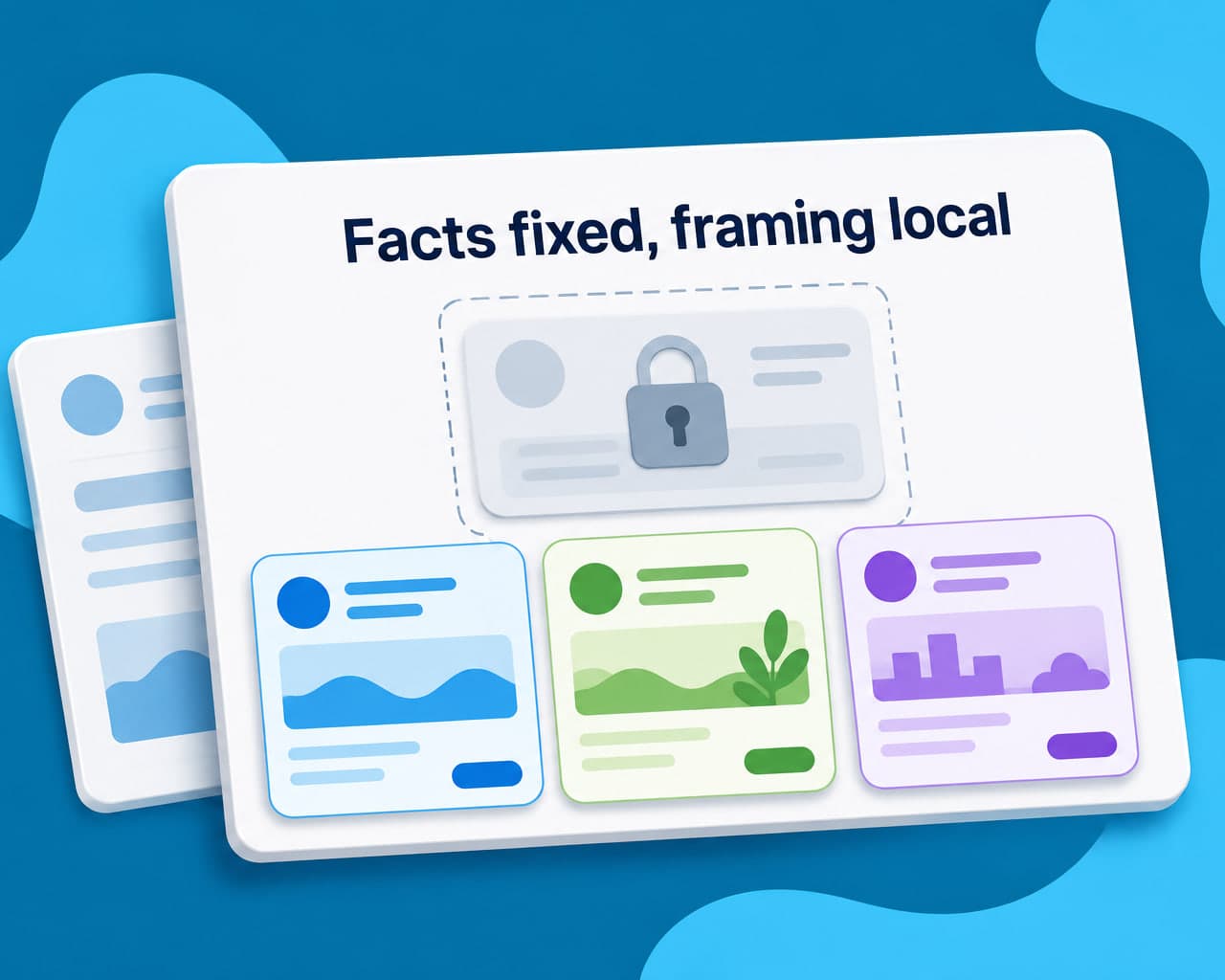
Quick answer — Public health content needs adapting rather than translating, because health literacy, terminology and trust differ by community. Keep the clinical facts fixed and let the framing, examples and messenger change.
Vitra.ai Universe runs white-labelled, and on-premise where data cannot leave.
Understanding is not the goal, acting is
Health communication succeeds when someone does something — attends a screening, takes a course of treatment, changes a behaviour.
A translation that is accurate and unpersuasive has failed at the thing it was for. This is the content type where transcreation earns its cost, because the framing that motivates one audience does not motivate another.
What stays fixed and what moves
| Element | Treatment |
|---|---|
| Clinical facts and dosages | Fixed, never adapted |
| Safety warnings | Fixed wording, per approved terms |
| Eligibility and where to go | Fixed content, local detail |
| Framing and motivation | Adapted per audience |
| Examples and scenarios | Adapted, sometimes replaced |
| Imagery | Adapted, and checked locally |
| Messenger | Local |
The line is straightforward in principle: facts do not move, persuasion does. Keeping that line explicit in the brief prevents both failure modes — a clinically loose adaptation, and a rigid translation nobody responds to.
Health literacy is the practical constraint
Clinical vocabulary is difficult in any language, and a term with a common equivalent in one language may have only a technical one in another.
Where that happens, explaining the concept plainly beats using the technical term and hoping. The source should be written at the reading level the hardest- to-reach audience needs, since simplifying once improves every version — the plain language point again, with higher stakes.
Trust decides response more than wording
Communities differ in their confidence in health authorities, often for reasons that have nothing to do with the current campaign.
Where trust is low, the most accurate leaflet underperforms a conversation with someone the community already relies on. Budget for partnership and local delivery rather than putting everything into asset production.
Imagery needs local review
Images carry meaning that does not travel — who appears, in what setting, doing what, and what is implied about them. A local review of imagery catches problems that no linguistic review will, and it is cheap compared to withdrawing a campaign. It is worth doing before production rather than after, since an image is expensive to reshoot and a stock selection is not. Asking two or three people from the community what a proposed image says to them takes a day and answers a question nobody else in the process can.
Delivery
Video dubbing and captions cover the video, image translation the text inside graphics, and quality control verifies that clinical facts and safety wording are identical across every adapted version — the one thing that must not vary. The campaign machinery behind it is multilingual campaign automation.
Where health data cannot leave your estate, the pipeline runs on-premise.
FAQ
Should health campaigns be translated or adapted? Adapted, with a clear line. Clinical facts, dosages and safety wording stay fixed, while framing, examples, imagery and messenger change for each audience.
What is the main constraint in health communication? Health literacy. Clinical vocabulary is hard in any language, and a term with a common equivalent in one language may have only a technical one in another, so plain explanation beats the technical term.
Why does trust matter more than wording? Because communities differ in confidence in health authorities for reasons unrelated to the campaign. Where trust is low, an accurate leaflet underperforms a conversation with someone the community relies on.
Why does imagery need local review? Because images carry meaning that does not travel — who appears, in what setting, and what is implied. A local review catches what no linguistic review will, far more cheaply than withdrawing a campaign.