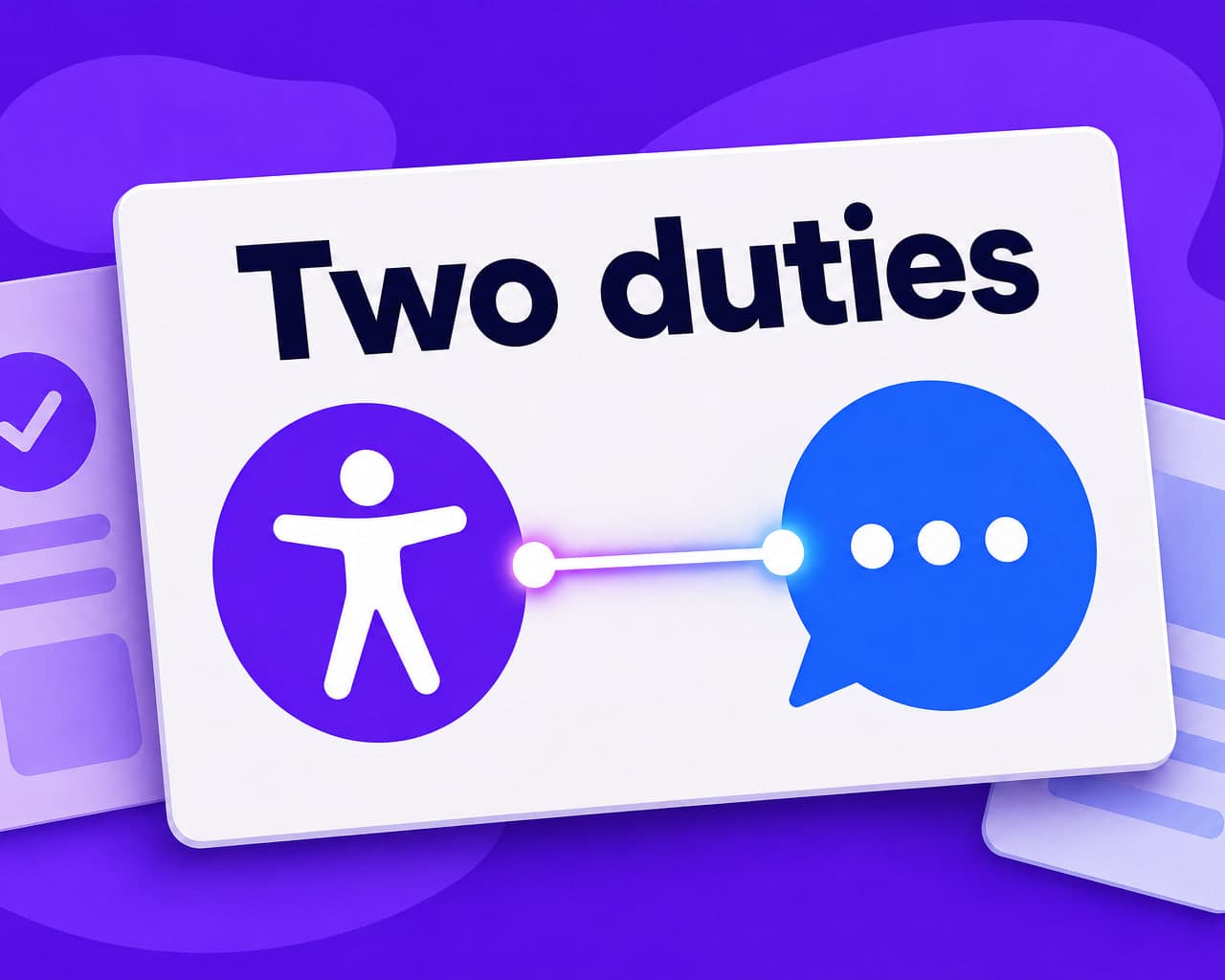
Quick answer — Accessibility and language access are separate duties. Content can be fully translated and still unusable, and technically accessible while remaining incomprehensible, so both have to be checked rather than assumed from the other.
Vitra.ai Universe runs white-labelled, and on-premise where data cannot leave.
Two obligations, often confused
Accessibility is about whether someone can perceive, operate and understand the content — including with assistive technology. Language access is about whether content exists in a language the person reads. The specific requirements differ by jurisdiction, and yours may treat them together or separately. What holds everywhere is that satisfying one does not satisfy the other.
Where they interact
| Situation | Result |
|---|---|
| Translated page, wrong language attribute | Screen reader uses the wrong voice |
| Translated text inside an image | Invisible to assistive technology |
| Right-to-left content in a left-to-right layout | Unusable |
| Translated page, untranslated alt text | Content missing for some users |
| Video dubbed, captions only in one language | Excludes deaf users in other languages |
| Plain-language original, dense translation | Understandable becomes unreadable |
The language attribute is the small technical detail with the largest effect. A page marked as one language but containing another is read aloud with the wrong pronunciation rules, which produces sound rather than speech.
Text inside images
An image containing text is invisible to a screen reader and untranslatable by a document pass, so it fails both duties at once.
Where such images are unavoidable — a diagram, a map, a scanned notice — the text needs a real alternative in every offered language, and the graphic itself needs image translation rather than a caption that describes it vaguely.
Video needs more than one thing
A dubbed video without captions excludes deaf viewers. Captions without audio description exclude blind viewers. Both in one language only serve one audience.
The workable minimum for public-facing video is captions in each offered language, with dubbing where the audience is more likely to listen than read, and a transcript that is itself translated.
Plain language is the shared foundation
Simplifying the source helps every group at once — assistive technology users, people reading in a second language, people under stress, and anyone in a hurry.
It is also the cheapest intervention available, because it improves the original and reduces the cost of every translation made from it.
Delivery and assurance
Website translation handles the pages and quality control can check language attributes, alt text coverage and terminology across every version rather than a sample.
Where the platform must run inside your own environment or under your own branding, on-premise deployment and white-label delivery are both available.
FAQ
Are accessibility and language access the same obligation? No. Accessibility concerns whether someone can perceive, operate and understand content, including with assistive technology. Language access concerns whether it exists in a language they read, and satisfying one does not satisfy the other.
Why does the page language attribute matter? Because a screen reader uses it to choose pronunciation rules. A page marked as one language containing another is read aloud as sound rather than speech, which makes correct translation useless.
What is wrong with text inside images? It is invisible to assistive technology and untouched by document translation, so it fails accessibility and language access at once. It needs a real text alternative in every offered language.
What is the cheapest thing that helps both? Plain language in the source. It helps assistive technology users, second-language readers and anyone in a hurry, improves the original, and lowers the cost of every translation made from it.