Quick answer — Use image-to-video when you care what is in the frame. You generate or supply a still, approve it, then animate it — so composition, character and brand are settled before any motion is paid for. Text-to-video is for when the subject does not need to match anything.
Video creation supports both paths.
The actual difference
Text-to-video takes a description and invents everything: the subject, the framing, the lighting, the motion. Image-to-video takes a still you already have and adds motion to it, leaving the content of the frame alone.
That sounds like a small distinction. It decides almost everything downstream.
| Text-to-video | Image-to-video | |
|---|---|---|
| Who decides the frame | The model | You |
| Consistency across clips | Poor without extra work | Inherited from the still |
| Art direction | A prompt | An image you approved |
| Cost of a bad result | A wasted clip | A wasted still, which is far cheaper |
| Brand control | Hard | Straightforward |
Why the approve-then-animate order matters
Generating a still is fast and cheap. Generating video is neither.
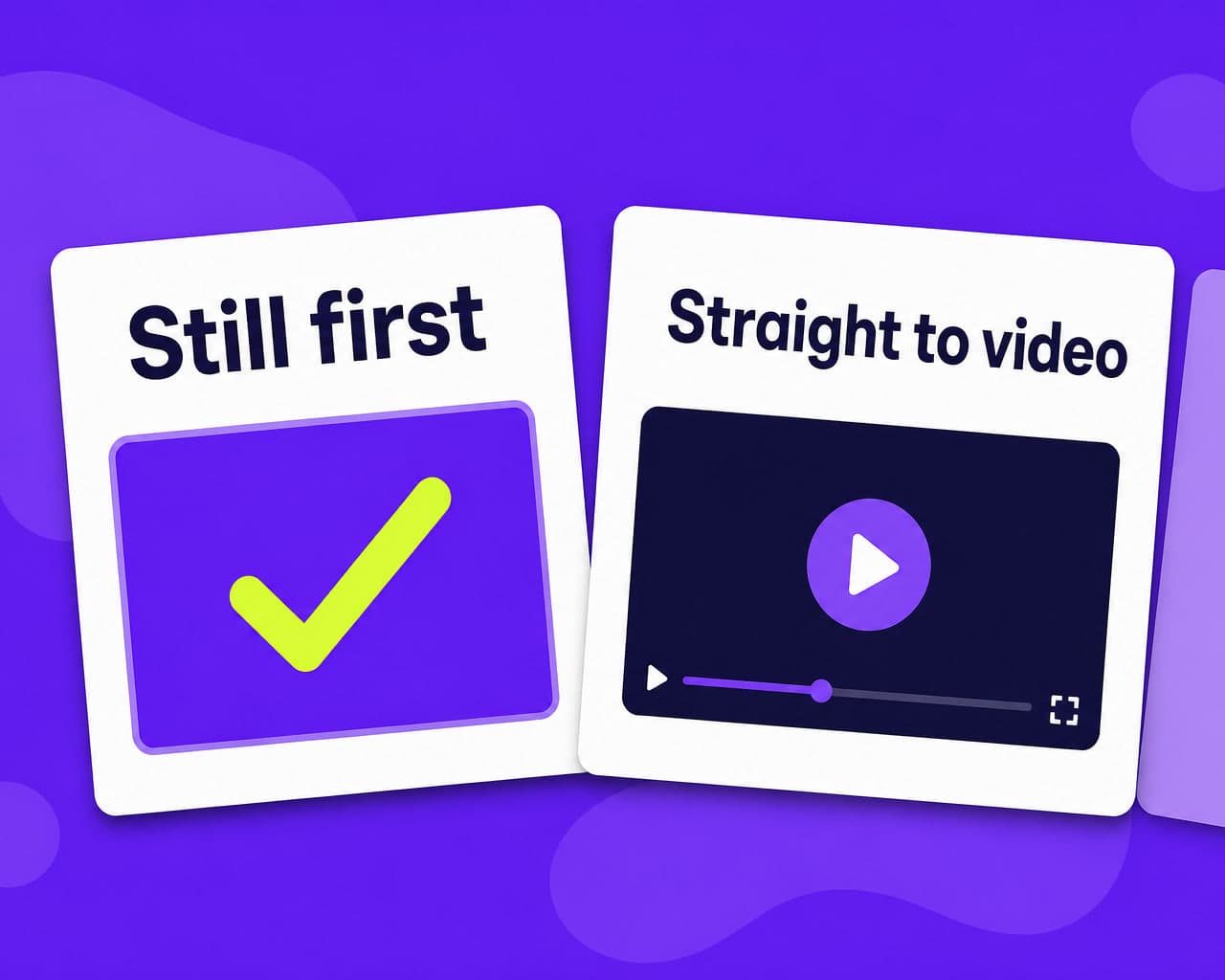
So the sensible order is: generate several stills, pick the one that is right, then animate that one. You are paying for motion on an image that already passed your eye, rather than discovering at the end of a slow render that the product is the wrong colour.
It also gives you a natural review point. A still can go through quality control before anyone spends on animation, which is a lot cheaper than moderating the finished clip.
Where text-to-video still wins
Abstract or atmospheric footage where nothing has to match — smoke, water, particles, an establishing landscape. Nobody is checking whether the mountain is the same mountain.
It is also the only option when you have no still and no way to make one that matches the prompt.
Where image-to-video wins
Anything with a product in it. Anything with a person who appears twice. Anything where the brand has a colour, a logo or a layout that must survive.
And anything where you already have the asset. A campaign photograph you paid a studio for can become motion, which is usually a better result than asking a model to invent something similar.
The practical constraints
Image-to-video clips are short — think a handful of seconds — and typically offer a small set of durations and resolutions rather than arbitrary values. Plan the edit around short beats rather than expecting one continuous shot.
The source image also has to be reachable by the service as a public URL, which matters more than it sounds when your assets live behind a login.
Where to start
Take one campaign still you already own and animate it. Compare it against a text-to-video clip generated from a description of the same scene. The difference in how much it looks like your brand is the whole argument.
FAQ
What is the difference between text-to-video and image-to-video? Text-to-video invents the entire frame from a description. Image-to-video takes a still you already control and adds motion to it, so composition, character and brand are settled before any motion is generated.
Which is better for brand content? Image-to-video, in almost every case. Anything with a product, a repeated person or a brand colour needs a frame you approved rather than one a model invented from a prompt.
Why generate a still before generating video? Stills are fast and cheap, video is neither. Approving the image first means you pay for motion on something that already passed your eye, and it gives you a review point before the expensive step.
When is text-to-video the right choice? Abstract or atmospheric footage where nothing has to match - smoke, water, particles, an establishing landscape - or when you have no still and no way to produce one that fits.