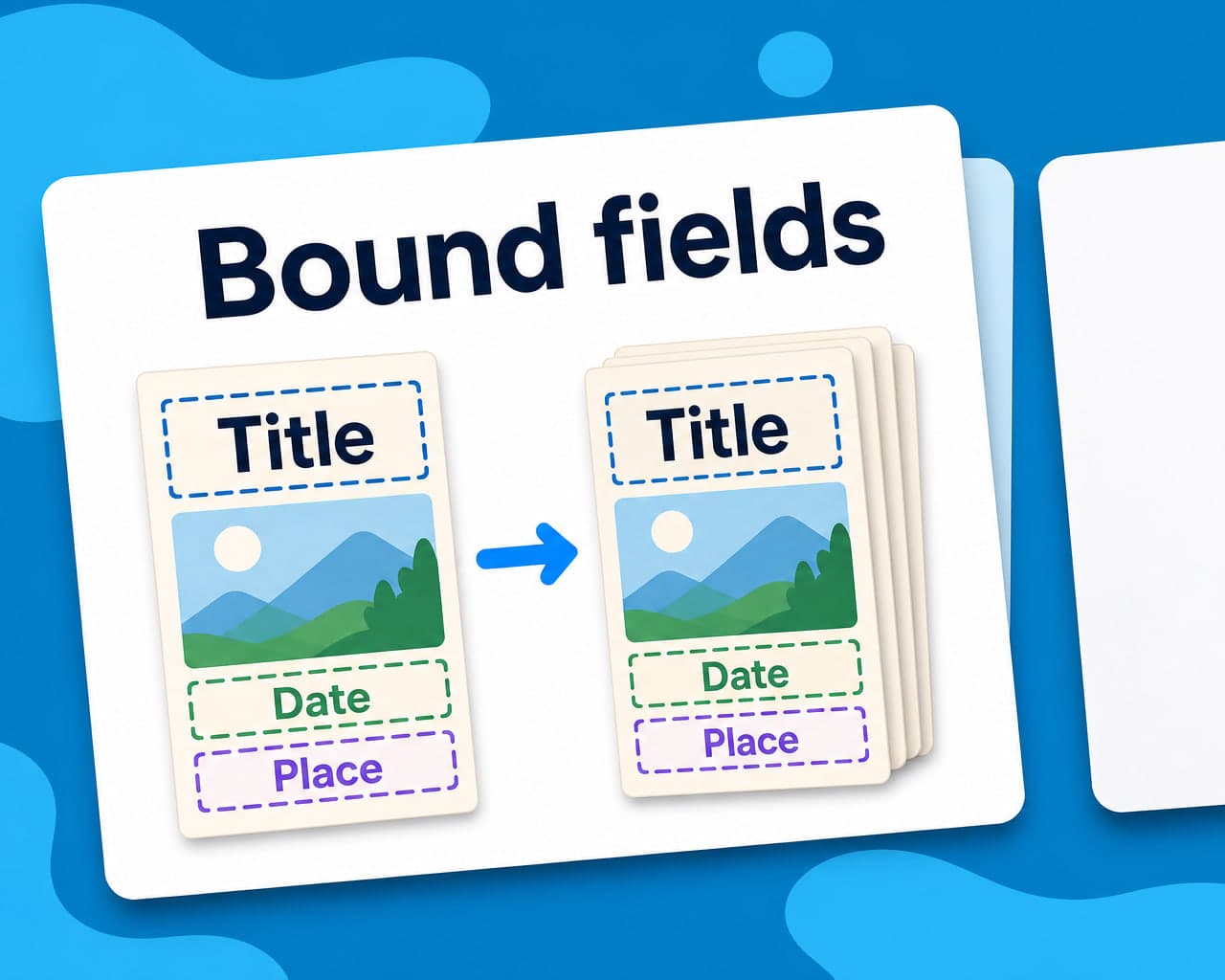
Quick answer — The mechanism is a template with bound fields plus a contact list. Each element in the creative points at a data field rather than holding fixed text, and a render worker produces one image or video per row — thousands of assets from one approved design.
Image personalization and video personalization cover both outputs.
The bottleneck is production, not targeting
Most teams can already segment. They know the region, the dealer, the product, the language. What they cannot do is produce a separate asset for every combination, so segmentation collapses back to three or four versions and the data goes unused.
Personalization at scale is a rendering problem.
How binding works
A template is a design where elements point at data instead of holding it. A text layer is not the words "Sunrise Motors" — it is a reference to the business name field, resolved per record at render time.
| Element type | Bound to |
|---|---|
| Text | A field: name, firm, area, offer, price |
| Image | A URL field: dealer logo, product shot |
| QR code | A generated value, often per-recipient |
| Shape and icon | Usually fixed, occasionally conditional |
Geometry is stored as percentages of the canvas rather than pixels, which is what lets the same template render at different output sizes without a redesign.
Language comes from the data too
The strongest form of personalization is not the name in the headline. It is the language, and it can be derived rather than asked for — a contact's state or region implies a language, and that mapping is configuration rather than a field someone has to fill in.
Names get transliterated into the target script while descriptions get translated, which is a distinction worth getting right because doing it backwards is very visible.
Video, and why it is different
Personalized video works the same way with two extra costs. Each variant is a render rather than a composite, so it takes real time and real money per record — and if there is a voice track, the audio has to be generated per variant too.
The economics change accordingly. Personalized images at ten thousand records is routine. Personalized video at ten thousand records is a budget decision, and the sensible pattern is to personalize video for high-value segments and images for the rest.
What must never be editable
Anything a recipient could rely on. Price, offer terms, expiry date, any regulated claim. These bind to the source record with no manual override, because a personalized asset is a communication about a specific person's money and a typo in a rate is not a design error.
Where to start
One template, one field bound — the recipient's own dealer name — against a control that gets the generic version. That single field is usually enough to move the number, and it tests the whole pipeline before you commit to the complicated version.
FAQ
Why does ad personalization fail in practice? On production rather than data. Most teams can already segment by region, dealer and language, but cannot produce a separate asset per combination, so it collapses back to three or four versions.
How does a personalized creative template work? Elements point at data fields instead of holding fixed content. A text layer references the business-name field rather than containing a name, and a render produces one asset per row of the contact list.
Is personalized video as scalable as personalized images? No. Each video variant is a render rather than a composite, and any voice track is generated per variant, so the usual pattern is personalized video for high-value segments and images for everyone else.
What should never be editable in a personalized creative? Price, offer terms, expiry dates and any regulated claim. These bind to the source record with no manual override, because a typo in a rate is not a design error.