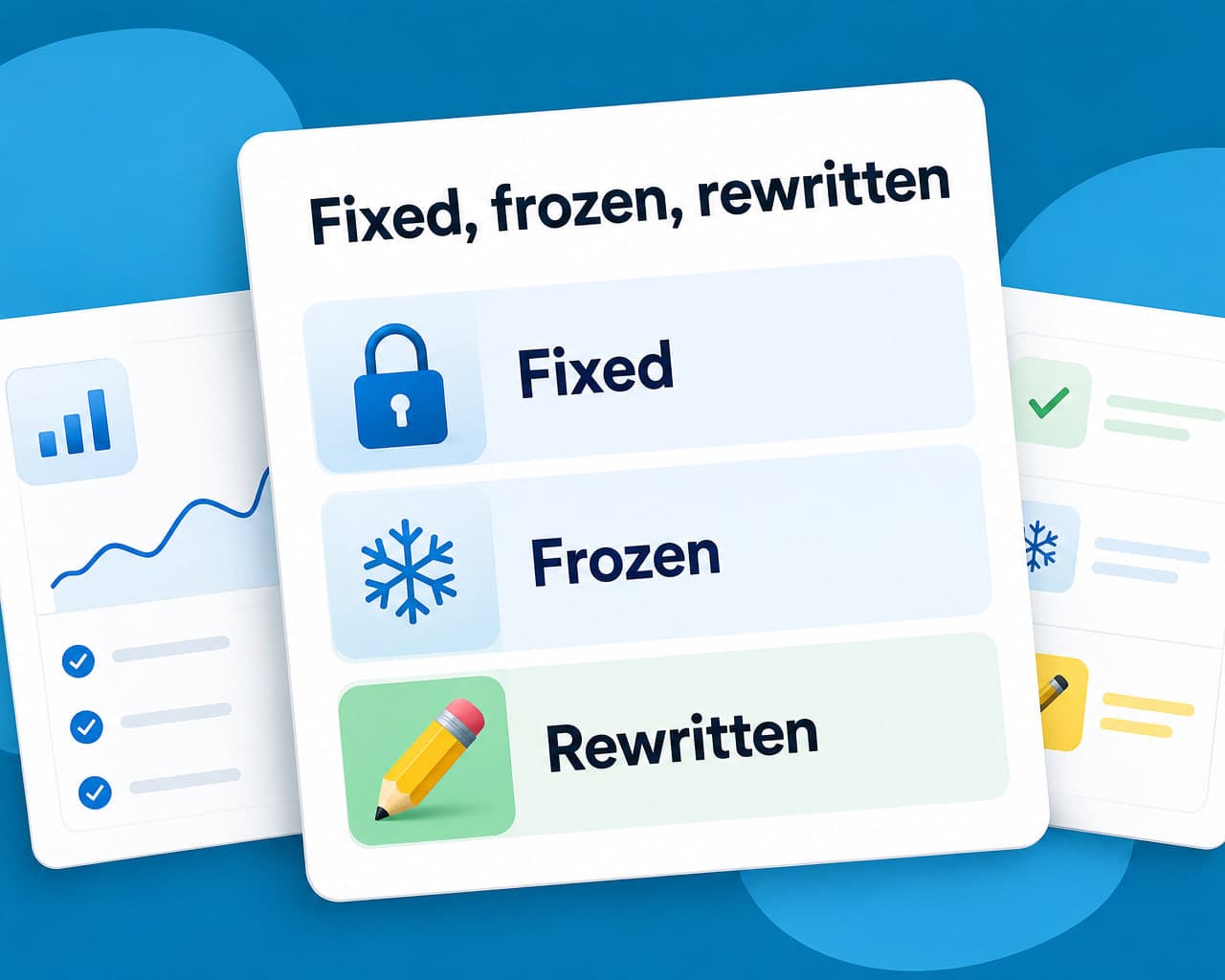
Quick answer — Product names and model codes normally stay fixed, feature names are decided once per language and then frozen, and taglines are rewritten rather than translated. Screening has to happen before tooling and packaging, not after.
Vitra.ai Universe keeps one product vocabulary across box, app, page and video.
Four categories, four rules
Naming is treated as one decision and behaves as four.
| Type | Default | Why |
|---|---|---|
| Product name | Keep, unless screening objects | Recognition, packaging, search |
| Model code | Never change | Support, parts, compatibility |
| Feature name | Decide per language, then freeze | Appears in every asset |
| Tagline | Rewrite | Wordplay does not survive |
| Accessory names | Usually keep, sometimes describe | Sold separately, searched separately |
The expensive mistakes come from applying one rule to all five rows.
Screening comes before tooling
A name that carries an unfortunate meaning, sounds like something else, or collides with an existing mark in a target market has to be caught before packaging is printed, moulds are cut and listings are created.
Screening after launch is not screening, it is a recall decision. That check belongs at the same point as the wake word review, since both are phonetic questions and both are effectively irreversible.
Feature names are frozen once decided
A feature name appears on the box, the product page, in the app, in the manual, in support articles and in every campaign. Renaming one after launch means updating all of it, in every language, including printed material that cannot be updated at all. That is why the decision deserves more scrutiny than its size suggests, and why it should be recorded in the glossary rather than left to whoever translates the next asset. The same reasoning applies in software, covered in naming features across languages.
Keep, translate, or transliterate
Three genuine options, and the choice is per market rather than global. Keeping the English name preserves recognition and search volume, and works where the audience is comfortable with English product terms. Translating helps comprehension where the name is descriptive rather than coined. Transliterating into a different script keeps the sound while making the name readable and typeable — the distinction is set out in transliteration versus translation. Search behaviour in the market is the deciding evidence, not preference.
Making it stick
Put every naming decision on a do-not-translate list with the per-market variants recorded, and pin them in translation memory so no fuzzy match can rename a product mid-campaign.
Then quality control checks names on every output, which is the only way to catch the one asset in two hundred where a name slipped back to English.
Ranges with many variants make this harder again, which is the subject of automotive terminology across model ranges. Holding one name everywhere is brand consistency across languages.
FAQ
Should product names be translated? Usually not, since the name carries recognition and search volume. The exceptions come from screening — a name that carries an unfortunate meaning or collides with an existing mark has to change in that market.
What about model codes? Model codes never change. Support, spare parts and compatibility all depend on them being identical everywhere, and a translated code makes a device unsearchable in its own support site.
How should feature names be decided? Once per language, then frozen in the glossary. A feature name appears on packaging, the product page, the app, the manual and every campaign, so renaming it later means updating material that cannot be updated.
When should a name be transliterated rather than translated? When the market uses a different script and the name is coined rather than descriptive. Transliteration keeps the sound while making the name readable and typeable, which supports local search.