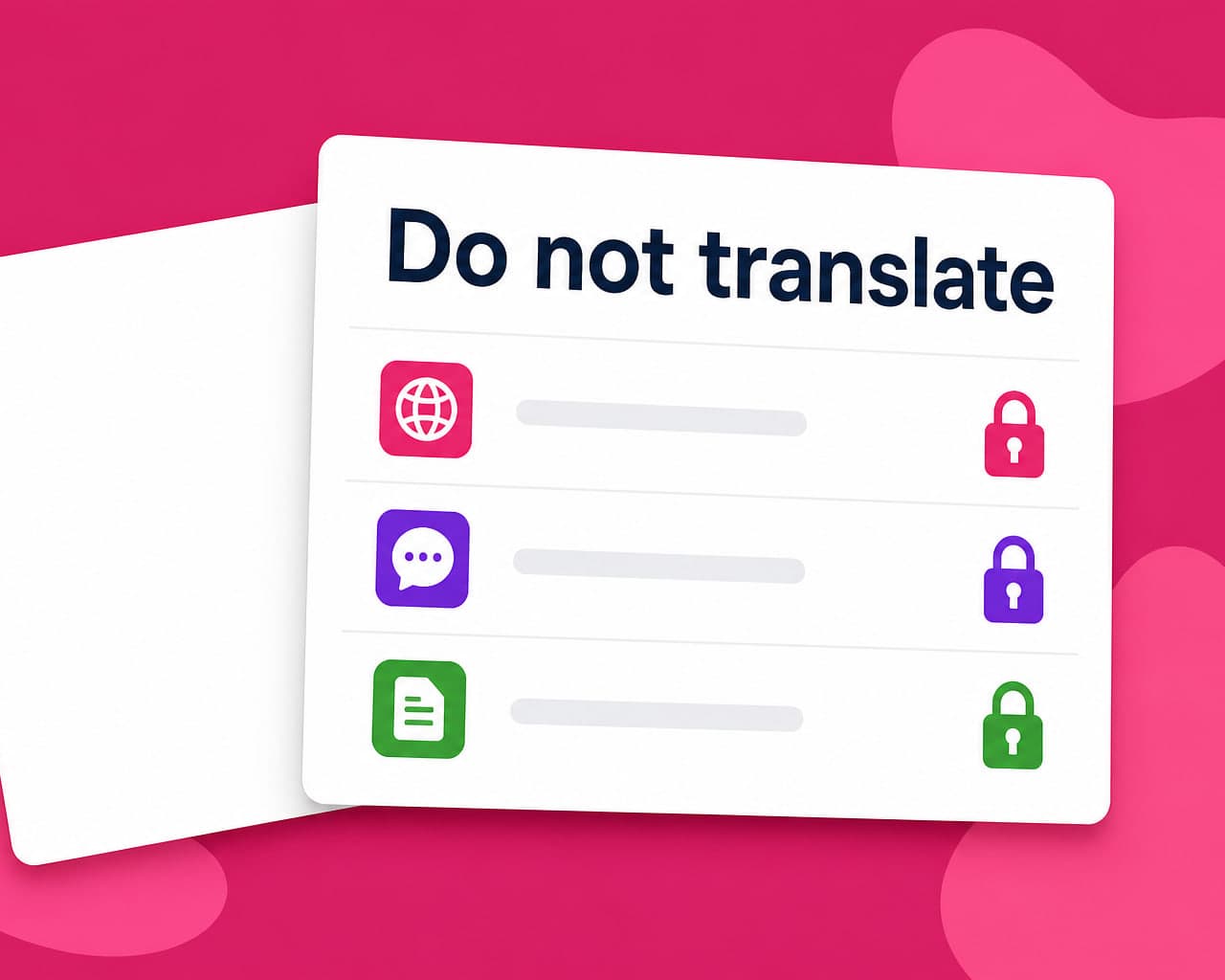
Quick answer — A do-not-translate list names strings that must survive translation unchanged — product names, legal entities, code identifiers, UI labels. It is enforced at translation time, and over-filling it produces text no reader in the market can follow.
Vitra.ai Universe keeps one memory and one quality gate across every format.
The failure it prevents
A translator, human or otherwise, is trying to be helpful. Given a product name that looks like an ordinary noun, the helpful thing is to translate it.
So the product becomes a different product in every market, support cannot find the ticket, and the trademark filing quietly stops matching the marketing.
The fix is a list of strings that must come out the other side untouched.
What belongs on it
| Item | Why |
|---|---|
| Product and feature names | Trademark and findability |
| Legal entity names | A registered name is not a phrase |
| Code identifiers and placeholders | Translating them breaks the build |
| UI labels quoted in help text | Docs must match the button |
| Third-party brand names | Not yours to translate |
| Certification and standard names | Recognised only in original form |
Placeholders deserve particular care. A variable inside a sentence is a token, and a translator who renders it as a word ships a page reading Hello {name} in the literal sense — which is a class of bug that reaches production more often than it should.
Where the list is applied
At translation time, not afterwards.
A protected term resolves identically regardless of context, and a general memory match cannot overwrite it — the same mechanism that makes a glossary binding, pointed at a narrower job.
Checking afterwards means finding the problem in review, which is later and more expensive than not creating it.
The cost of over-protecting
This is where lists go wrong, and it is not obvious until a market complains.
Protect too much and the target text fills with untranslated English. A German page that keeps every feature name, every category label and every descriptive noun in English is not brand protection; it is a page a German reader has to decode.
The test is whether the term functions as a name or as a description. "Asset Manager" as a product name stays. "asset manager" describing what someone does is ordinary vocabulary and should translate.
Hardware brands hit the limit of that test soonest, because model codes and button labels are printed on the object — product naming across markets. Review the list when a market gives that feedback, and keep the decisions in quality control so the same argument is not had twice.
FAQ
What should go on a do-not-translate list? Product and feature names, legal entity names, code identifiers and placeholders, UI labels quoted in documentation, third-party brands, and certification names recognised only in their original form.
What happens if placeholders are translated? The build breaks or the page ships with a literal token visible to users. A variable inside a sentence is code rather than language, and rendering it as a word is a bug that regularly reaches production.
Can a do-not-translate list be too long? Yes, and the symptom is a target page full of untranslated English that a local reader has to decode. Protect terms functioning as names; let descriptive vocabulary translate normally.
How is a do-not-translate list enforced? At translation time, with the protected string resolving identically regardless of context and immune to being overwritten by a general memory match. Checking after the fact catches it later and costs more.