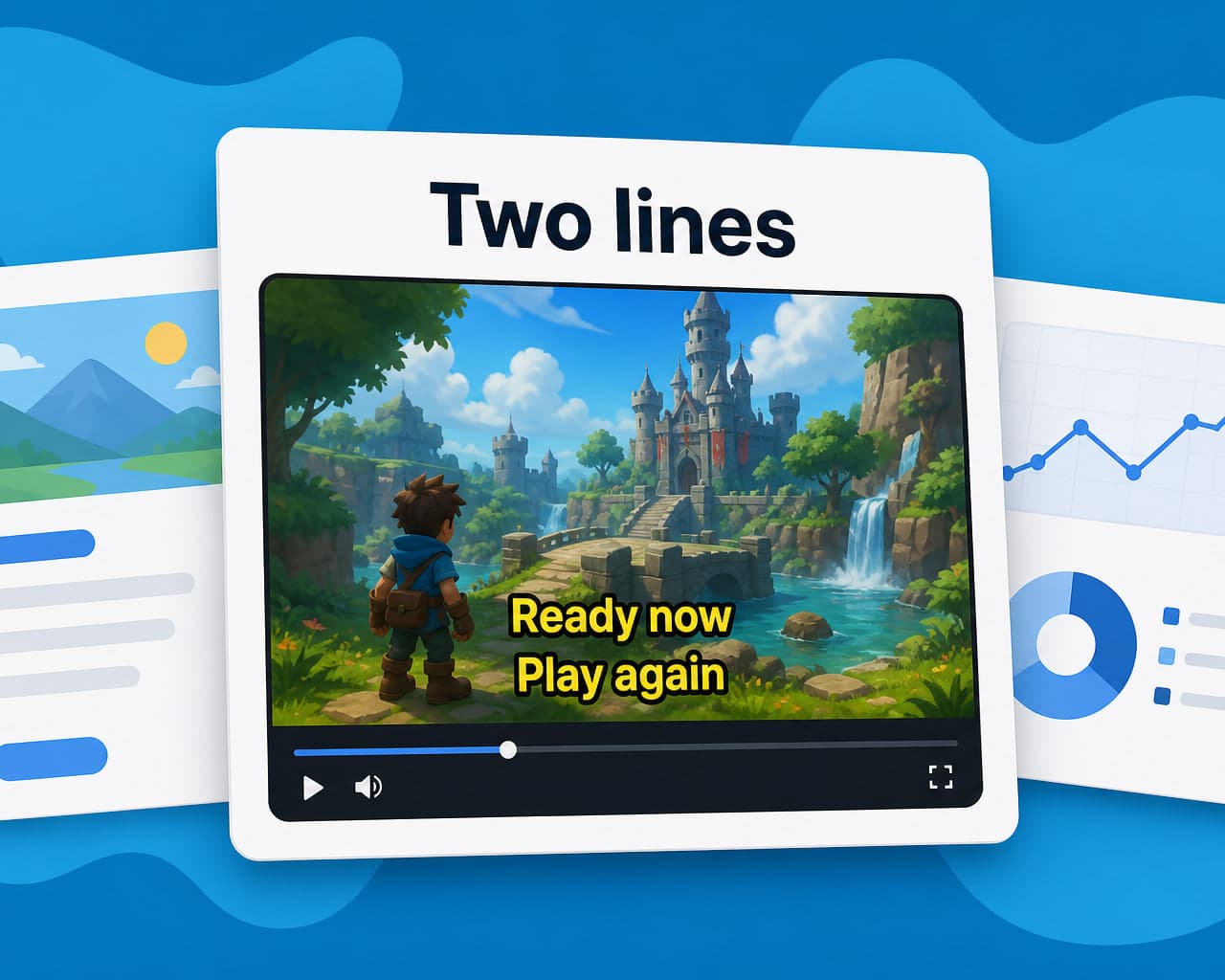
Quick answer — Game subtitles are read by most players, so readability matters more than completeness. Keep to roughly two lines, respect a reading speed players can follow, and never place text where the HUD already sits.
Vitra.ai Universe keeps character voice and terminology intact across every language.
Subtitles are not an accessibility extra
A large share of players turn subtitles on regardless of language, and in many games they are the primary way dialogue is followed at all — during combat, with background audio, or on a handheld in a noisy room.
That means subtitle quality is a mainstream experience decision, not a compliance one.
The readable defaults
| Property | Practical default |
|---|---|
| Lines on screen | Two, rarely three |
| Reading speed | Slow enough to finish before the line changes |
| Line breaks | At clause boundaries, not mid-phrase |
| Position | Clear of HUD, safe area respected |
| Speaker labels | Where more than one character is off-screen |
| Background | A plate or shadow, never text alone on gameplay |
Reading speed is where translation and readability collide. A faithful translation that runs long forces either a faster read than a player can follow or a line that disappears mid-sentence, so translated subtitles have to be condensed rather than complete — the same discipline as dialogue timing.
Condensing is a skill, not a loss
Subtitles are not a transcript. Removing filler, redundancy and repeated names while keeping meaning and character is what makes a line readable at speed. A translator working to a character-per-second budget produces better subtitles than one translating fully and letting the display truncate. The budget has to travel with the line, though. Without it the translator has no way to know the constraint exists, and the condensing decision falls to a renderer that simply cuts at the character limit mid-word.
Options players expect
Size adjustment, a background opacity control, speaker names on or off, and the ability to separate dialogue subtitles from non-speech captions.
Those are settings rather than translation work, but a localization that ignores them delivers text nobody can comfortably read — which wastes the translation budget entirely.
Non-speech information
Captions for meaningful sound — a door behind the player, an approaching enemy — serve deaf and hard-of-hearing players and are frequently the difference between playable and not, which is the distinction covered in video accessibility.
Keep the wording consistent through memory so the same sound is described the same way, and run quality control on the rendered frames rather than the script, because position and overlap are only visible on screen.
FAQ
Do most players use game subtitles? A large share do, including in their own language, because dialogue competes with combat, background audio and noisy environments. Subtitle quality is a mainstream experience decision.
How long should a game subtitle line be? Around two lines, broken at clause boundaries, at a reading speed a player can finish before the line changes. Translated lines usually need condensing to stay inside that budget.
Is condensing subtitles a loss of accuracy? No. Subtitles are not a transcript. Removing filler and repeated names while keeping meaning and character is what makes a line readable at speed, and it produces a better result than truncation.
What subtitle options do players expect? Size adjustment, background opacity, speaker names on or off, and separate control of dialogue subtitles and non-speech captions. Without them the translation cannot be comfortably read.