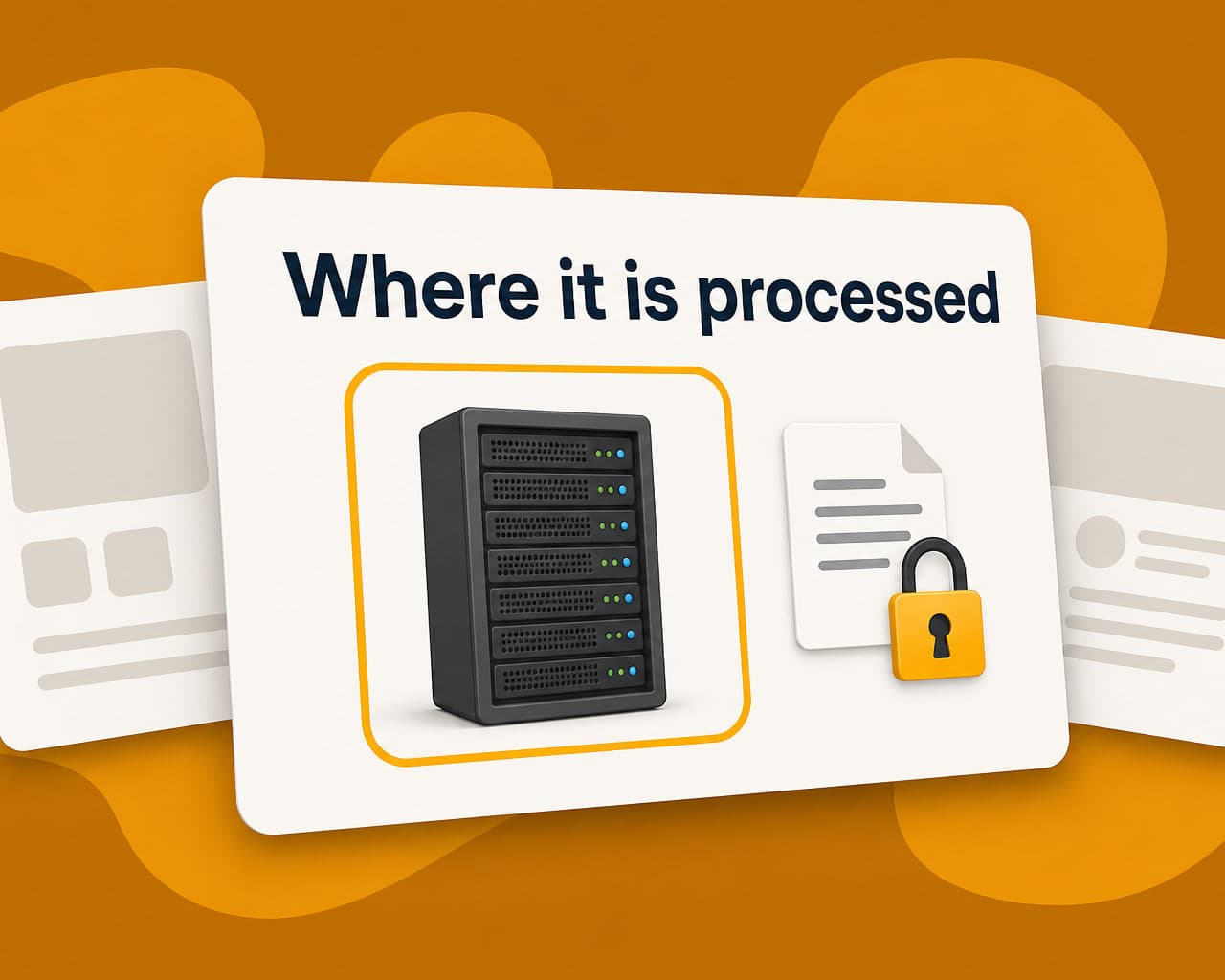
Quick answer — Where records carry personal or classified information, the deciding question is where text is processed rather than translation quality. On-premise and air-gapped deployment keep the data inside your estate.
Vitra.ai Universe runs white-labelled, and on-premise where data cannot leave.
Classification decides the route
For most content, the choice of translation approach is about quality and cost. For sensitive records it is about where the text goes, and that question is settled before any other.
Personal data, case files, health and social care records, security material and anything held under a statutory duty of confidence all constrain processing, and the constraints come from your own rules rather than from a supplier's assurances.
What the deployment options mean
| Option | What it means |
|---|---|
| Public cloud service | Text leaves your estate |
| Dedicated region with residency guarantees | Leaves the estate, stays in a jurisdiction |
| On-premise deployment | Runs inside your own infrastructure |
| Air-gapped deployment | No network path out at all |
| Human translators under contract | People, with vetting and undertakings |
On-premise deployment puts the platform inside your environment, so records are processed on infrastructure you control. Air-gapped operation goes further and removes the network path entirely, which suits material where the boundary is a requirement rather than a preference.
Where the estate can use a hosted service, data residency should be recorded explicitly rather than assumed from a supplier's marketing.
Access control does not stop at the platform
Deployment location is one control. Who can see a record inside the system is another, and translation frequently creates a second copy that inherits weaker controls than the original.
Role-based access, retention rules and audit logging should apply to translated versions exactly as to the source, and the audit trail should record who translated what and when.
Redaction before translation
Where a record is to be released or shared, redaction should happen before translation rather than after.
Translating first and redacting second produces two documents to redact, and a mismatch between them is a disclosure. Doing it in the right order also reduces the volume translated. That saving is real rather than incidental, since releasable material is often a fraction of the file. It also removes any argument about whether a redaction was applied consistently to both versions, because there is only ever one version to redact.
People are part of the perimeter
Where human review is required, the reviewers need the same vetting and undertakings as anyone else handling the record. That is often the practical limit on how much human review is affordable, which is an argument for machine-first processing inside the boundary with review targeted at what matters — the split covered in machine translation. Vetting takes time, and the pool of cleared linguists in any given language is small. Planning around that in advance beats discovering it when a case needs a language nobody on the list covers.
Delivery
Document translation inside the boundary, translation memory held locally so terminology does not require an external service, and quality control producing a record of what was checked.
The platform can also run white-labelled so it appears as your own service to staff and residents.
FAQ
What decides how sensitive records can be translated? Where the text is processed, not translation quality. Personal data, case files, health and care records and security material constrain processing, and the constraints come from your own rules.
What is the difference between on-premise and air-gapped? On-premise runs the platform inside your infrastructure so records stay on systems you control. Air-gapped goes further and removes the network path entirely, for material where the boundary is a requirement.
Do access controls apply to translated copies? They should, and often do not. Translation creates a second copy that can inherit weaker controls, so role-based access, retention and audit logging need to apply to translations exactly as to the source.
Should redaction happen before or after translation? Before. Translating first leaves two documents to redact, and any mismatch between them is a disclosure. Redacting first also reduces the volume that needs translating.