Quick answer — In e-commerce, AI earns its place wherever content changes faster than a person can keep up: product data, variant copy, reviews and seasonal campaigns. It disappoints on the handful of pages that actually close the sale, which still deserve a human read.
Churn is the whole argument
A catalogue is not a website. It is thousands of records that change price, stock and description continuously, and every change invalidates a translation somebody paid for.
That is why e-commerce localization fails on cost rather than quality. A store translating fifty thousand SKUs by hand pays for them again every season, which is unaffordable at any per-word rate. translation memory inverts that: the second season reuses the first one's approved renderings and only genuinely new copy reaches a model at all.
Where AI clearly pays
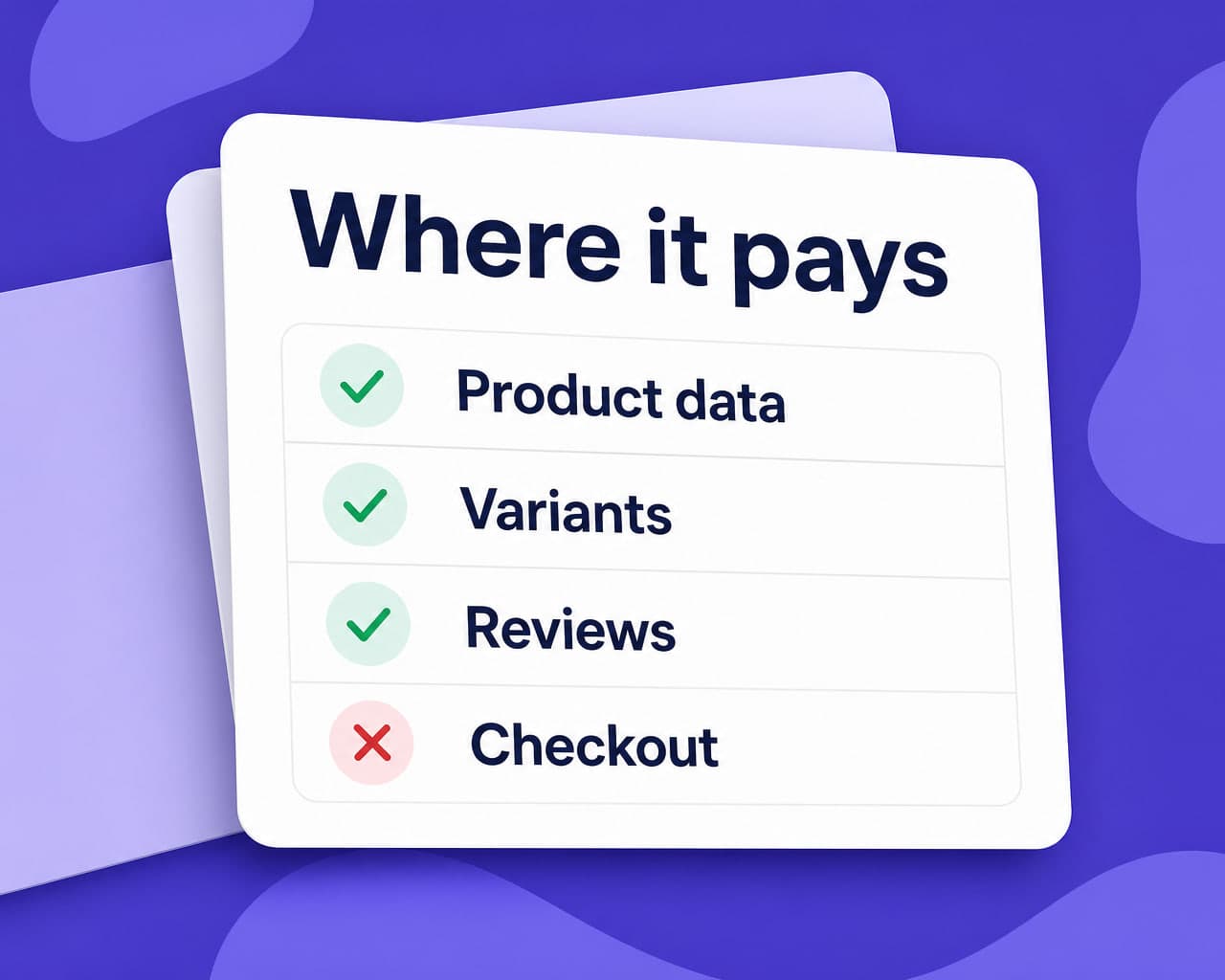
Product titles and attributes, category pages, filter labels, size and care information, shipping and returns copy. High volume, highly repetitive, low individual consequence. Reviews too, which most retailers ignore. A product with forty reviews in a language a shopper cannot read is a product with no social proof.
Where it does not
The five pages that carry the brand: the about page, the sustainability claim, the founder story, the flagship campaign. Those convert on tone, and tone is where machine output is weakest.
Split the catalogue from the brand. Automate the first entirely and review the second properly.
The feed is a different artefact
Marketplace and comparison feeds have schemas, character limits and rejection rules. A translation that overruns a field does not look bad; it fails validation and the listing does not appear. Website translation covers the storefront, but the feed needs its own field-level rules.
The other half is making the assets
Translation assumes the image already exists. Increasingly it does not, because the same catalogue churn that breaks translations also demands fresh creative for every channel and season.
That side splits the same way. AI product photography is reliable for colourway variants and crops and unreliable for a first capture, and the PDP image set is mostly constructions built from two real photographs. Product video comes out of the listing copy you already wrote, and ad creative is the one place volume itself is the point.
Apparel has its own two: ghost mannequin images and on-model imagery, where fit accuracy decides whether the saving survives the return rate.
Where to start
The category pages and product attributes, in your two largest non-English markets, before anything on the brand side.
How startups do this without a localization team covers the operating model, and the platform question covers procurement.
Formats are handled in e-commerce translation.
On whether it moves revenue, see does multilingual content increase sales.
FAQ
Which e-commerce content should be machine-translated? Product titles and attributes, category pages, filter labels, size and care information, shipping and returns copy, and customer reviews. All high volume, highly repetitive and low individual consequence.
Which pages should not be? The handful that carry the brand: the about page, the sustainability claim, the founder story and the flagship campaign. Those convert on tone, which is where machine output is weakest.
Why does catalogue localization fail on cost? Because a catalogue changes continuously, so every price, stock or description edit invalidates a translation already paid for. Translating fifty thousand SKUs by hand means paying for them again every season.
Are product reviews worth translating? Usually yes, and most retailers skip them. A product with forty reviews in a language the shopper cannot read is a product with no social proof at the moment of decision.