Quick answer — A tourism board has no inventory to sell and is measured on arrivals it cannot directly book. That makes its content strategy different from an operator's: build once in the destination's voice, distribute to the trade, and localize per source market.
Image translation and video dubbing let one approved campaign reach every source market without a separate production per language.
You don't own the transaction
An operator localizes to convert a booking. A DMO has no booking to convert. The visit gets sold by an airline, an OTA, a tour operator or a hotel, months later and somewhere else entirely. So the job is different: make the destination legible and desirable in each source market, then hand usable material to everyone who does sell it. Content that only lives on the board's own site is doing half the work.
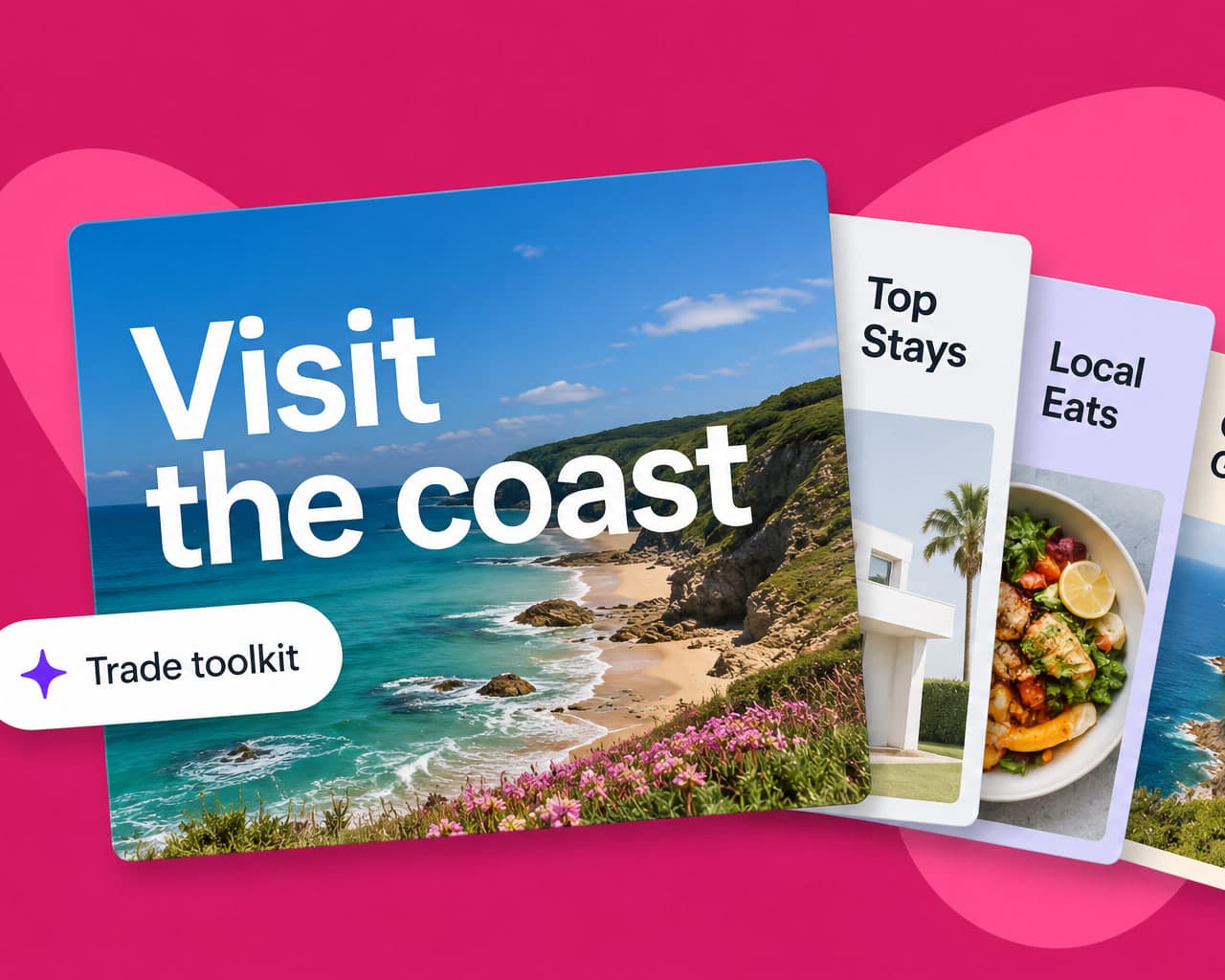
The trade toolkit is the most under-produced asset
Tour operators and travel agents in your source markets sell your destination to their customers, in their language, using whatever they can find.
If the only material you publish is English, you've made every one of them an unsupervised translator. They'll describe your national park, your visa rules and your monsoon season in their own words, and some of it will be wrong. Localized trade material is not a courtesy to the channel — it's how a board controls what's said about it abroad.
Where the budget actually goes
| Asset | Typical treatment | Better treatment |
|---|---|---|
| Hero destination film | One language, sometimes two | Dubbed across all priority markets |
| Trade brochures and fact sheets | English only | Localized per source market |
| Press and media kits | English only | Localized, with captioned video |
| Site and campaign pages | Two or three languages | Every priority market |
| Domestic-market content | Often an afterthought | Usually the largest audience |
That last row is worth staring at.
For most boards, domestic and regional visitors outnumber international arrivals by a wide margin and receive the smallest share of the content budget.
Adapt the destination, don't just translate it
The same beach means different things in different places. A Gulf traveller and a German traveller are not buying the same holiday, and a single film with nine caption tracks quietly assumes they are.
Keep the destination's own voice — that's the asset — and vary what you lead with. Same footage, different edit, different emphasis. Image translation handles the campaign creative inside the design file so the layout survives, and per-market versions come off one approved master rather than nine separate briefs.
Proving it worked
Arrivals data is slow, seasonal and shared with every other factor affecting travel that year. It's a poor feedback loop for a content decision.
Better near-term signals: search interest for the destination by source market, trade portal downloads by language, and video watch-through by market. All three move within a campaign rather than a fiscal year, and all three are attributable to something you actually changed.
FAQ
How is a tourism board's content strategy different from a hotel's? A board owns no inventory and can't convert a booking directly. The visit gets sold later by an airline, OTA or operator, so the job is making the destination legible in each source market and arming everyone who does sell it.
What should a DMO localize first? The hero destination film and the trade toolkit. Operators and agents abroad sell your destination in their own language from whatever material exists, so English-only collateral turns each of them into an unsupervised translator.
Should tourism boards prioritise domestic or international markets? For most boards domestic and regional visitors outnumber international arrivals substantially while receiving the smallest share of the content budget, which usually makes domestic the larger under-served opportunity.
How do you measure destination marketing content? Not on arrivals alone, which are slow and confounded by everything else. Search interest by source market, trade portal downloads by language, and video watch-through per market all move within a campaign.