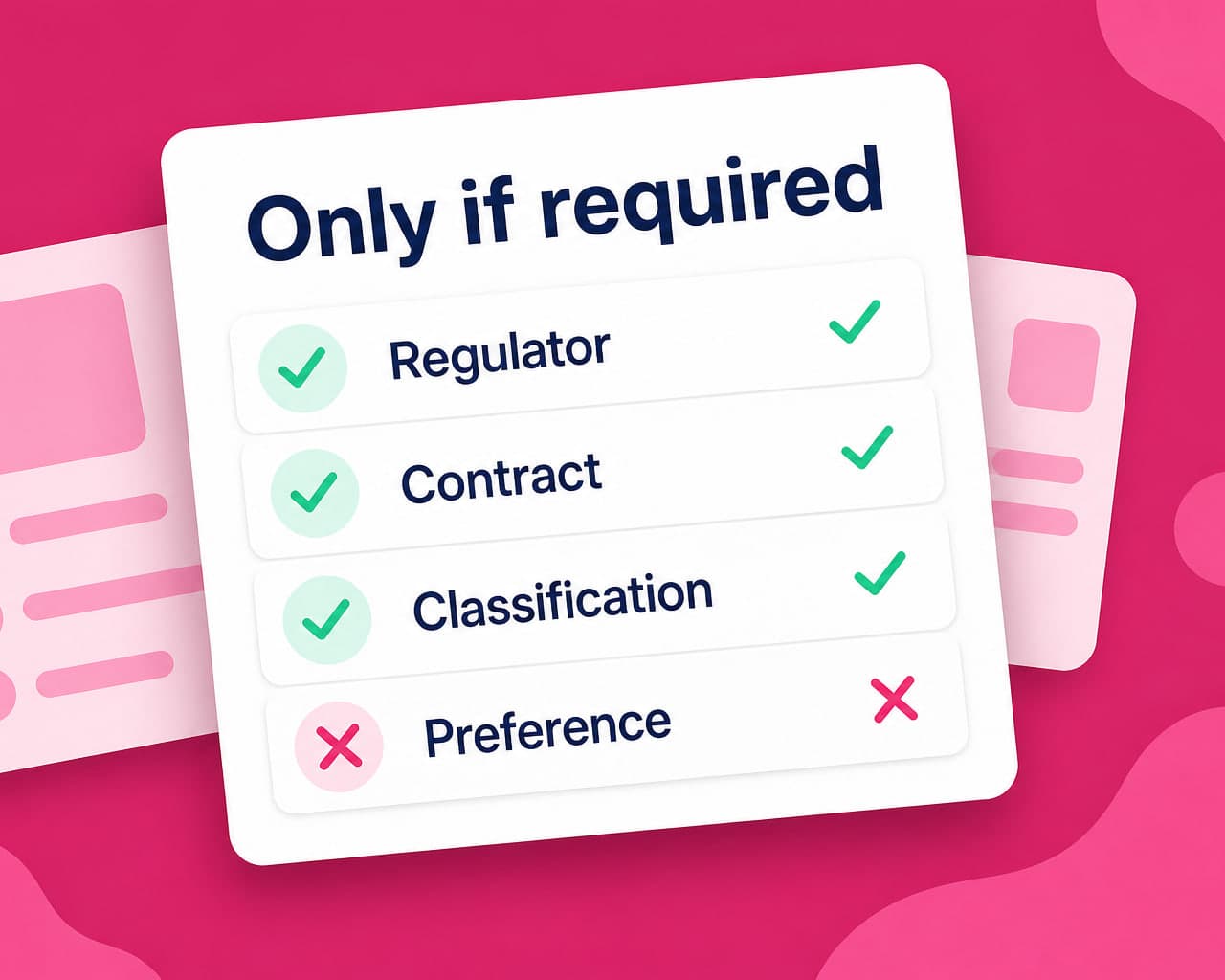

Quick answer — Certification requirements come from whoever receives the document, and they differ by country and by body. Ask the recipient what they accept before commissioning anything, because the terms used for certification are not equivalent across jurisdictions.
Vitra.ai Universe keeps terminology fixed and every change traceable.
The word does not mean one thing
Certified, sworn, official and attested describe different arrangements in different countries, and a document prepared to satisfy one system may not satisfy another. Some jurisdictions maintain a register of authorised translators whose seal is itself the certification. Others accept a signed statement of accuracy from the translator or the agency. Others require notarisation of the translator's signature, and cross-border use sometimes adds a further layer of legalisation. None of that is interchangeable, and assuming it is causes rejected filings.
Ask the recipient first
The only reliable source is the body that will receive the document — a court, a registry, an immigration authority, a university, a counterparty.
| Question to ask | Why |
|---|---|
| What form of certification is accepted | Terms are not equivalent |
| Who may certify | Some registers are closed |
| Is notarisation required | Separate step, separate cost |
| Is legalisation required for foreign use | Adds time |
| Must the original accompany it | Changes logistics |
| Is a digital version acceptable | Increasingly yes, not always |
Asking takes one email. Discovering the answer after a rejection costs a filing window.
Where certification is usually not needed
Most translated material in a commercial matter never goes near a court or a registry.
Internal review documents, due diligence reading sets, correspondence, background material and draft negotiation documents are read for understanding. Certifying those is spending on a formality nobody will look at, and it slows the work down at the point where speed has real value.
The honest split is between documents that must be accepted by an authority and documents that must be understood by a person.
What certification does and does not do
It attests that the translation corresponds to the source. It does not make the translation correct, and it does not transfer legal effect from one system to another.
A certified translation of a contract governed by another system still needs a lawyer qualified there to say what it means locally — the point set out in governing law and jurisdiction.
Preparing the underlying work
Whatever route certification takes, the translation itself benefits from the same discipline as any contract: fixed terminology through translation memory, structure preserved with document translation, and a meaning check rather than a fluency read through quality control.
Certification sits on top of that. It is not a substitute for it. The underlying pipeline is AI content localization.
FAQ
What is a certified translation? It depends on the country. Some systems use registered or sworn translators whose seal certifies the work, others accept a signed statement of accuracy, and others require notarisation or further legalisation.
How do I know which form I need? Ask the body that will receive the document — the court, registry, authority or counterparty. The terms are not equivalent across jurisdictions, so their answer is the only reliable one.
When is certification unnecessary? For material read for understanding rather than filed with an authority, such as due diligence sets, correspondence and draft negotiation documents. Certifying those spends money on a formality nobody checks.
Does certification make a translation legally equivalent? No. It attests that the translation corresponds to the source. It does not make the translation correct, and it does not transfer legal effect between systems.