Quick answer — Translating a GIF means handling every frame that contains text while keeping the animation timing, frame delays and loop behaviour intact. Text that moves or changes across frames is the part that breaks naive approaches.
Frames, not an image
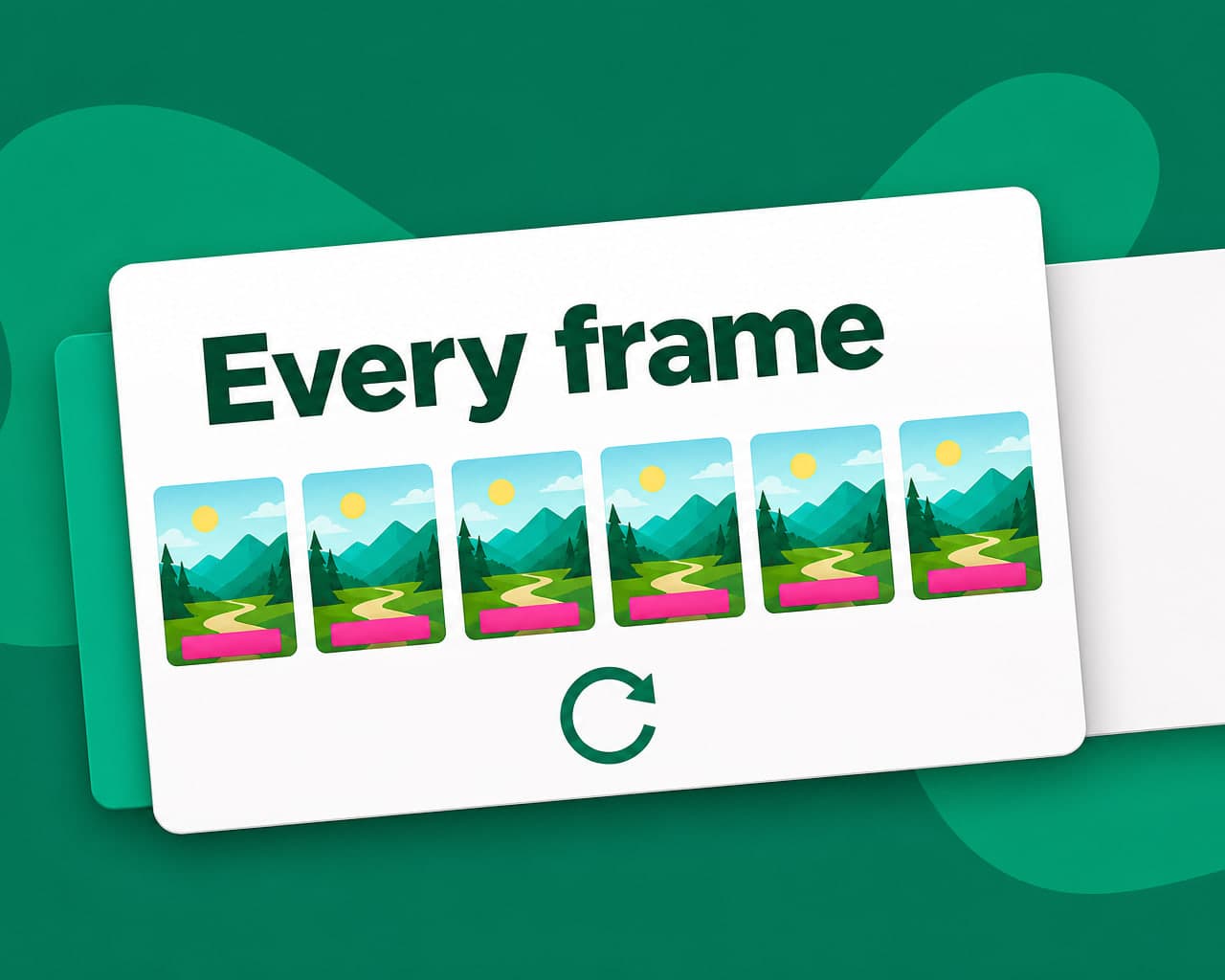
A GIF is a sequence with per-frame delays and a loop setting. Text may sit statically across all frames, appear partway through, animate in, or change entirely. Extracting one frame, translating it and reassembling produces either a static image or an animation where the text jumps. Both are worse than leaving it in English.
What has to survive
| Property | Why it matters |
|---|---|
| Frame delays | Uneven timing reads as broken rather than stylised |
| Loop count | Infinite versus once is a design decision |
| Palette | GIF is limited to 256 colours; re-encoding can band the gradients |
| Transparency | An incorrectly handled index produces a coloured halo |
| Dimensions | Changing them breaks wherever it is embedded |
Expansion is worse here than in a static image
There is no reflow and often very little space. A caption sized to an English phrase has nowhere to go when the German version is a third longer, and shrinking the text in a small animated image quickly makes it unreadable at the size it actually displays.
Shortening the copy is usually the honest answer. A GIF caption is closer to a headline than to a sentence.
Moving text is the hard case
If the text animates — sliding in, fading, changing position — every frame's text must be replaced consistently and the motion must still read as deliberate. This is where automated approaches struggle and where a rebuild from the source file is often cheaper than repair.
Keep the source. A GIF exported from a design file can be re-exported per language; a GIF that only exists as a GIF has to be reconstructed.
Where GIFs actually appear
Product tours and feature explainers in documentation. Email marketing, where video does not play. Social replies. Onboarding hints inside apps.
Documentation is the volume case, and it is also where an untranslated GIF is most obvious — a page fully translated around a small animated image still showing an English interface.
image translation handles the text layer across frames without rebuilding the animation.
Setup notes are on the GIF translation integration page.
When to use a video instead
If a GIF is long, detailed or carries a lot of text, the honest answer is often that it should have been a short video. Video handles subtitles properly, compresses better and does not force text into 256 colours.
Documentation teams reach for GIFs out of habit. For anything over a few seconds, a muted autoplaying video with real captions is cheaper to localize and better to read. Video dubbing then covers the audio if one is ever added.
File size limits still apply
Platforms cap GIF size, and a longer translated string does not change the file size but a re-encode can. Re-encoding with a different palette or dithering setting inflates the file past a limit that the original scraped under.
Check the output size against the destination's limit before shipping a set of translated variants.
Where to start
Find the GIFs embedded in your documentation. They are usually the largest group and the most visibly untranslated.
FAQ
Can text in a GIF be translated? Yes, but every frame containing text has to be handled while preserving frame delays, loop count, palette and transparency. Extracting one frame and reassembling produces a static image or a jumping animation.
Why is text expansion worse in a GIF? Because there is no reflow and usually very little space. A caption sized to an English phrase has nowhere to grow, and shrinking text in a small animated image makes it unreadable at display size.
What if the text moves across frames? That is the hard case. Every frame's text must be replaced consistently and the motion must still read as deliberate, which is often cheaper to solve by re-exporting from the source design file.
Where do untranslated GIFs show up most? In documentation. A page translated around a small animated image still showing an English interface is the most visible version of the problem, and docs are usually the largest group.