
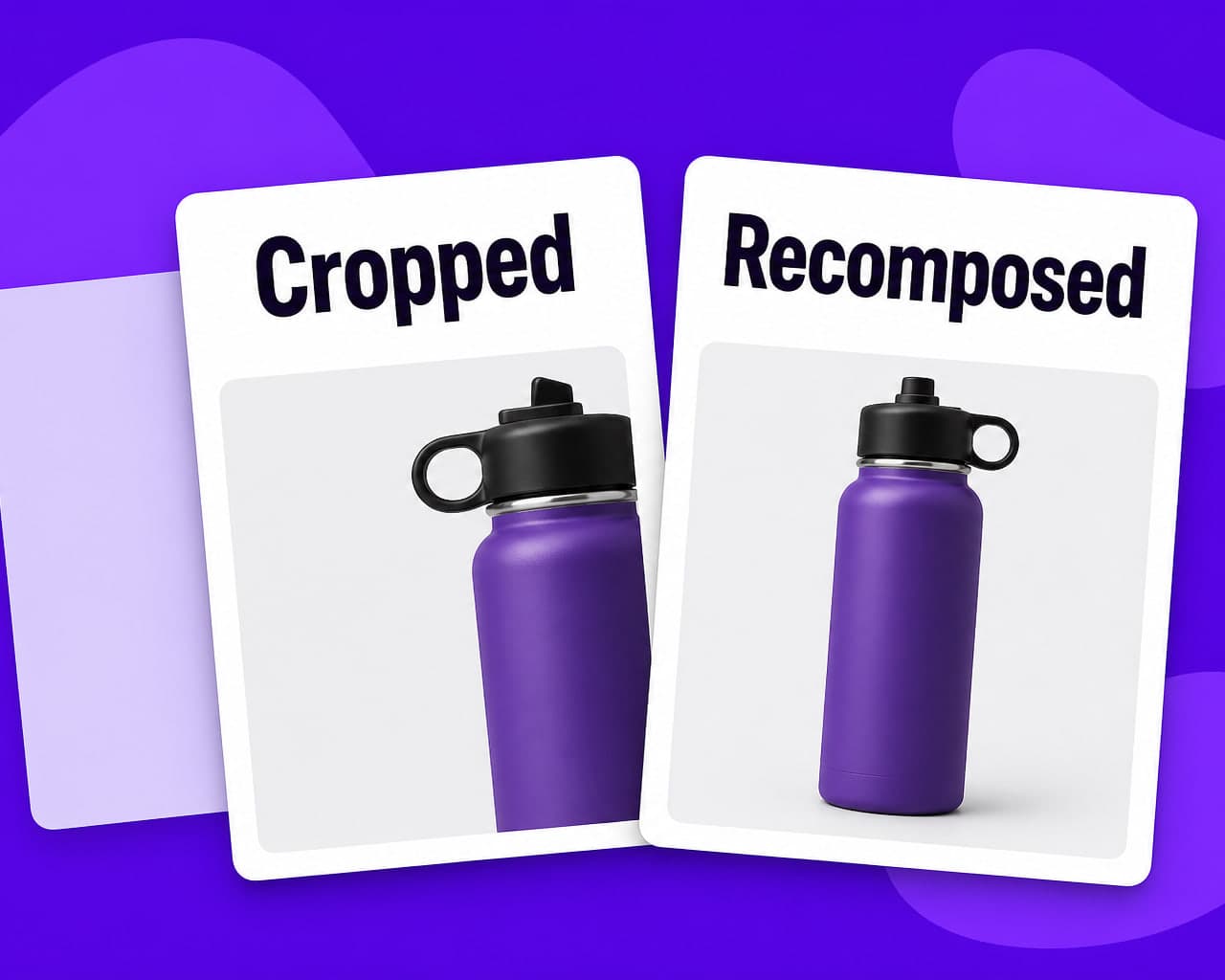
Quick answer — Every channel wants a different aspect ratio, and a plain centre-crop cuts the product out of most of them. Recomposition re-frames the subject for each shape instead, which is the difference between a batch and a redesign.
Vitra.ai Universe generates, adapts and translates the whole set.
A dozen shapes from one file
| Placement | Ratio | The usual trap |
|---|---|---|
| Marketplace main | 1:1 | Below 1000px, zoom silently stops |
| PDP gallery | 1:1 or 4:5 | Inconsistent ratios make the grid jump |
| Instagram feed | 4:5 | Centre-crop clips the top of tall products |
| Stories and Reels | 9:16 | Product ends up tiny in the middle |
| 2:3 | Wide products lose their ends | |
| Google Shopping | 1:1 | Borders and watermarks get the listing pulled |
| Wide | Retina versions double the file weight |
Nothing on that list is difficult. The difficulty is that there are twelve of them per image and several thousand images.
Why the naive resize fails
Centre-cropping assumes the product is in the centre and fills the frame. Catalogue photography frequently has it off-centre, or small in frame with white space around it, because that is what the marketplace main image asked for.
Take that file to 9:16 and you get white space with a fragment of shoe.
Recomposition solves it by finding the subject and re-framing around it rather than cutting from the middle.
Image personalization does this per placement, and it is the only part of the pipeline that genuinely needs to understand the picture.
Padding versus cropping
Two honest options when the ratios fight.
Crop when the product tolerates it and the composition has room. Pad — extend the background rather than adding bars — when cropping would cut the product, which keeps the frame full without inventing anything. Letterbox bars are the one to avoid. They read as a mistake, and on Google Shopping a border can get the listing disapproved outright.
Running it as a pipeline, not a task
The specs change. A channel updates a ratio, a marketplace raises a minimum, and someone has to redo four thousand files.
That is an argument for keeping masters addressable in an asset manager and for triggering the derivatives automatically — agentic workflows firing on upload means new products arrive with every size already made, rather than someone noticing three weeks later that the Pinterest set was never built.
Name the outputs predictably too. Half the time lost here is not processing; it is finding which of six files is the current 4:5. One channel sets harder floors than the rest. Amazon's image requirements are worth reading before the batch runs.
FAQ
Why does automatic image resizing cut the product out? Because a centre-crop assumes the product is centred and fills the frame. Catalogue images are often off-centre with white space, so cropping to a tall ratio keeps the space and loses the item.
What size should marketplace product images be? At least 1000px on the longest side for zoom to work, and 1600px is a safer default. Falling below the threshold disables zoom without any warning on the listing.
Is it better to crop or to pad when ratios do not match? Crop when the composition has room and the product tolerates it. Pad by extending the background when cropping would clip the item. Avoid letterbox bars, which can get listings disapproved on shopping channels.
How should derivative sizes be kept up to date? Generate them from a stored master automatically on upload rather than by hand. When a channel changes its spec, a re-run from the master beats reprocessing thousands of files nobody can locate.