Quick answer — Translated travel pages only rank if each language has its own URL, a self-referencing canonical, hreflang annotation and server-side rendering. Get those four wrong and the pages exist for visitors but are invisible in the market you built them for.
Website translation renders server-side and generates the URL and hreflang structure, so translated pages are crawlable rather than browser-only.
The four things that decide whether a translated page ranks
- Its own URL. A language toggle that swaps text without changing the address gives a crawler nothing to index.
- A self-referencing canonical. Pointing every language at the English original tells Google the others are duplicates.
- Hreflang, with region where it matters.
es-MXandes-ESare different markets buying different trips. - Server-side rendering. Text injected in the browser is text the crawler may never see.
Three of the four are configuration.
The fourth is architectural, and it's the one that quietly kills programmes.
Search terms are not translated terms
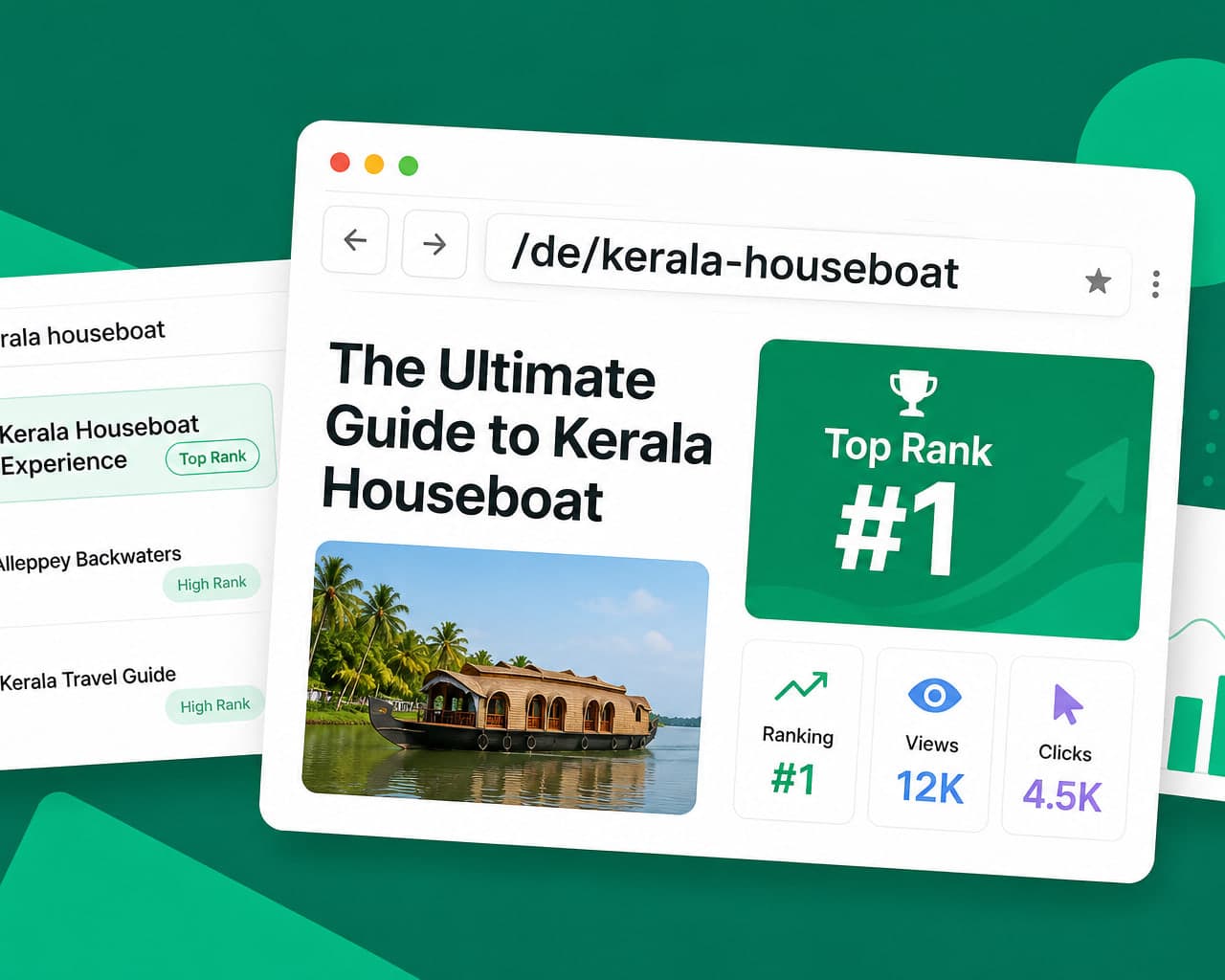
This is where travel goes wrong more than most industries. A German traveller does not search the German translation of "Kerala backwater houseboat tour". They search something closer to "Hausboot Kerala", often alongside a month, because Northern European trip planning starts with when rather than what. Translate your English keyword list and you'll rank for phrases nobody types. Do the research in-market, in the language, and treat the translated page as a page that has to earn its own terms.
What to actually check first
| Check | How | What a failure looks like |
|---|---|---|
| Indexation | Coverage report, by language | Pages exist, none indexed |
| Rendering | Fetch as a crawler, not a browser | HTML has no translated text |
| Canonical | View source per language | All point at the English URL |
| Hreflang | Any hreflang validator | Missing return links |
Indexed pages per language is the first number worth watching. A page that isn't indexed cannot rank, and this is where a canonical mistake shows up in a week instead of a quarter.
The pages travel brands forget
Destination guides get localized. The things people actually search before booking often don't: visa and entry pages, best-time-to-visit pages, getting-around pages, and the FAQ.
Those pull informational traffic months ahead of a booking, which in travel is when the decision is made. They also have to meet accessibility requirements. They're also cheap, because they change rarely — unlike the inventory listings that need a continuous pipeline.
Keeping pages fresh without redoing them
Search rewards pages that stay current, and travel content decays faster than most — a rate, an opening season, a route that no longer runs.
Trigger the update from the change itself rather than a content calendar, and the localized versions stay in step with the source instead of ageing separately.
FAQ
Why don't translated travel pages rank? Usually one of four reasons: no distinct URL per language, a canonical pointing back at the English page, missing or broken hreflang, or client-side rendering that leaves the translated text invisible to a crawler.
Should you translate your keyword list for other markets? No. A German traveller doesn't search the German translation of your English phrase, and Northern European trip planning often starts with a month rather than a destination. Research the terms in-market, in the language.
What is the first multilingual SEO metric to watch? Indexed pages per language, as a share of what you published. A page that isn't indexed can't rank, and the ratio exposes a canonical or rendering fault in about a week rather than a quarter.
Which travel pages are worth localizing for SEO first? Visa and entry, best-time-to-visit, getting-around and the FAQ. They pull informational traffic months before a booking, which is when the decision is actually made, and they change rarely so they stay cheap.