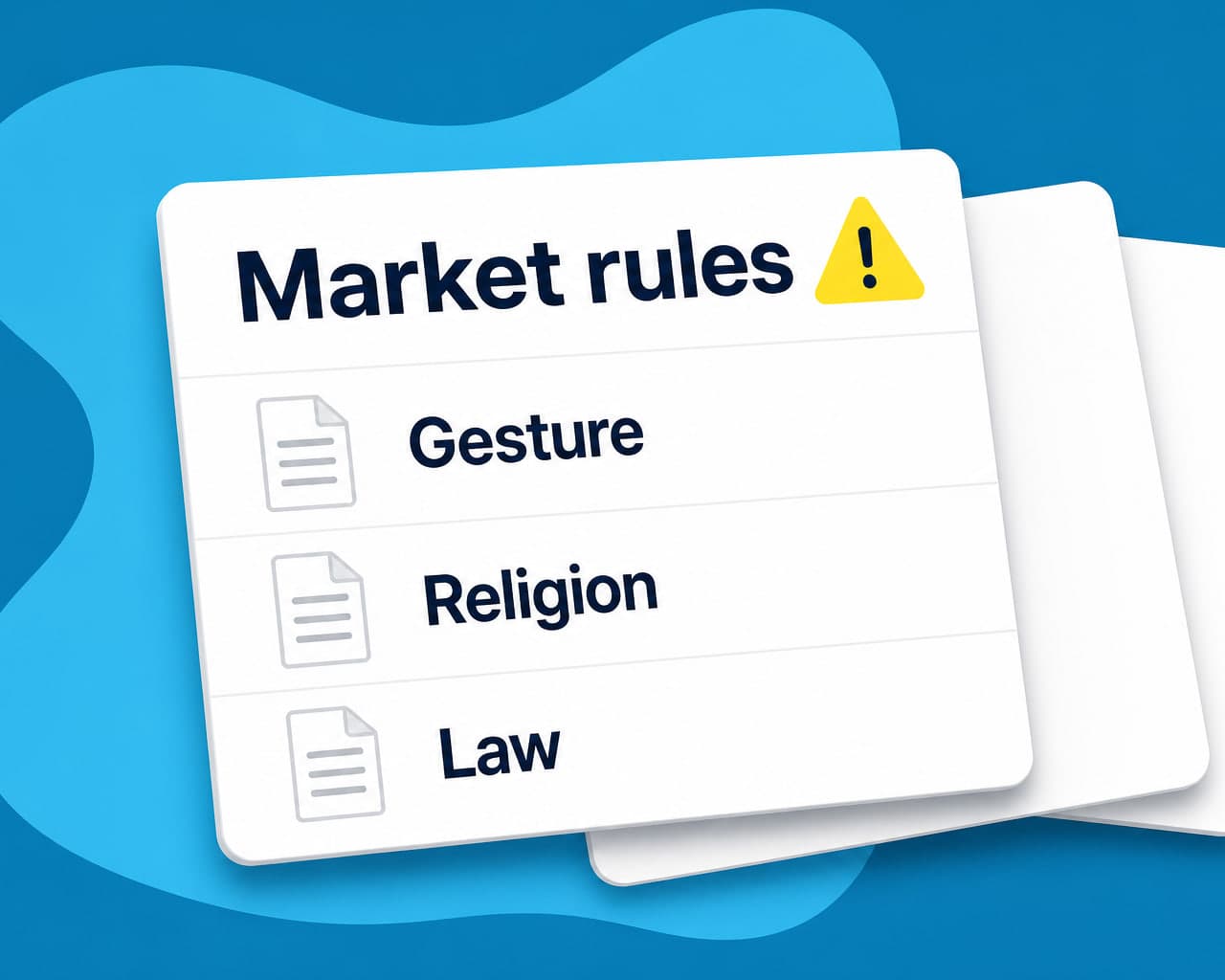
Quick answer — Cultural compliance is the check that asks whether a piece of creative is acceptable in a specific market, as opposed to whether it is explicit. It runs against written per-market rules covering religion, history, gesture, law and stereotype.
Quality control ships with 16 market rule packs and 124 rules.
The definition
Cultural compliance checking scores a piece of content against a written set of market-specific rules. Not a general safety model asking "is this offensive", but a specific question: is this acceptable in Japan, in Poland, in the Gulf?
The distinction matters because the answers conflict. Alcohol in a lifestyle shot is unremarkable in Germany and a problem in Saudi Arabia. A thumbs-up is positive in most of the world and rude in parts of the Middle East.
What the rules actually look like
They are plain-English policy statements, not keyword lists. A few real ones, which give the flavour better than a description:
| Market | Rule |
|---|---|
| Japan | Chopsticks stuck upright in a bowl of rice |
| Germany | Nazi symbols, swastikas, SS runes, Hitler salute |
| Netherlands | Zwarte Piet blackface imagery |
| France | The quenelle inverted-salute gesture |
| Poland | "Polish death camps" phrasing |
| India | Hindu deities on footwear or commercial products |
| Canada | Indigenous heritage treated as a Halloween costume |
The Japanese one is instructive. Chopsticks upright in rice mimics an incense ritual at funerals, so a food photograph that looks fine to a European art director reads as a death omen. No safety classifier catches that. It is knowledge, written down.
Three categories of rule
Legal. Germany's restrictions on Nazi imagery, Thailand's lèse-majesté provisions, Italy's laws on fascist apologia. Breaking these is a criminal matter, not a brand-safety one.
Religious. Depictions of prophets, deities on merchandise, disrespect toward sacred imagery. Frequently also legal, depending on the market.
Social. Gestures, stereotypes, historical sensitivities, caricature. Not illegal, and the fastest way to lose a market's goodwill.
Who writes the rules
Both machine and human, in a deliberate loop. The market packs ship as a starting point. When a check finds a genuine concern that no existing rule covers, it returns a suggested rule — a generalised, reusable statement with no reference to the specific asset — which a person can review and promote into the pack.
Generation and promotion are decoupled on purpose. Candidates are returned for review and nothing is written until someone accepts it, so the rulebook grows under human control rather than drifting.
What it is not
It is not legal advice, and no rule pack replaces counsel in a market where the exposure is criminal. It is also not a substitute for someone from that market looking at the work. What it does is make sure the obvious, documented, repeatedly made mistakes get caught before a campaign ships.
Where to start
Adapting creative per market is the other half of this, and hyperlocal marketing covers it.
Pick the two markets where a mistake would cost most and read their rule packs end to end. It takes twenty minutes and it is the fastest cultural briefing available to a creative team.
FAQ
What is cultural compliance in advertising? Checking creative against written rules for a specific market covering religion, history, gesture, law and stereotype. It answers whether content is acceptable in Japan or Poland, not whether it is explicit.
How is cultural compliance different from brand safety? Brand safety asks a general question about offensive content. Cultural compliance asks a market-specific one, and the answers conflict - alcohol is unremarkable in Germany and a problem in Saudi Arabia.
Can a general AI safety model catch cultural problems? No. Chopsticks upright in a bowl of rice mimics a Japanese funeral rite, so the photograph looks fine to a general classifier and reads as a death omen in market. That is written knowledge, not detection.
Who writes cultural compliance rules? They ship as market packs and grow from use. When a check finds a concern no rule covers it returns a reusable suggested rule, which a person reviews and promotes. Nothing is added automatically.