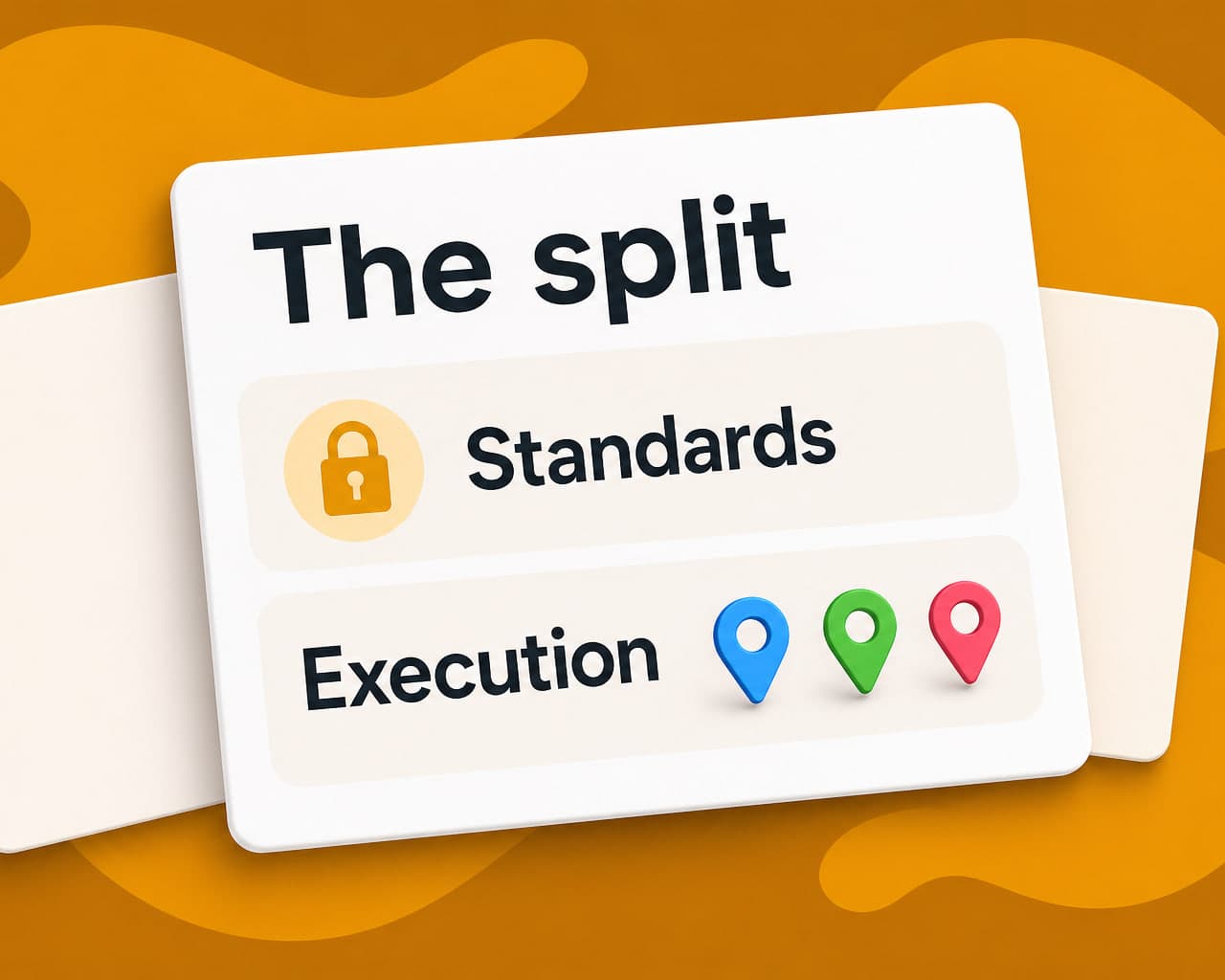
Quick answer — Centralised localization protects consistency and becomes a bottleneck; federated localization moves fast and forks terminology. The workable split is central standards and shared memory, with local execution and approval.
Vitra.ai Universe creates, translates, adapts and publishes from one place.
Both models fail in a predictable direction
A central team owns quality and becomes the queue everyone waits in. Requests are prioritised, markets wait, and regional teams start going around it — which is how a shadow localization process begins. A federated model removes the wait and forks the vocabulary. Six regions each find their own vendor, each builds its own memory, and the same product acquires six descriptions.
Neither failure is a personnel problem. Both are structural, and both are predictable enough to design around.
Split by what benefits from being shared
| Function | Central | Local |
|---|---|---|
| Terminology and glossary | Yes | — |
| Brand voice and style guide | Yes | — |
| Memory | Yes, one | — |
| Tooling and standards | Yes | — |
| Story and content selection | — | Yes |
| Review and approval | — | Yes |
| Vendor and reviewer relationships | — | Yes |
| Publishing decisions | — | Yes |
The rule underneath is simple. Anything that gets better by being the same everywhere is central. Anything that requires knowing a market is local.
Terminology is the clearest central case, because its entire value is consistency. Approval is the clearest local case, because judgement about an audience belongs to someone in it.
What makes federation safe
Shared memory. If every region reads and writes one memory, local execution does not fork the vocabulary — a term approved in Brazil is available in Portugal, and a correction anywhere improves everything.
That single mechanism is what lets you distribute the work without distributing the standards.
What makes centralisation survivable
Not being the queue.
Central owns the rules and the platform; regions run their own workflows inside them without filing a ticket. If a regional lead can set up an approval chain themselves, the central team stops being a dependency and becomes infrastructure.
Quality control then enforces the standards automatically, which is the only version of enforcement that scales — a central team cannot read everything, and a standard nobody checks is a suggestion.
Most organisations land here eventually. Getting there deliberately is considerably cheaper than getting there after the shadow process appears. Dealer and distributor networks are federated by construction — automotive campaign localization.
FAQ
Should localization be centralised or federated? Split it. Terminology, brand voice, memory and tooling are central because their value is consistency. Content selection, review, approval and vendor relationships are local because they require knowing the market.
How does a central localization team become a bottleneck? By owning the queue as well as the standards. When every request is prioritised centrally, markets wait, and regional teams start going around the process, which creates a shadow pipeline.
What goes wrong with fully federated localization? Terminology forks. Each region finds its own vendor and builds its own memory, so the same product ends up with several different descriptions across markets.
What makes federated localization safe? One shared translation memory. Local teams execute independently without forking vocabulary, because a term approved in one market is immediately available in another and corrections propagate.