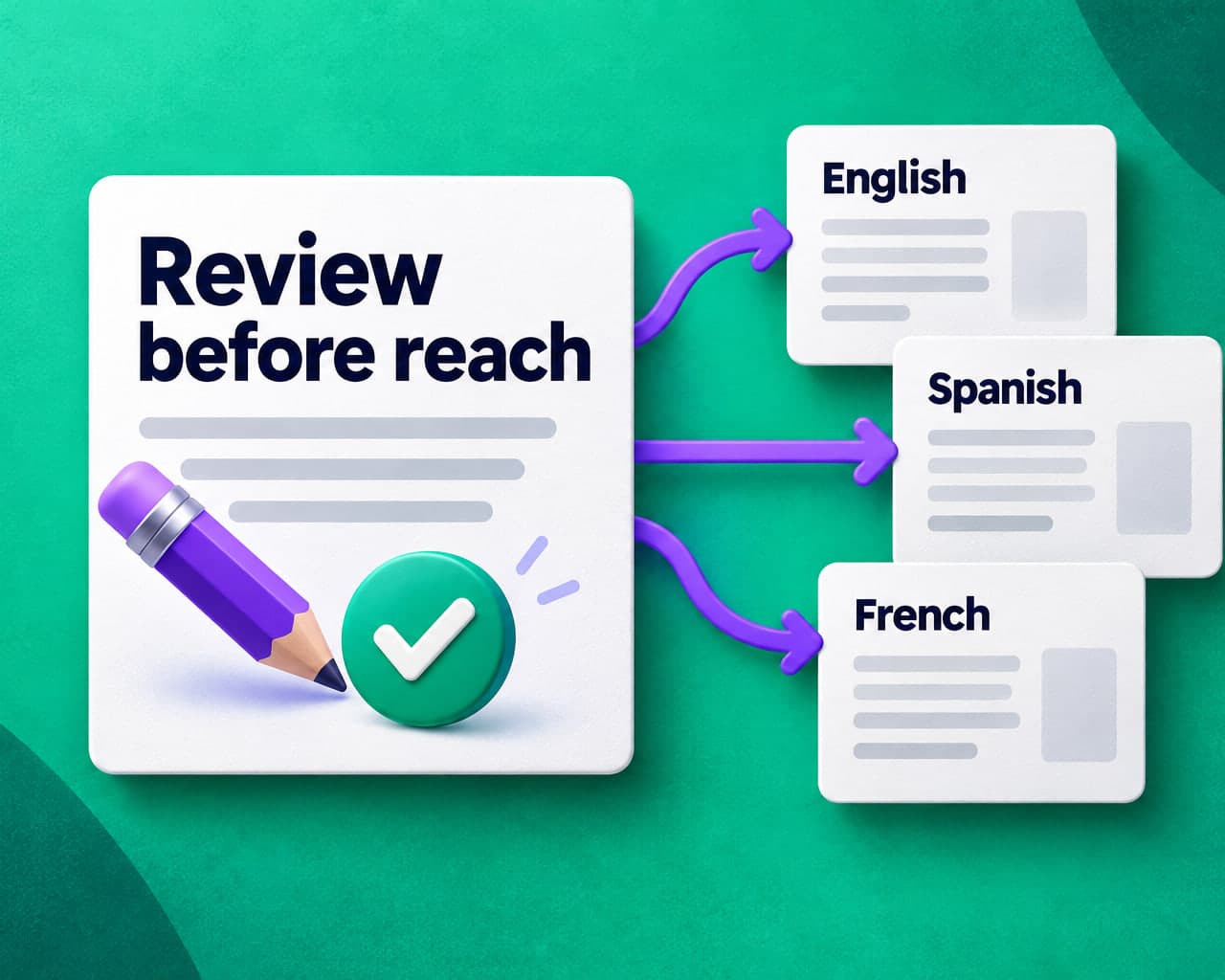
Quick answer — A multilingual blog workflow starts with a useful source article and human review. Translate it with product context and approved language resources, review each language version, and keep the versions connected when the source changes.
Vitra Universe connects blog creation, blog translation, and editorial planning with shared context and review.
Start with a question the reader actually has
“We need ten articles this month” is a capacity decision, not an editorial idea. A useful article starts with a question and an answer your team is qualified to give.
Take a collaboration product. Buyers might ask whether guests need paid accounts. A generic article about the future of teamwork won't answer that. A clear explanation of guest access, limitations, and examples might. The product team supplies the facts; the editorial team makes them understandable. AI can help organize a draft, but neither the topic nor the expertise should be invented to fill a publishing slot.
Before adding an article to the calendar, write its purpose in one sentence: “After reading this, an account administrator should know how guest access affects their rollout.” If you can't write that sentence clearly, the brief probably isn't ready.
Give the draft a source of truth
A strong AI-assisted brief includes product facts, audience, source material, the reader's question, and the claim the article must support. Add writing guidance and relevant examples. Keep the evidence close enough that an editor can check it.
Don't use a target keyword as a substitute for substance. It helps define what someone may search for, but it doesn't tell you what your answer should be. The same applies to search intent: a person comparing tools needs decision criteria, while someone trying to fix a file needs working instructions. Those are different articles, even if they share vocabulary.
Vitra's blog creation workflow can use selected memories, prompts, and brand context. Treat the output as an editable draft. Read the whole piece, verify the examples, remove unsupported claims, and make sure it answers the question before expanding it into other languages.
Review the source before multiplying it
One mistaken feature claim in English can become the same mistake in several languages. Translation doesn't repair the premise.
Separate the checks. A subject expert verifies the facts. An editor checks the argument and clarity. A brand reviewer checks voice where needed. One person can hold several responsibilities, but the responsibilities should remain explicit. “Looks good” isn't enough when the article includes a pricing statement, technical instruction, or safety claim.
Google's people-first content guidance emphasizes useful, reliable content for readers. A large volume of interchangeable articles isn't the goal. A smaller collection of answers grounded in real expertise is a more sensible starting point for a brand that wants to be trusted.
Translation and local relevance are separate checks
An accurate translation can still be unhelpful in a different market. The article might use an unavailable product example, link to an English-only help page, or discuss a question local buyers don't ask in that way.
Give the local reviewer the original purpose, not just the text. Explain which claim must stay unchanged and which examples can be adapted. Use the same product terms and protected names as your other content, but allow natural local phrasing. If the local reviewer needs to change the argument itself, resolve that with the source owner rather than quietly publishing a different claim.
| Stage | Owner's question | What gets checked |
|---|---|---|
| Source brief | Is this worth answering? | Reader need, product facts, evidence |
| Source review | Is our answer correct? | Claims, examples, instructions, voice |
| Translation | What should the local reader understand? | Meaning, terminology, audience context |
| Local review | Does it work in this market? | Examples, links, conventions, finished copy |
| Site release | Can people and search engines find it? | Language URLs, metadata, links, annotations |
| Update | Which versions are affected? | Changed facts, language drafts, renewed approval |
Vitra TMS supplies the language-resource layer: adaptive memory, terms, glossary, style, and context. Blog translation keeps the language work connected to the article. The reviewer still decides whether it is ready for the audience.
Set up the public language versions deliberately
Your CMS and website need to deliver the translated article properly. A translated draft in a workspace isn't yet a multilingual page that a search engine can discover.
Google's multilingual-site guidance recommends distinct URLs for language versions and language annotations such as hreflang. Let readers switch language explicitly, and keep the page's main content and navigation understandable in that language. Avoid a setup that only swaps boilerplate while leaving the article unchanged.
Check the actual URL, title, description, internal links, and language annotations before release. Review local search wording rather than mechanically translating the English keyword. These are practical site checks, not a promise of rankings or traffic.
Keep the calendar close to the work
A calendar should show more than the publication date. It should make the next owner and review step clear.
For a small team, start with a topic, source owner, draft date, reviewer, target languages, and release decision. Don't schedule twenty translated posts if there is nobody available to check them. Generation capacity and editorial capacity are not the same thing. Universe's content calendar connects planning to creation and translation; use that connection to organize a realistic cadence rather than increase volume for its own sake.
At the end of the job, keep the article and supporting assets together. Export to the format your CMS actually accepts. Confirm a connector's scope before relying on automatic publication; not every content system has the same native integration.
Plan for the update before the first release
Most workflow diagrams stop at publish. Product content doesn't.
If guest access changes, the English article, translated versions, screenshots, and related tutorial may all need attention. Keep a record of which source version was reviewed and which local versions depend on it. An updated draft should not look like it still has the previous approval.
This is the lasting value of a connected multilingual workflow. The team knows what changed, who should check it, and which versions are safe to use. AI can help with the repeated production work; the editorial system keeps the meaning accountable to people.
FAQ
Should we translate a blog article before reviewing the source? Review the source first. An inaccurate claim becomes an inaccurate claim in several languages. Check the argument, evidence, product facts, and examples before creating language versions.
Does translating blog content automatically improve SEO? No. The article must be useful for the local audience, and the site needs crawlable language URLs, appropriate metadata, internal links, and correct language annotations. Translation alone does not guarantee traffic or rankings.
What happens when the source article changes? Identify which language versions depend on the changed facts or instructions, update them from the current source, and review the affected wording. Keep the previous approved version distinguishable from the new draft.