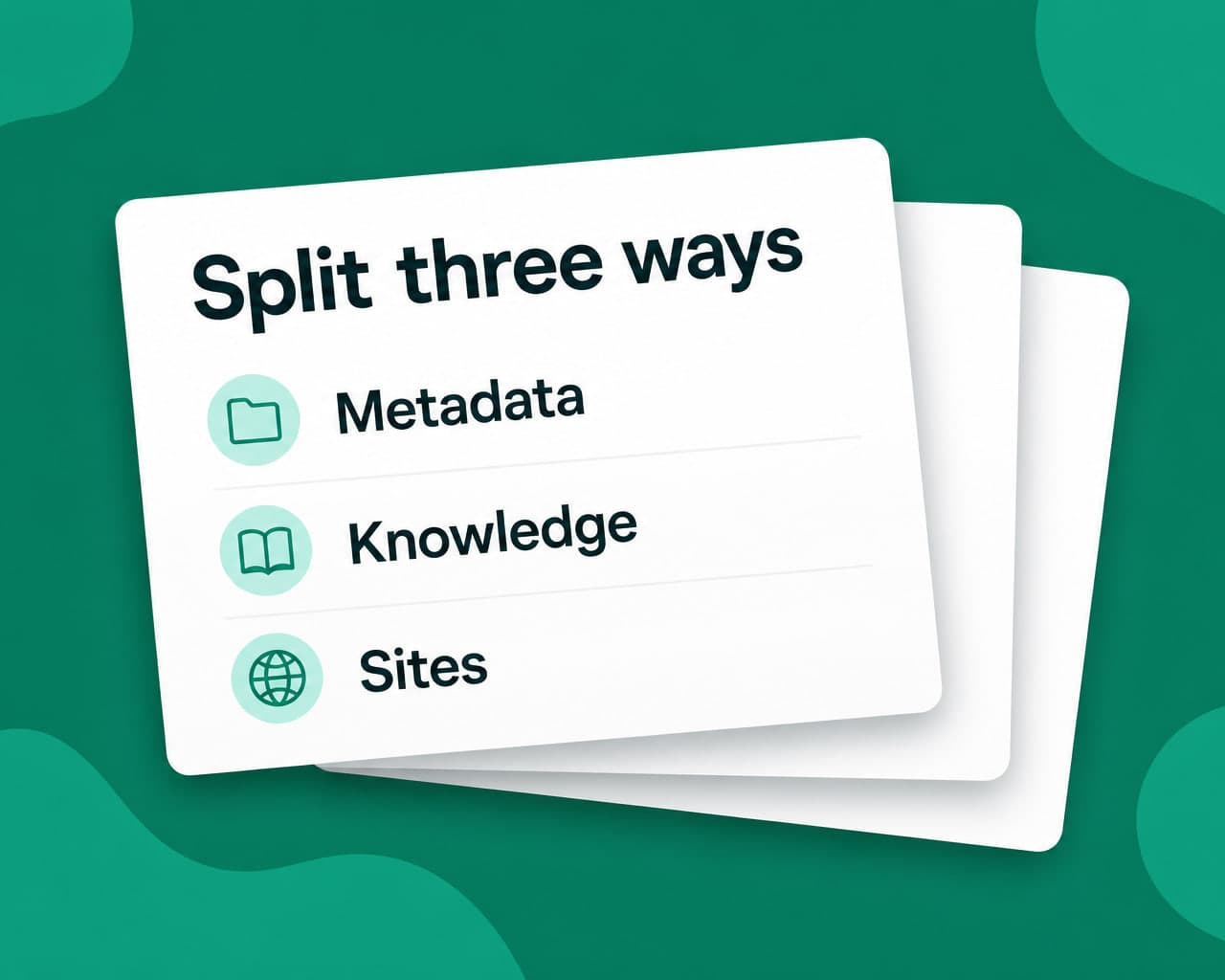
Quick answer — Salesforce splits translation across several systems: the Translation Workbench for metadata and custom labels, article translation for Knowledge, and separate handling for Experience Cloud sites. Each has its own scope and none covers the others.
Four separate translation surfaces
Metadata via Translation Workbench. Field labels, picklist values, record type names, help text. Anything an admin configured. Custom labels. Strings developers put in code so they would not be hard-coded. These are the reason a well-built org can be translated at all.
Knowledge articles. A full content type with its own translation lifecycle, draft states and publishing.
Experience Cloud. Customer-facing sites and portals, with their own pages, components and CMS content.
An org can have perfect Workbench coverage and a Knowledge base entirely in English, because the two are unrelated systems that happen to live in the same tenant.
Picklist values are the sharp edge
A picklist has an API name and a label. The API name is what integrations, reports and automations reference; the label is what a user sees.
Translate the label. Never the API name. Changing an API name breaks every report, flow and integration that references it, and the breakage surfaces somewhere unrelated days later.
Knowledge is where the volume is
A mature Knowledge base runs to thousands of articles and it is the thing customers actually read. It also has a translation lifecycle of its own: an article version can be published in English and draft in French, and the routing rules decide what a customer sees when their language has no published version. Decide that fallback behaviour deliberately. The default is often to show nothing, which is worse than showing English.
document translation handles the article bodies and translation memory keeps product terminology identical across thousands of them, which manual review across that volume cannot.
Hard-coded strings are the ceiling
Anything a developer wrote directly into Apex or a Lightning component instead of a custom label cannot be translated through any of these systems. It needs a code change first.
Audit for that before promising a timeline. It is the constraint that most often turns a two-week Salesforce localization into a quarter.
Experience Cloud is its own project
Portal pages, community content, self-service flows and email templates. Closer to translating a website than to translating an org, and worth scoping separately.
Supported objects and setup are on the Salesforce integration page.
Flows, validation rules and error messages
A validation rule's error message is user-facing text stored in metadata, and so is the error text in a Flow. Both appear at exactly the moment a user is already stuck.
They are covered by the Workbench, and they are routinely skipped because nobody lists them as content. An English validation error on a translated form is worse than an English form, because it arrives at the point of failure.
Reports, dashboards and list views
Report names, dashboard titles and list view labels are configuration and are translatable. Whether they should be depends on who uses them — an internal sales team may prefer one shared vocabulary, and translating those can make a global org harder to run rather than easier.
Where to start
Run a custom-label audit. The proportion of user-facing strings that are labels rather than hard-coded tells you whether this is a configuration project or a development one.
FAQ
What does the Salesforce Translation Workbench cover? Metadata an admin configured — field labels, picklist values, record type names and help text — plus custom labels. It does not cover Knowledge articles or Experience Cloud, which are separate systems.
Should picklist API names be translated? Never. The API name is what reports, flows and integrations reference, so changing it breaks them and the failure surfaces somewhere unrelated days later. Translate the label only.
How does Salesforce Knowledge handle translation? As a full content lifecycle with its own drafts and publishing, so an article can be published in English and draft in French. Decide the fallback deliberately, because the default often shows nothing rather than English.
What limits how much of Salesforce can be translated? Hard-coded strings. Anything written directly into Apex or a Lightning component instead of a custom label needs a code change first, and auditing for that is what separates a two-week project from a quarter.