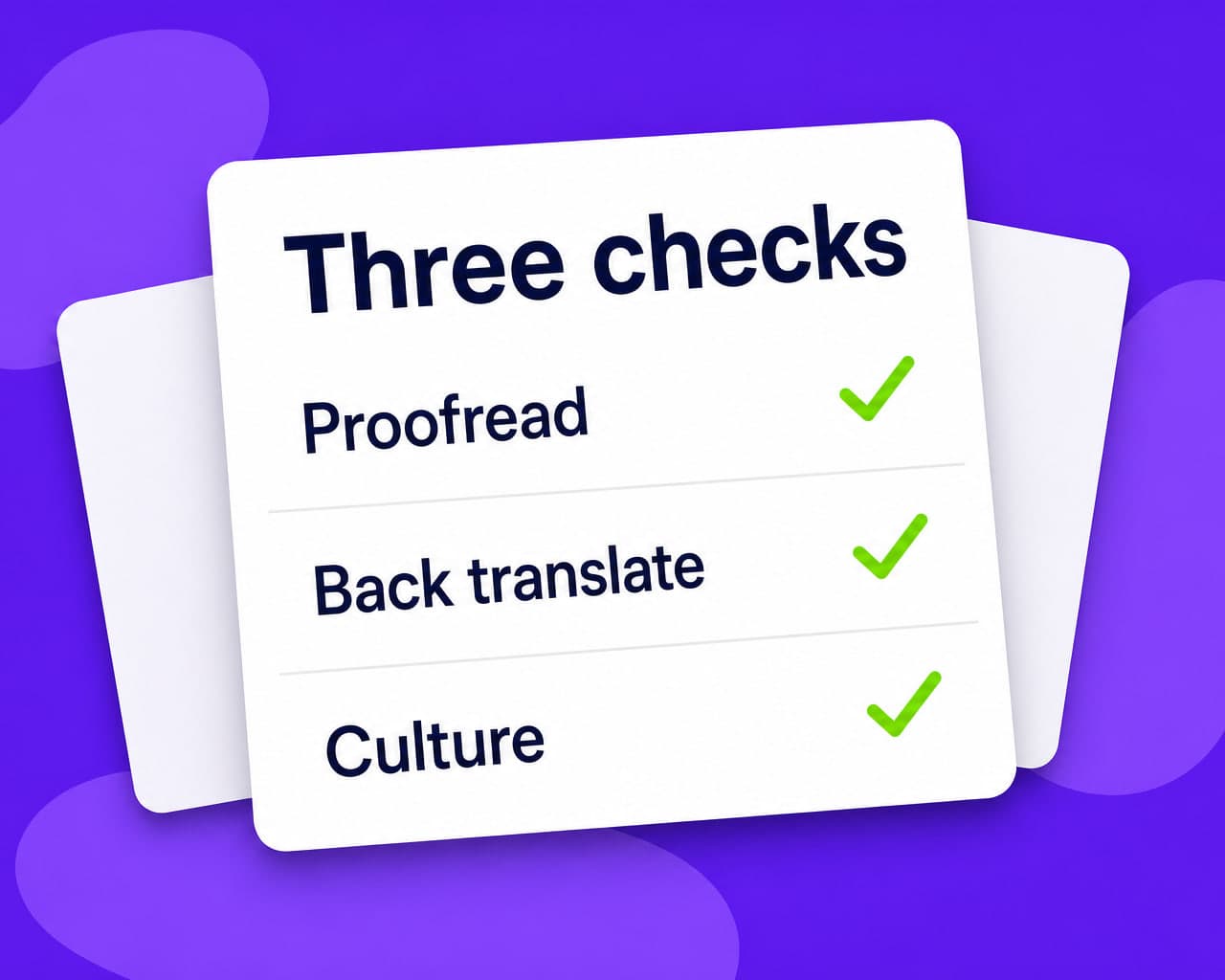
Quick answer — AI translation quality assurance runs three checks before content ships. A proofreading agent reads as a language and subject-matter expert, a back-translation agent catches meaning drift mechanically, and a cultural rule engine scores per region — returning approved, review or blocked with reasons.
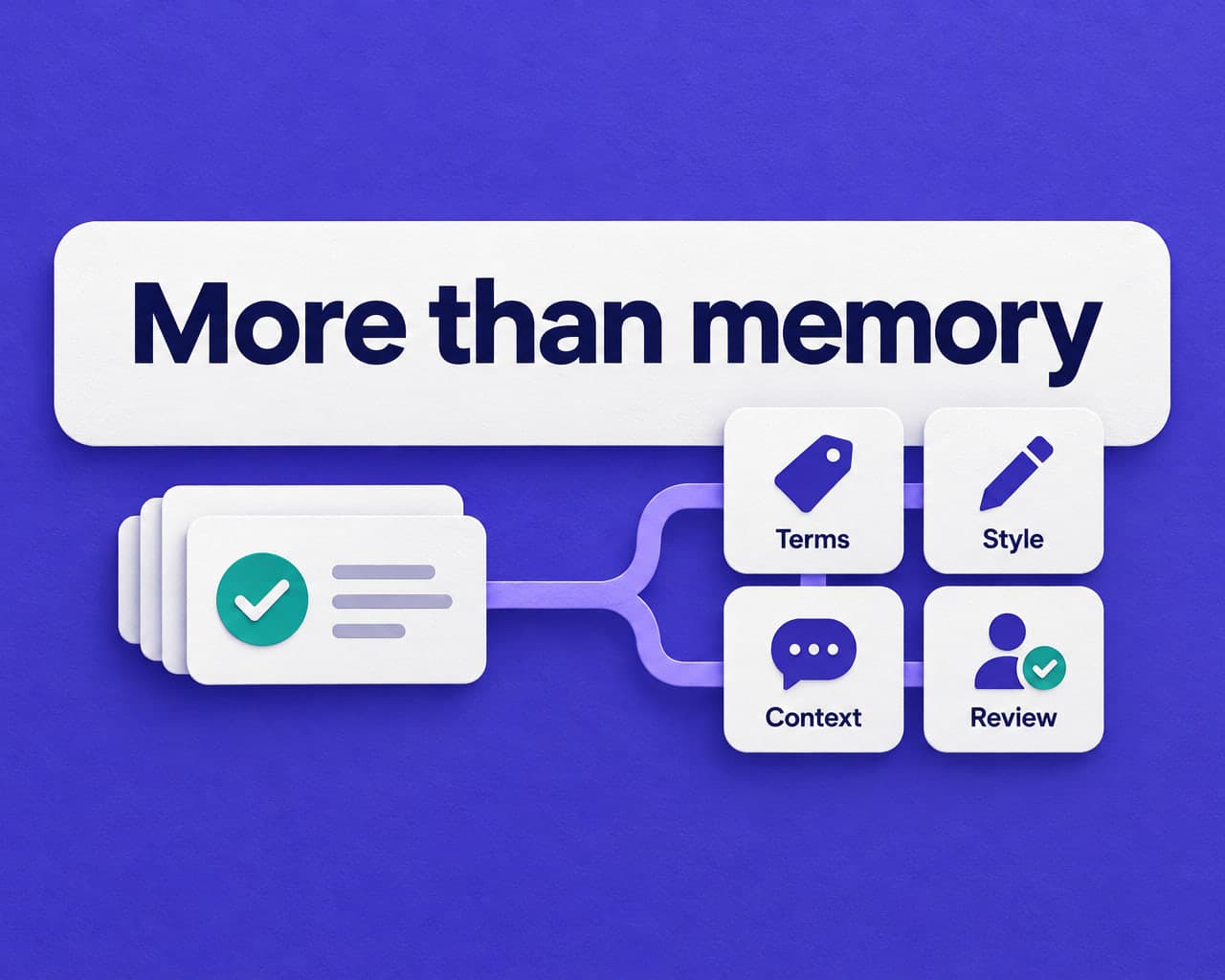
Vitra.ai Universe keeps one memory and one quality gate across every format.
A score tells you nothing you can act on
Most quality tooling returns a number. Eighty-seven out of a hundred. Then somebody has to decide whether eighty-seven is good enough to publish, and nobody knows, so either everything goes to review or nothing does.
The useful output is a decision plus the evidence behind it. Quality control returns approved, review or blocked, with the specific findings that produced the call — which is a thing a workflow can route on and a person can argue with.
The three agents, and what each is for
| Agent | Catches | Misses |
|---|---|---|
| Proofreader | Grammar, register, domain error | Meaning that drifted but reads well |
| Back-translator | Meaning drift | Style and tone |
| Cultural rules | Region-specific offence, claims, imagery | Ordinary language errors |
The proofreading agent reviews as both a language expert and a subject-matter expert. That second role is the one a generic grammar checker cannot fill: a sentence can be flawless English and still be wrong about what a policy excludes or what a dosage means.
The back-translation agent translates the output back and compares it to the source. Drift gets caught mechanically rather than by a reviewer happening to notice, which matters because drift is exactly the failure a fluent translation hides. It is covered in more depth in back translation.
The cultural rule engine scores content per region with severity weighting. A claim that is ordinary in one market needs substantiation in another, and an image that is unremarkable in one is not in the next.
It runs on more than text
The checks are multimodal, which is the part people miss. Image QC for brand and quality, text QC for accuracy and tone, audio QC for voice and dubbing, and video QC for translation inside the finished cut.
A stack that checks text and ships the dubbed video unchecked has verified the cheapest asset and skipped the expensive one.
From verdict to fix
A flagged image can be regenerated into a compliant version for that region straight from the decision, instead of rejoining a design queue two weeks out.
Everything else routes to a person, and it should — this replaces the mechanical pass, not the judgement. Where the reviewer band belongs is a separate decision, covered in human translation review. Corrections write back to translation memory, so a fault found once is not found again. That is what makes the check compound instead of repeating.
FAQ
What does AI translation quality assurance actually check? Three things in parallel: language and domain correctness through a proofreading agent, meaning drift through back-translation, and region-specific risk through a cultural rule engine with severity weighting.
Why return a verdict instead of a quality score? Because a number is not actionable. Approved, review or blocked with the findings behind it can be routed by a workflow and challenged by a person, where a score of 87 leaves the publish decision unmade.
Can automated checks review video and images, not just text? Yes. Image checks cover brand and quality, audio covers voice and dubbing, and video covers translation inside the finished cut. Checking only text verifies the cheapest asset and skips the costliest.
Does automated QA remove the need for human reviewers? No. It removes the mechanical pass so reviewers see fewer, better-prepared items. Anything with legal, medical or contractual consequence should still reach a person before it publishes.