US Banking Translation Rules, State by State
Four federal regulators, fifty state ones, and only a handful of rules that name a language. Where the duty is real and where it is only exposure.

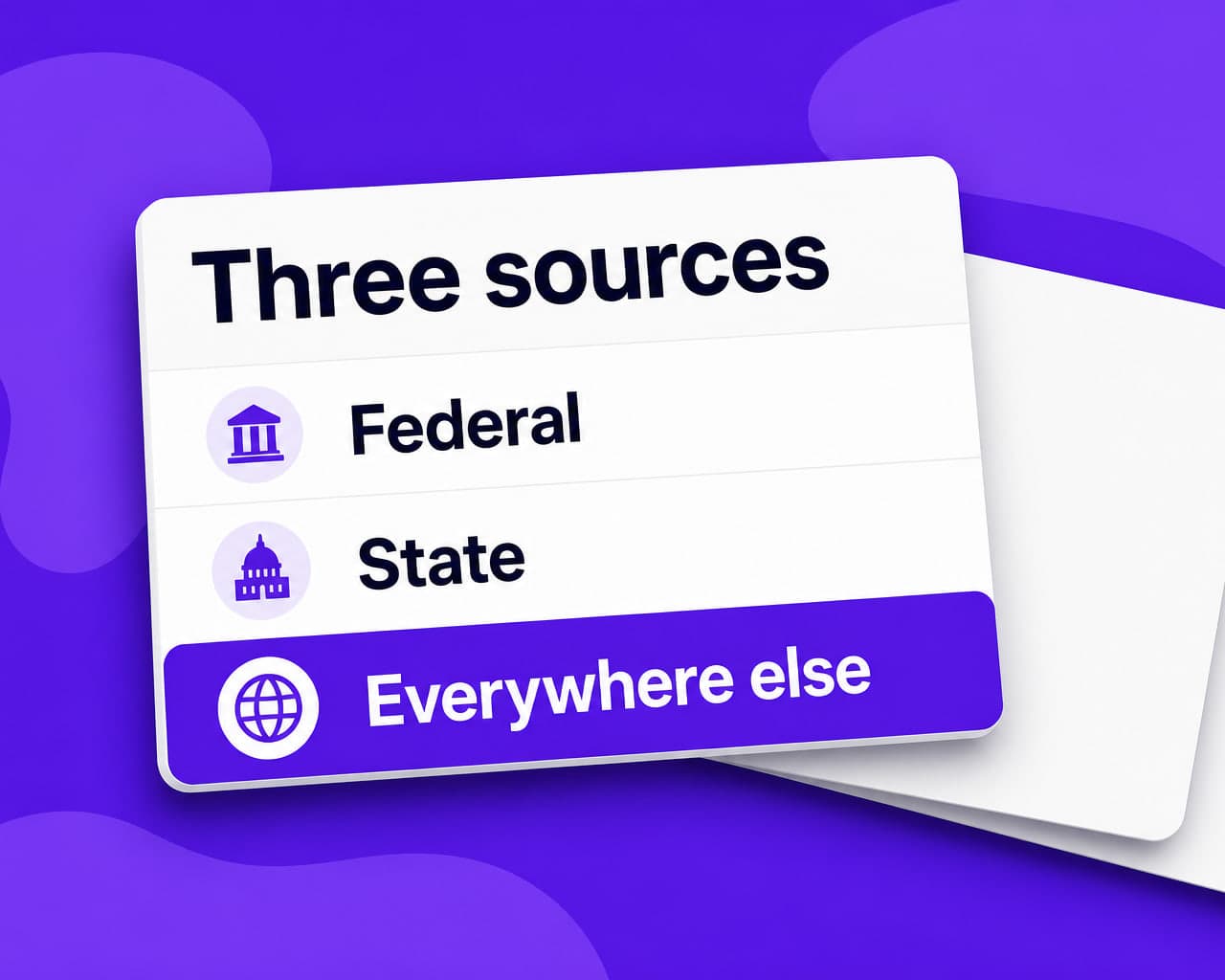
Quick answer — US banking language duties come from three places at once: a small number of federal rules that name languages, a handful of states that legislate directly, and everywhere else the rule that if you market in a language you must service in it.
Banking has federal regulators, and they mostly do not mandate translation
Unlike insurance, banking is federally supervised — by the OCC, the Federal Reserve, the FDIC and the CFPB, with state banking departments underneath for state-chartered institutions. That sounds like it should produce a national language rule.
It mostly does not.
Federal consumer regulations are written in English and set few translation requirements. There is a narrow set of exceptions, and they matter enormously to the banks they touch. Everyone else is left with a question about service rather than about compliance.
The three drivers
| Driver | Where it applies |
|---|---|
| A statute that names languages | California, and Texas through its constitutional home-equity notice |
| Federal rules that reach language | Everywhere: Regulation Z requires Spanish disclosures in Puerto Rico, Regulation B governs how a language preference may be recorded, and CFPB guidance addresses limited-English-proficiency customers |
| Advertise-then-service exposure | Every remaining state, because marketing in a language you cannot service in is where the complaints come from |
California is the clearest case. Civil Code section 1632 reaches loan contracts negotiated in Spanish, Chinese, Tagalog, Vietnamese or Korean. Separate provisions require translated summaries of key mortgage-servicing and foreclosure documents. Texas takes a different route entirely: its constitutional home-equity regime ties the required notice to the language the loan was negotiated in, which is a rule about conduct rather than about a list.
The exposure most banks actually carry
Not an unmet mandate. A half-covered journey.
A bank runs Spanish-language advertising. It offers a Spanish application. Then it services the account in English only, so the customer was recruited in one language and abandoned in another. That asymmetry is what draws complaints and examination attention, not the absence of a translated brochure.
Fixing it is cheaper than it sounds, because the servicing messages repeat. Translation memory turns a recurring per-message cost into a one-off one, which is what makes full-journey coverage affordable at all.
What actually varies by state
Three things, and none of them is the language list.
The remittance corridor, which tells you both the language and the product.
The lending and foreclosure regime, which decides how much time a borrower has and therefore how urgent a translated notice is.
The unbanked share, which decides whether the first conversation is about a product at all or about access to one.
Every state
Each of the fifty has its own page, keyed on those three rather than on a repeated language list.
Alabama · Alaska · Arizona · Arkansas · California · Colorado · Connecticut · Delaware · Florida · Georgia · Hawaii · Idaho · Illinois · Indiana · Iowa · Kansas · Kentucky · Louisiana · Maine · Maryland · Massachusetts · Michigan · Minnesota · Mississippi · Missouri · Montana · Nebraska · Nevada · New Hampshire · New Jersey · New Mexico · New York · North Carolina · North Dakota · Ohio · Oklahoma · Oregon · Pennsylvania · Rhode Island · South Carolina · South Dakota · Tennessee · Texas · Utah · Vermont · Virginia · Washington · West Virginia · Wisconsin · Wyoming
Where to start
The journey, not the document. Pick your largest non-English acquisition channel and follow it through to servicing and collections.
Website translation and mobile app translation cover acquisition; the gap is almost always after it. The country-level comparison is in AI for banking.
FAQ
Is there a federal US rule on banking translation? A few narrow ones rather than a general duty. Regulation Z requires Spanish disclosures in Puerto Rico, Regulation B governs how a language preference is recorded, and CFPB guidance addresses limited-English-proficiency customers.
Which states legislate banking language directly? California most clearly, through Civil Code section 1632 for loan contracts plus translated summaries of key mortgage-servicing and foreclosure documents. Texas ties its constitutional home-equity notice to the language of negotiation.
What is the biggest US banking language exposure? A half-covered journey. Marketing and applications in one language with servicing in English only means the customer was recruited in one language and abandoned in another, which is what draws complaints.
What varies most between states? The remittance corridor, the lending and foreclosure regime, and the unbanked share. The language list matters less than those three, because they decide the product, the urgency and whether access is the problem at all.
Our blog
Lastest blog posts
Tool and strategies modern teams need to help their companies grow.
Automotive
Automotive Brochure Localization by Market
A car brochure is a spec grid, a legal footer and a photo library, all market-specific. What actually has to change, and why the layout decides the schedule.

Automotive
Automotive Campaign Localization Across Markets
Campaigns run through national companies and dealer networks, so one master becomes hundreds of files. Where the offer text and the disclaimers actually break.
Automotive
Car Service Manual Translation for Technicians
A workshop manual is read mid-repair by someone with the car on a lift. What that demands of procedures, torque figures and fault codes, in every language.